The set design project for the production of August Strindberg’s play, «Sonata of the Ghosts,» was developed for the Rostov State Music Theatre as part of an initiative aimed at introducing audiences to the works of distinguished world playwrights.

The Rostov Musical Theater was chosen as the venue for the project due to its openness to contemporary artistic experimentation. Coordination with HSE was not established.
The main objective was to create a visual space that conveyed an atmosphere of mysticism, unreality, and the internal tension of the work. The core concept of the scenography was to reflect the characters' psychological conflicts and their struggle with the ghosts of the past through an absurd and transforming space.
The project’s mission was to investigate theatrical space as a tool for revealing a character’s internal conflicts. The focus was on creating set design that not only accompanied the action but also functioned as an independent dramatic element, reflecting the characters’ struggle against the ghosts of the past, their fears, and destructive illusions.
To realize the project:
— I conducted an in-depth analysis of the play «Sonata of Ghosts» and the artistic methodology of August Strindberg.
— I developed the overall artistic concept for the performance and the visual identity of the production.
— I created the set design for the performance: sketches, a model, and a 3D model of the stage space.
— I designed the costume elements and visual personas for the characters.
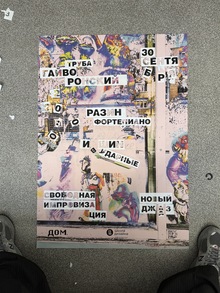
— I designed the promotional poster and the unified graphic style for the project.
— I planned the lighting and spatial design of the performance, based on the interplay of shadows, projections, and spatial transformation.
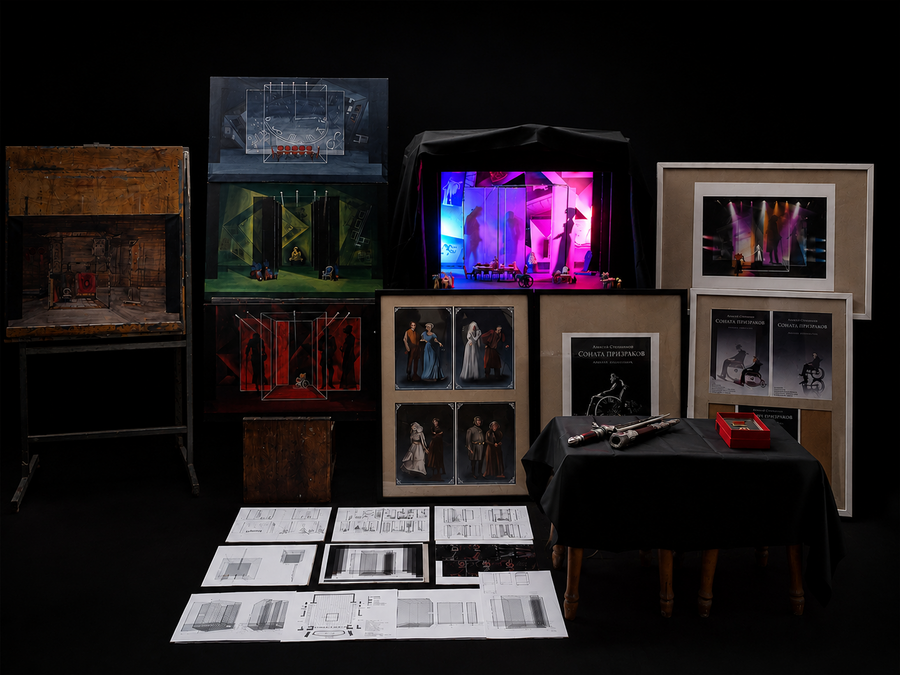
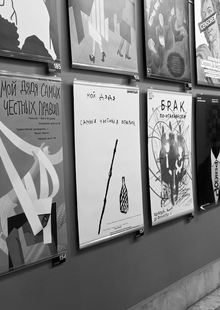
Sketchbook Exhibition
As part of the project, I independently developed the complete scenography concept for the performance and executed all key stages of the artistic design process, including set sketches, stage models, 3D modeling, costume design, and the poster.
Concept
Soft, muted light and a system of shadows enhanced the mystical perception of the space, while lighting accents helped highlight key emotional moments of the performance.
The central element of the set design is a cubic frame featuring folding, translucent panels. It reflects the closed nature of the characters' inner worlds while simultaneously serving as a tool for spatial transformation.
Stage backdrop. Special attention was paid to the absurdist nature of the interiors and the effect of a «spatial rupture.»
The resulting work created a cohesive scenographic concept for the performance, unifying space, lighting, costume, and visual elements into a single artistic system.
Sketches


All set design sketches were executed by hand based on an analysis of the play and the developed artistic concept. Throughout the process, I searched for a visual image of the space that could convey the atmosphere of mysticism, anxiety, and the work’s inner tension.
Mockup
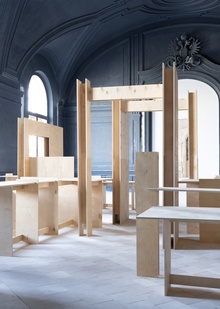
I manually created the stage space model at a 1:20 scale, and it became a critical phase in vetting the scenography concept.
Costume Design
Particular attention was paid to the fabric textures, silhouettes, and details that created a sense of spectrality and emotional fragility in the characters.
The costume design was developed as an extension of the play’s overall scenographic concept. The characters' looks blend elements of historical costume with symbolic theatrical stylization, emphasizing their inner states and dramatic conflicts.


Posters