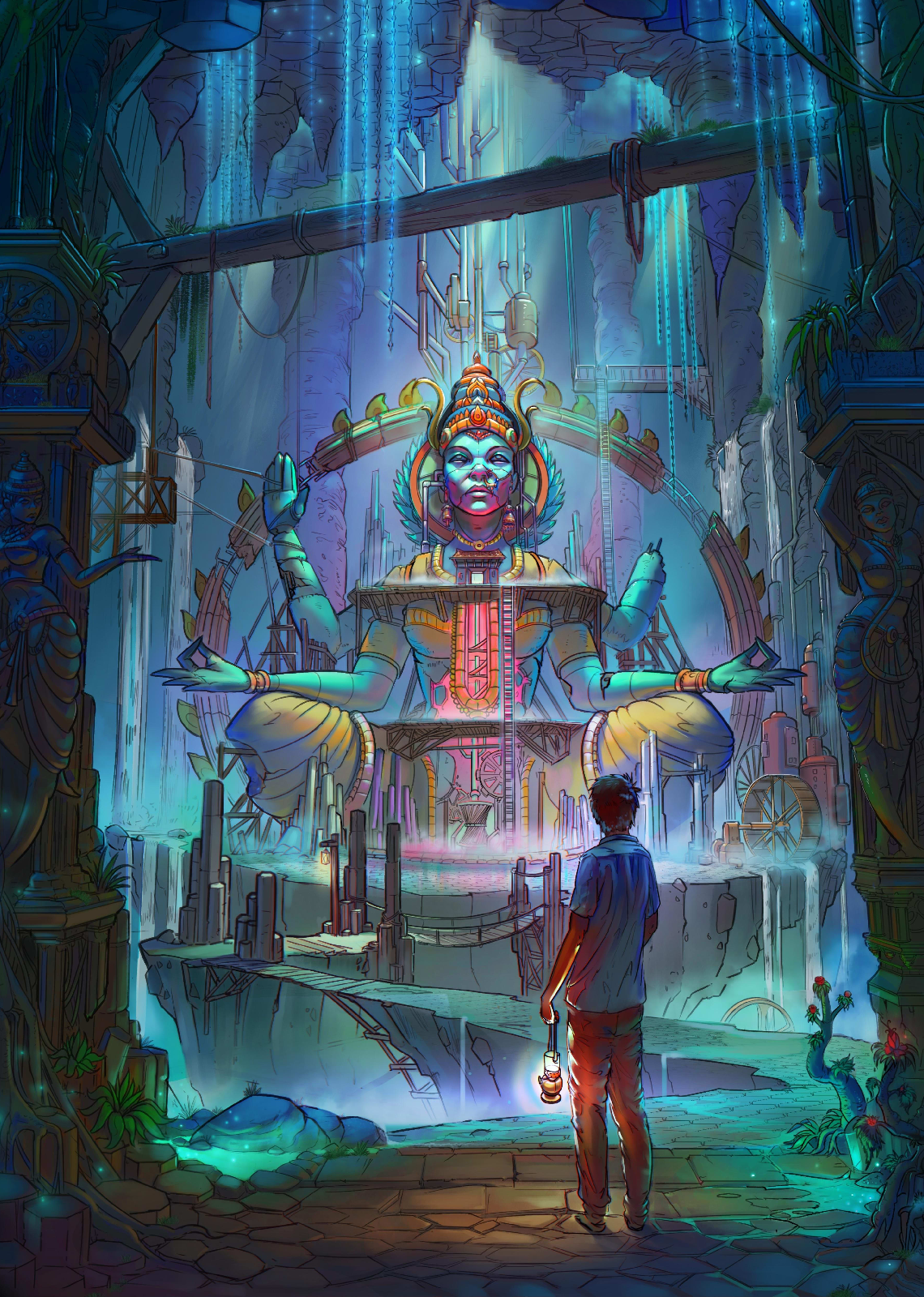
Research Concept
As in many years past, the world of video games remains influenced by key regions that have established a monopoly on genre conventions and the creation of games of global significance.
This is particularly relevant for America and Japan, which were among the earliest to be integrated into the evolutionary processes of the medium. At the same time, many less developed and agile countries and their gaming companies remain overlooked by the public.
But this does not mean that the landscape of game design and the games themselves are absent in these areas. One such country is India, which has largely been excluded from global technological and creative processes.
Because of this, we know almost nothing about what is being created in this country—what it is rich in and what it is proud of. This article is an attempt to explore and correct this oversight, thereby increasing awareness of the evolution of the video game medium in this corner of the world.
In the first chapter of this study, we will begin by analyzing some of the earliest independent video games created in India, without external assistance.
Despite the fact that the journey of Indian video games has been quite rich, this specific period defined the core values that Indian developers adhere to even today. One of the main guiding principles for creators remains the creative and mythological heritage of old India.
The second part of this research focuses on games that influence the public. Primarily, their storylines are connected to contemporary issues, especially those widely prevalent in India.
This includes poverty, modern-day slavery, and universal human psychological crises—issues that hold significant importance for people across the globe.
Another chapter of this article is dedicated to examining the mobile video game market. Here, we can note how significantly the political situation in the country impacts the growth of gaming companies and the market landscape.
During times when the government bans the latest multiplayer online games, Indian studios find an opportunity to establish themselves in an unoccupied niche. However, things are not entirely smooth yet, as developers still struggle to reach the heights set by their international predecessors.
Next, we move on to the most contemporary video games that have already been released. The main objective here is to identify the key similarities among these projects. These traits represent a reinterpretation of the characteristics attributed to Indian video games since their very inception.
Game companies continue to aim at showcasing mythological motifs in their projects, but they accomplish this with greater subtlety now. Narratives in games transition from direct retelling to critical commentary and adaptation, bringing these projects closer to the realm of art.
The final chapter describes the newest games that have not yet been released. These signal that video games in India are poised for great success, provided the project creators manage their ambitions and execute their visions fully.
At first glance, these games appear even more ambitious than anything previously created by Indian studios.
The core idea of this research is that the lack of knowledge regarding the evolution of games created in remote corners of the world deprives humanity as a whole of a significant stratum of unique and inimitable experience that the authors described in their games convey.
If we are able to close this gap in a timely manner, it will positively affect not only video game consumers but also creators, accelerating development by fostering widespread support.
The research text was segmented according to the key developmental periods of Indian video games. However, sections on mobile games and socially significant projects are highlighted—these are described not by timeframes, but by unique characteristics: the platform of implementation and the scope of influence.
The written material is based on my own analysis of the games discussed, as well as articles about their creators and interviews with them. The research includes my thoughts on each period of game evolution in India.
The images in the study are screenshots from the game projects or their promotional materials; they illustrate the primary visual style within the game and offer insight into the project’s atmosphere, which is crucial for understanding Indian game design.
Entering the World of Video Games
The research begins by examining the history of the first steps taken by Indian companies in video game development. This became possible once the country’s residents gained unfettered access to modern technology.
It can be argued that India entered the gaming landscape quite late, adopting video games only after their development had reached significant heights and imposed specific demands.
This meant that initially, Indian games did not receive the anticipated enthusiasm from users, who were accustomed to the high quality of international productions.
It is worth noting, however, that even then, game creators were able to discover their unique voice. Indian mythology, ancient traditions, and contemporary local creativity became the core themes of the first video games in India.
Hanuman: Boy Warrior, 2009. Aurona Technologies.
As of now, this is considered the first console video game entirely created in India. It was developed specifically for the PlayStation 2.
The story revolves around an Indian deity in the form of a monkey-man, who is one of the key figures in the local epic, the «Ramayana.»
Hanuman wakes up alone in the middle of a tropical forest, with no memory of his past. Throughout his adventures, he fights «evil» and explores the surroundings.
At the end of the story, as the hero regains his strength and skills, he remembers all his exploits and heroic deeds. This plot is likely a free reinterpretation of the original myths of Hanuman.
Despite the game’s breakthrough significance for the Indian world, it sparked considerable controversy within the Hindu community. Some of its members claimed that playing as and controlling a deity was sacrilegious and offensive.
Ghajini — The Game, 2008. FXLabs.
Socially Significant Games
This chapter points to the «pain points» of Indian society. The authors attempt to voice and address these issues through their video games, which feature relevant narratives.
To some extent, this drive to describe «complex» themes and stories may be influenced by the country’s sociopolitical state.
Poverty, caste inequality, and human trafficking are not merely harrowing tales from distant corners of the world—they are the everyday reality for many Indian citizens.
Stay, Mum, 2015. Lucid Labs.
The creator of this game aimed to combine meaningful narrative content with a purely mechanical puzzle-solving gameplay experience.
This project introduces us to the story of a lonely boy who is often by himself. Although the game is not voiced, the animations convey how the plot progresses.
The child’s mother works to provide sustenance and daily life for their small family and has very little time to see her son. In exchange, she gives him toy blocks.
In the boy’s imagination, these blocks transform into marvelous creatures. The goal of the game is to construct figures from these blocks based on given outlines.
Missing: Game for a Cause, 2016. Flying Robot Studios.
This game is part of the campaign by the Missing Link Trust, founded by Lynn Kedgriwal. The organization’s core mission is to prevent human trafficking and raise awareness among vulnerable members of society.
In this role-playing project, players accompany the heroine through every stage of her story: from being kidnapped and enslaved and forced to reside in the «red-light district» to her happy rescue.
The main value of this project is engaging the audience through the medium of play. The quests within the game provide insight into the victim’s experience, but they also convey the message: «There is a chance for rescue; this is not your fault.»
Clone Games
In this section, the research addresses the mobile project market. It is important to note that India is a significant proving ground for the development of numerous mobile games.
With increasing accessibility to technology and smartphones, Indian users, in particular, have begun to command a substantial share of the mobile gaming consumption market.
India itself, as a nascent hub for game design, is not yet prepared to produce original projects for the mobile platform, which results in a strong desire to imitate tried-and-true methodologies.
To better understand the context in which these projects should be investigated, we turn to recent events in India’s video game landscape.
In 2020, the mobile version of the globally renowned game PUBG: Battlegrounds—PUBG Mobile—was banned in India. In 2021, an identical replacement, Battlegrounds Mobile India, was launched on the Indian market.
Despite the project’s initial success in India, it was once again placed on the banned list. The government justified this decision by stating that the game posed a threat to national security due to the transfer of user data to Chinese companies.
Rogue Heist, 2019. Lifelike Studios.
This game is considered one of the first Indian multiplayer online shooters. While currently in early access, it has already given players cause for optimism.
Many hope that the variety of game modes—heist, team versus team, battle royale, AI combat—will elevate the project to the level of PUBG and earn its accolades.
Furthermore, this project has become a platform for holding esports competitions after entering into an agreement with the Indian application MPL (Mobile Premier League).
FAU-G: Fearless and United Gua, 2021. nCore Studio.
This game is a natural consequence of events taking place in the Indian gaming market. It tells the story of «selfless and brave» Indian warriors fighting on the nation’s borders.
The project has a distinct nationalistic and patriotic tone. Despite this, it received widespread support from Bollywood actors. However, this did not bring the game players the fame or recognition they deserved.
Even though the game developers state that it is not trying to copy PUBG Mobile, such comparisons are inevitable. This is especially noticeable when the creators announce plans to introduce a battle royale mode.
But for now, the game only features a single-player story campaign and the ability to customize weapons by purchasing cosmetic upgrades.
Player dissatisfaction with this project is evident in the critically low ratings on the mobile application store.
Games of the 2010s
In this section of the study, we will explore key games created after 2015. It can be said that Indian game design is experiencing a golden age right now.
Creators have finally found themes that are genuinely interesting to them while still being able to capture the attention of a global audience.
The focus has been on the diversity of Indian historical and artistic traits that create a recognizable and unique identity for Indian games. Furthermore, storytelling about personal and significant experiences has become a key element in many of these projects.
Asura: Vengeance Edition, 2017. Ogre Head Studio.
This is an action-adventure game with roguelike elements. The protagonist is a demon seeking revenge for his death.
In the plot, an Indian ruler, fearing a sinister calamity upon his lands, sacrifices a boy as an offering to appease the gods. However, malevolent Rakshasa demons intervene during the story and grant the hero powers.
It is highly probable that the central character’s archetype is based on the myths of Asuras, who are considered lesser deities or demons in mythology and are typically opposed to the gods.
The gameplay is quite diverse due to the application of generation methods and algorithms in creating game locations and the hero’s skill tree, which increases the likelihood of replayability.
Asura: Vengeance Edition, 2017. Ogre Head Studio.
Raji: An Ancient Epic, 2020. Nodding Heads Games.
This is another vibrant project set in ancient India, inspired by local myths and the majestic epics of antiquity.
Special attention should be paid to the project’s stylization, which relies heavily on the heritage of the Pahari peoples, specifically their painting.
This is an action-adventure game that also incorporates acrobatic elements. The narrative begins when demonic forces attack the human world.
The protagonist, under the patronage of Indian deities who grant her miraculous powers and weapons, embarks on a quest to save the universe from demons and rescue her brother from the clutches of monsters.
Throughout the gameplay, we will encounter numerous enemies, puzzles in the form of mandalas, and also acquire a significant body of knowledge about Indian history and religion.