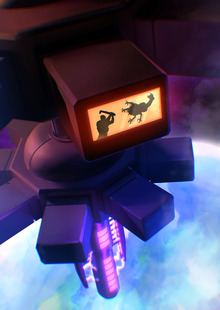
Alka is a board game composed of 12 mini-games. To win, you must score points by playing these mini-games, which are selected at random. Once you accumulate enough points to fill all the circles on your card, you win!
This is a game of logic, dexterity, reaction time, fine motor skills, improvisation, and spatial reasoning.


Initially, the game was conceived for a museum of Soviet arcade machines. The design of the player cards is inspired by the arcade machines displayed in the museum.
Game Logic

Mini-game definition
At the start of each turn, the player rolls a die of their choice. Each side of every die (of which there are two in total) features a symbol corresponding to a specific mini-game. The rolled symbol determines which mini-game the player participates in for that round.
Cycles
Each mini-game has a set duration. Time is tracked using hourglasses placed inside the box, where one cycle equals 30 seconds; the cycles are also displayed on the cards. Players may use any other timer or verbally announce the time elapsed.
The point value for each game also varies. The more complex the mini-game is to complete, the more points can be earned.
Here is a brief overview of each mini-game.
1. This is how I feel
To the left is the detail map (left side of the layout, right side of the drawing), and to the right is the conditions map.
The player draws a random component card with the picture face up;
The player draws and studies the condition card;
The player closes their eyes while their opponents place 14 component cards, including the card from step 1, onto the playing field.
The player’s goal is to find the required shape within the time specified on the condition card, while blindfolded. Only one attempt is permitted.
Time limits and the number of points awarded are indicated on the cards.
Each piece in the hole is marked with a number that corresponds to a number on the piece maps.
2. Detailing in the Labyrinth
On the left is a maze, which the player’s hand navigates. On the right is the field the player is observing.
Each player and their opponents receive one game board. The opponents secretly draw a maze on their board. They place the maze’s start point and a target item inside. They may also place up to two bombs. Once the maze is drawn, the player must find the target item in the maze without hitting a bomb. The player navigates the maze, seeing only their own empty board, while their hand, holding a covered marker, rests on the board with the maze. The maze is navigated based on the opponents' clues. They must warn the player if a bomb is within one cell’s radius and must guide the player back if they attempt to pass through a wall. The time to complete the challenge is 60 seconds. The point value is 2.
3. Improvisation
On the left is the component diagram. On the right is the conditions diagram.
To the player whose turn it is, a partner is randomly selected;
The player secretly takes a drawing piece card, placing it face up, then takes a improvisation condition card, preliminarily stating whether they will read the black or white side;
The player places 7 figure pieces on the board, including the one they drew, along with the stand;
Next, the player has a limited time to explain to their partner which drawing piece they should choose. The player explains according to the condition, and their partner must select the correct drawing piece on the first try. Touching the drawing pieces is forbidden.
Time to complete the challenge: 60 seconds. Points: 2.
4. By Eye
Opponents secretly place any number of pieces on the playing field using stands. The mandatory condition is that a minimum of two pieces without overhangs or gaps can connect to each other;
The task for the player whose turn it is is to determine, within 30 seconds and on the first try, which pieces can be joined. They cannot touch the pieces.
Score: 1.
5. Spatial Thinking
Top—flat patterns, bottom—drawings
The player is given a component layout card, unfolded upward;
On the field, the opponent places 14 components, including the required one;
The player must match the layout to the figure on the first attempt before the timer runs out.
Time limit for the challenge—60 seconds. Points awarded—2.
6. Memory
Opponents arrange 14 figures on the game board and allow the player to view them. The player is given 30 seconds to observe.
Afterward, the player closes their eyes, and the opponents make one rearrangement.
After the rearrangement, the player opens their eyes and must find any discrepancies from the original arrangement of the pieces on the board within two attempts and 30 seconds.
The point value is 1.