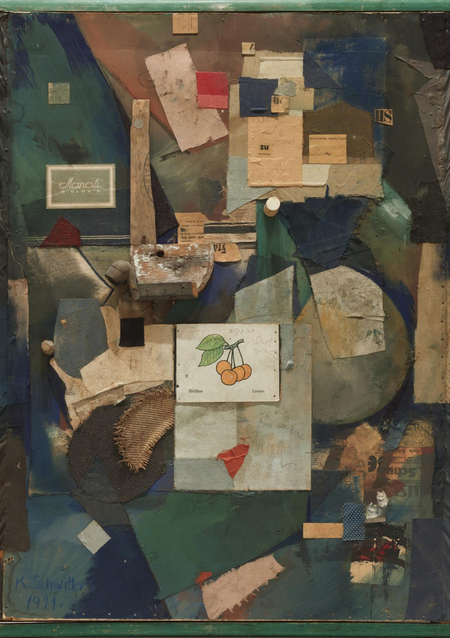
Concept
In everyday life, we perceive objects primarily through their function. A chair is meant for sitting, a bottle for holding liquid, and a wheel for propelling transport. We rarely consider how these things look in and of themselves, as their form seems familiar and intuitive.But what happens when an object ceases to perform its function? If it is placed in a museum, combined with another object, or presented as a work of art? Can it acquire new meaning even if its appearance barely changes?At the beginning of the 20th century, Dadaist artists began experimenting with such questions. They utilized ready-made industrial products, household items, and random materials, challenging traditional notions of artistic creation.
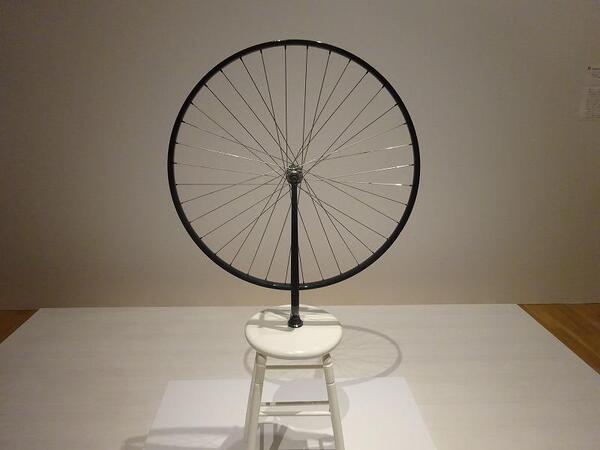
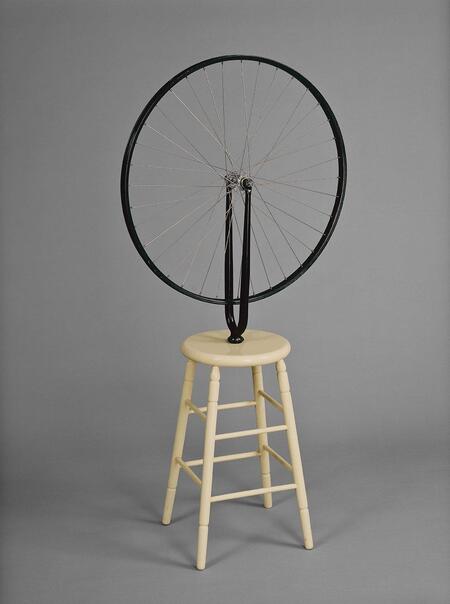
Marcel Duchamp — «Bicycle Wheel» — 1951
One of the most renowned examples was Marcel Duchamp’s «Bicycle Wheel.» The artist affixed an actual bicycle wheel to a standard wooden stool. Instead of creating a sculpture in the traditional manner, he combined two already existing objects. Before the viewer is an unusual construction: the wheel is no longer part of a bicycle, and the stool is not being used as a seat. Their usual functions disappear, yielding to a new form of interaction.
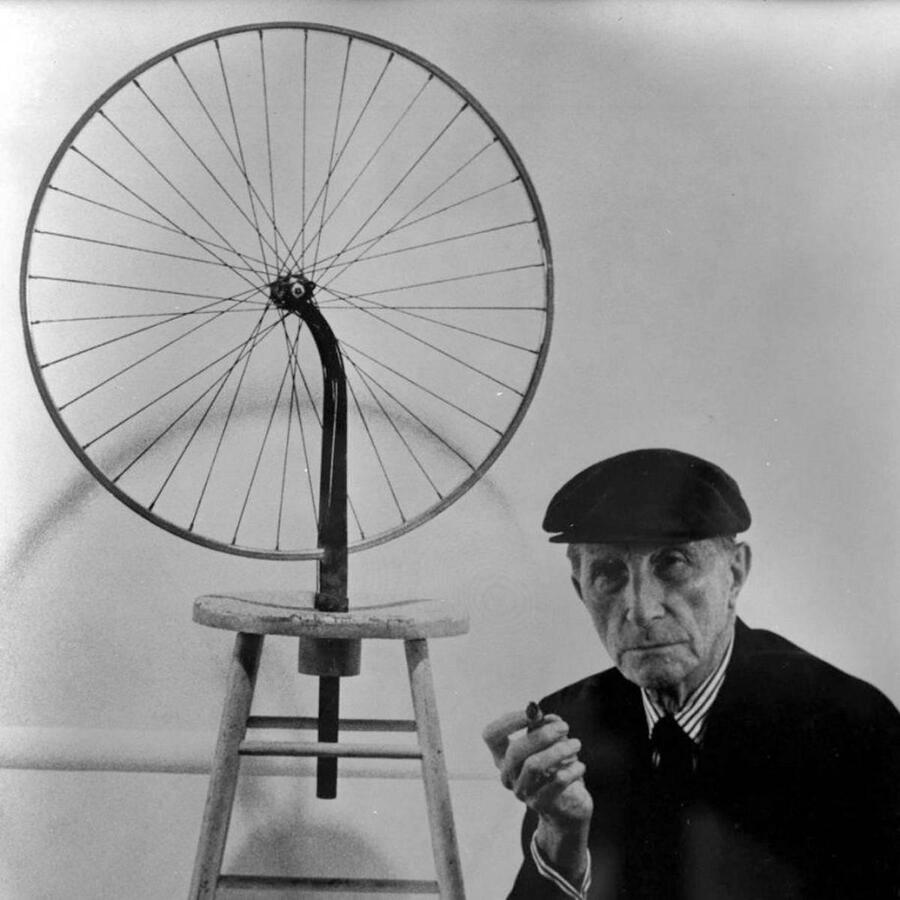
Marcel Duchamp — «Bicycle Wheel» — 1951
The initial version of «Bicycle Wheel» was created in Paris in 1913. Upon close inspection, one can observe that the structure consists of two elements with distinctly different visual characteristics. The metallic wheel forms a circular composition, while the thin spokes generate a recurring rhythm of lines. The wooden stool, in contrast, appears stable and static. Its straight legs and simple form contrast with the wheel’s rounded silhouette.
The work’s uniqueness also lies in the fact that the wheel retains the possibility of rotation. The viewer can set it in motion and observe how the immobile structure gains dynamism. Thus, the piece exists not only as a combination of forms but also as potential action.
«Seeing this wheel turn,» he noted once, «was very pleasant, very calming; it felt like it was opening a path toward something else—not the mundane, material life. I liked the idea of putting a bicycle wheel in the studio. I enjoyed looking at it, much like the tongues of flame in a hearth. As if I had a fireplace in my studio.»
{1}
Marcel Duchamp — «Bicycle Wheel» — 1951
It is important to note that the original 1913 object no longer exists. The images feature the third version of the work, created in 1951. It is housed at the Museum of Modern Art in New York.
Experiments with everyday objects did not arise randomly. They were part of a broader artistic movement that emerged during the First World War.
Dadaism appeared in neutral Switzerland in 1916. Artists and poets rebelled against established notions of order, logic, and cultural values. The war amplified their disillusionment with social institutions and traditional modes of thought.
One of the movement’s first centers was Zurich. The cabaret «Cabaret Voltaire» opened there in February 1916. It was a small space where artists staged theatrical performances, read unconventional poetry, performed music, and conducted artistic experiments.
Cabaret Voltaire — Zurich, 1916
Unusual costumes, masks, and strange constructions appeared on stage. Performances often combined multiple languages, nonsensical sounds, gestures, and elements of the absurd. The artists intentionally disrupted the usual sequence and logic of the events.
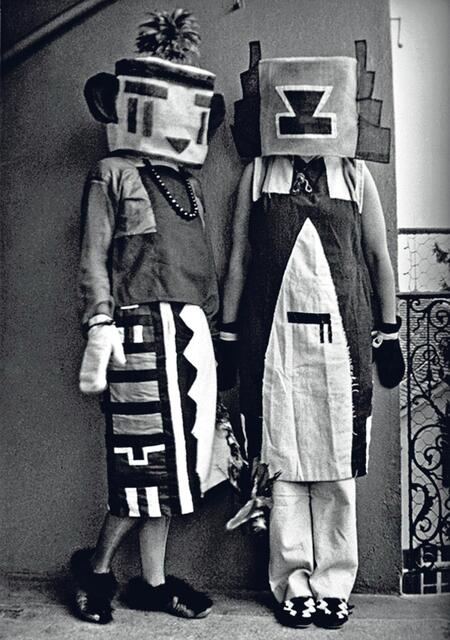
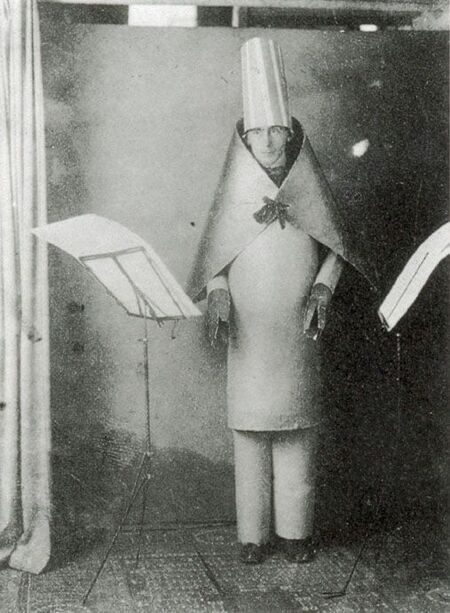
1. Sophie Taeuber-Arp and her sister Erika Schlegel in Hopi Indian costumes — 1922 2. Hugo Ball performing in a Cubist stage costume at the Voltaire Cabaret — 1916
Dadaist artists did not just aim to create unconventional works; they sought to critique the very rules that defined art. The Museum of Modern Art in New York describes their stance as:
«Dadaist artists experimented with various techniques—from collage and photomontage to using everyday objects and performance—shattering traditional notions of how art should be created and perceived, and what materials are acceptable.»
{2}
Dadaism did not possess a unified artistic style. Some artists worked with collages and photomontage, while others experimented with poetry, theater, and readymade objects. What united them was a desire to reconsider conventional methods of creating and perceiving art.It is within this environment that the use of everyday objects gains particular significance. If a piece of art doesn’t necessarily have to be a traditional painting or sculpture, the boundaries of artistic creation become much broader.
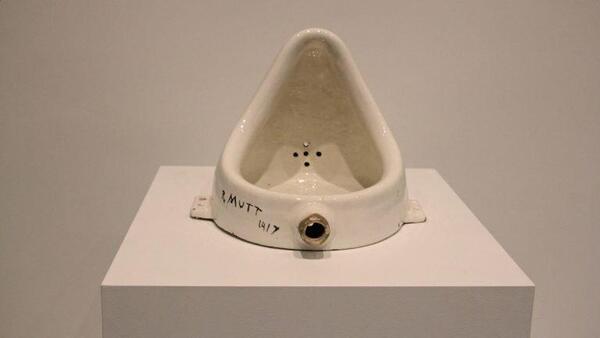
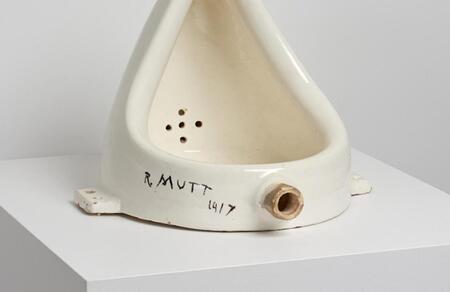
Marcel Duchamp — «Fountain» — 1964
In 1917, Marcel Duchamp presented one of the most famous and provocative readymades—"Fountain.» For this piece, he utilized a common white porcelain urinal. The artist turned it on its side, signed it with the pseudonym R. Mutt, and proposed it as a work of art.At first glance, the object barely resembled an ordinary plumbing fixture. It retained the material, form, and basic visual characteristics of the original item. What fundamentally changed, however, was its position and its meaning.
The context surrounding the work’s creation proved especially crucial. Duchamp submitted «Fountain» to the exhibition of the Society of Independent Artists in New York. The organizers claimed the show was open to all artists, yet they refused to allow the piece to be displayed. This incident sparked a debate about who has the authority to define the boundaries of art.
The First Exhibition of the Society of Independent Artists—New York, 1917
Whether Mr. Matt built the fountain with his own hands or not—that is irrelevant. He CHOSE it. He took an ordinary everyday object, placed it in a way that its practical meaning disappeared under the influence of a new name and a new perspective, and created a new idea for that object.
Thus, the significance of «Fountain» lies not only in the unusual use of a commonplace object. The work raises questions about the role of the artist, the exhibition space, and the viewer. If the object itself has not physically changed, but has been selected by the author and presented within an artistic context, is that sufficient to deem it art?The original from 1917 is lost. A historical photograph by Alfred Stieglitz shows the initial object, while a later replica allows viewers to examine its form within a museum setting.
«Bicycle Wheel» and «Fountain» demonstrate that Duchamp was able to alter the meaning of an object without creating it in a traditional artistic manner. In the first case, he combined two ready-made objects; in the second, he presented a manufactured item within a completely new context.
This approach was named the ready-made. This term came to denote pre-existing objects that an artist selects and presents as works of art. The crucial action becomes not the fabrication of the object, but the author’s decision about what precisely can become art.
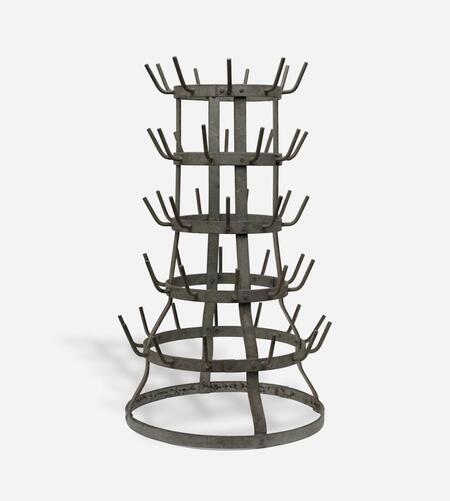
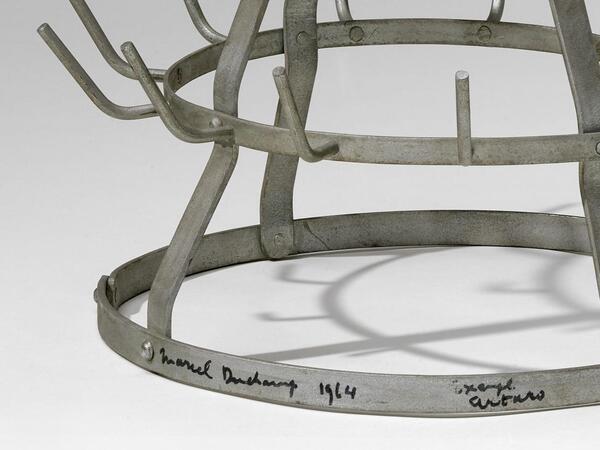
Marcel Duchamp — «Bottle Rack» — 1914
One of the early examples of this approach was the «Bottle Rack.» In 1914, Duchamp acquired an ordinary metal structure for drying bottles. He did not recreate it or substantially alter it. The artist selected an existing object and incorporated it into his artistic practice.
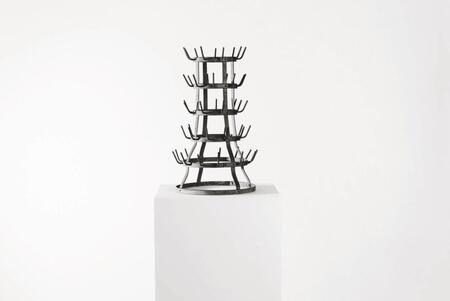
The object’s appearance diverges from conventional sculptural forms. Metallic protrusions radiate outward from the central mass, establishing a recurring rhythm. Because of this, the piece simultaneously recalls industrial machinery, a geometric construction, and abstract sculpture.In everyday life, this shape serves a practical purpose: the protrusions are designed to hold bottles. However, within the artistic context, the viewer begins to focus on the structure itself—its material, the repetition of its elements, and its silhouette.
Duchamp described the principle of selecting ready-made objects as a rejection of conventional aesthetic judgment:
«Based on the reaction of visual indifference, when there is a complete absence of good or bad taste.»
{4}
However, a contradiction arises here. If the artist chooses a ready-made object, precisely where does the artwork reside: in the object itself, in the author’s conceptual decision, or in the new context of its presentation? This example illustrates that the ready-made not only alters the function of an object but also shifts the perception of artistic creation itself. The author acts not as a manufacturer, but as someone who discovers and redefines the meaning of an existing object.
Marcel Duchamp — «Avant la chute du bras» — 1915







