Concept
Sound and music have accompanied play for centuries. In some games, they exist in the background, creating atmosphere and setting the mood for participants; in others, they are integral to the mechanics, serving as an assistant or a full player. Furthermore, the absence of sound can also play a role.
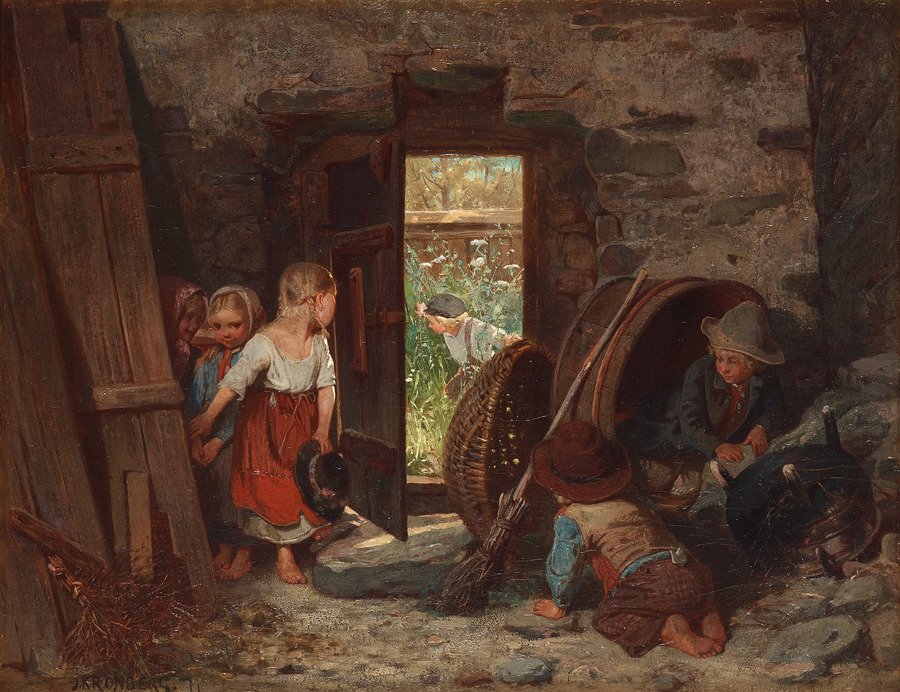
Julius Krongberg. «Hide-and-Seek.» 1871. Private Collection.
In his work Homo Ludens, Johan Huizinga examines play as a cultural phenomenon that exists within a specific set of rules.
This approach allows for the exploration of sound’s role not only in individual gameplay actions but also in the organization of the entire game process.
Historical examples illustrate the diversity of sound and musical content functions. In Ancient Greece, for instance, long jump was accompanied by music played on the aulos, an instrument resembling the modern clarinet or oboe. The music aided athletes in coordinating their movements, while trumpeters and heralds used their instruments to organize events. Children’s rhythmic counting games assign roles among participants. In the «musical chairs, ” the absence of music serves as the signal.
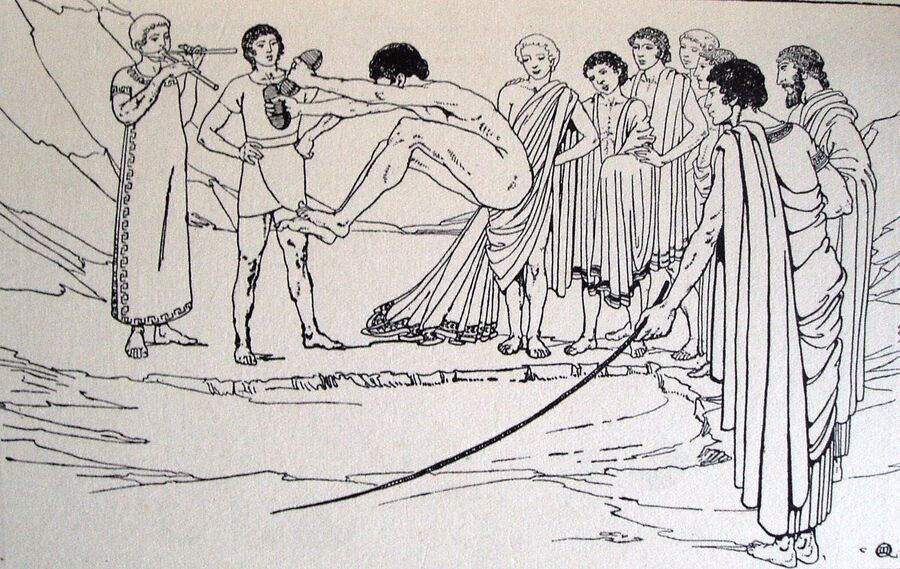
Unknown artist. «Long Jump with Dumbbells to the Accompaniment of an Aulos at the Ancient Olympic Games.» 20th Century. Book illustration.
Music and sound can play a spatial role. In hide-and-seek, the seeker uses their hearing to orient themselves in space and locate other participants. In hide-and-seek, conversely, suppressing any sound signal is critical so as not to give away one’s position. Silence has the power to influence the gameplay, even if it is not explicitly stated in the rules.
Jean-Honoré Fragonard. «Hide-and-Seek» («Hide-and-Seek»). c. 1750–1752. Toledo Museum of Art, USA.
The acoustic space is understood as the entirety of sounds, music, and their absence, which influences gameplay and participant interaction. The study exclusively considers pre-digital games.
The primary focus is on the role of sound in organizing the gameplay experience, rather than on its physical characteristics or qualities.
This research aims to identify the core functions of sound and silence in pre-digital games and their influence on the gameplay experience. Attention is given not only to sounds that directly dictate participant actions but also to those that participate indirectly in the gameplay, without being regulated by the rules.
Sound can serve various functions: accompanying play, organizing participant actions, conveying information, and aiding spatial orientation. These functions can combine, gaining meaning based on the game’s rules and characteristics.
Unknown artist. «Trumpeters» from the manuscript «Canticles of the Virgin Mary.» c. 1280. Escorial Monastery Library, Spain.
The research is divided into three parts. The first part focuses on sound and music as accompaniment and a means of organizing the gameplay. The second part examines auditory cues that prompt action, vocal commands, and musical pauses. The third part is dedicated to the spatial role of sound and silence, including auditory orientation and sound masking.
Alfred De Courcy & Co (Birmingham, England). «Abbey Referee» referee whistle. Circa 1916–1927. Private Collection.
The foundation of this research is a comparative analysis of historical descriptions of pre-digital games, including their rules and characteristics. This examination also covers children’s games and collective play practices. By comparing the game mechanics, descriptions, and rules of these games, we aim to propose a functional classification of sound, music, and their absence within the gameplay experience.
Music as part of play activity
Music as accompaniment
Music is not always an integral part of gameplay mechanics. Sometimes music serves as accompaniment—a backdrop to the gaming experience—creating the necessary atmosphere, maintaining the participants' mood, and enhancing the visual spectacle.
In this case, music does not dictate the gameplay, but serves as an integral part of it.
The gladiatorial combats of Ancient Rome serve as an example. Musicians accompanied the events in the arena, utilizing wind instruments like the tuba, cornu, and the hydraulic organ, the hydraulis. The musical accompaniment did not dictate the rules of the duel, but it did enhance the spectacle.
Unknown Master (Ancient Rome). Fragment of the «Zliten Mosaic» featuring a scene of musicians playing the tuba, hydolaulos, and cornu. Circa 2nd century CE. Tripoli Archaeological Museum, Libya.
In Ancient Greece, musicians performed during festivals that combined cultural events and athletic competitions. At the Panathenaic Games, music accompanied solemn processions, award ceremonies, and victories, complementing the contests and creating a festive atmosphere.
Unknown vase painter. Scene from a musical competition. Circa 500–485 BCE. Walters Art Museum, Baltimore, USA.
In Medieval Europe, knightly duels were accompanied by music. Trumpeters lent a particularly solemn character to the event, emphasizing the status of the participants and enhancing the spectacle. Music at such events was merely part of the ceremonial staging, having no bearing on the process or outcome of the event.
Unknown artist. Miniature «The Knightly Duel of Jean de Sangtre at the Tournament.» c. 1470. British Library, London, UK.
Rhythm as an organizer of gameplay actions
Unlike background accompaniment, rhythm can directly participate in the gameplay. A clear, repeating rhythm helps organize movement and maintain tempo.
A prime example of using supplementary musical rhythm is the long jump in Ancient Greece. The competitions were accompanied by music played on the aulos. The Greeks believed that music fostered coordination of movement.







