Concept
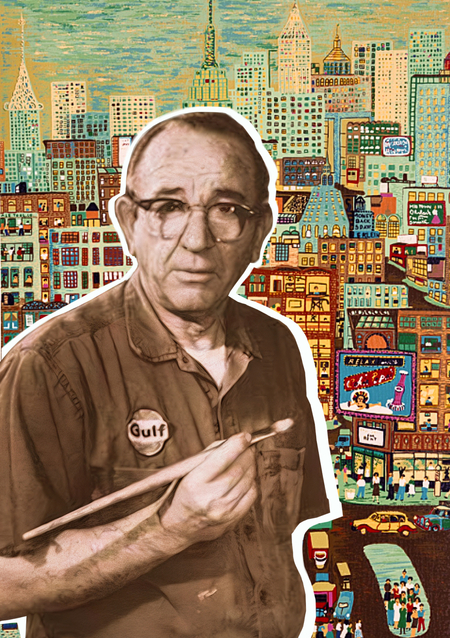
The American Dream holds a significant place in U.S. national culture, encapsulating ideas of equal opportunity, personal success, and the pursuit of a prosperous life. Throughout the 20th century, this ideal has repeatedly been the subject of artistic interpretation and critique, reflecting the tensions between societal expectations and the actual conditions of life for various social groups.Of particular interest in this context is the work of Ralph Fasannella (1914–1997)—an American autodidact painter, the son of Italian immigrants, whose paintings centrally feature labor, everyday life, and the historical memory of the working class. Lacking formal, systematic art training, Fasannella achieved widespread recognition later in life, maintaining a deep interest in the lives of ordinary Americans. His works allow for an examination of the American Dream from the perspective of those whose efforts built societal well-being, prompting the question of how accurately traditional notions of individual success reflect their lived experiences.
«The working class loves my paintings because I depict their emotions.» — Ralph Fasenella
The American Dream does not have a single definition. Its historical roots are tied to the ideals of equality, freedom, and the pursuit of happiness, proclaimed in the U.S. Declaration of Independence in 1776. In 1931, historian James Truslow Adams formulated one of the most well-known definitions of the American Dream as the aspiration toward a better and more complete life—one that implies opportunities for self-actualization regardless of a person’s background or social standing.Simultaneously, the concept of success as a result of individual effort has become widespread in American culture. In the 20th century, recognizable symbols of this prosperity became a stable income, owning a home, having an automobile, and the ability to provide a better future for one’s children. After World War II, the suburban lifestyle, associated with affluence, security, and social mobility, became particularly significant.However, this model does not fully account for differences in initial social conditions, access to opportunities, or the distribution of collective labor’s outcomes. It is precisely the contradiction between the promise of universal well-being and the actual conditions for achieving it that forms the theoretical basis of this research.
Ralph Fasannello’s artistic choices stem from his personal experience and his critical perspective on American reality. As the son of Italian immigrants, he grew up in New York’s working-class neighborhoods, observing social inequality and his parents' hard labor from childhood. His own work experience and union activities defined the themes in his painting. Without formal art training, Fasannello gained widespread recognition later in life, maintaining his interest in the lives of ordinary Americans.Visual Material was selected based on the principle of recurring motifs: labor, social inequality, public life, and historical memory. The comparative analysis of the works focuses on composition, perspective, figure scale, color contrasts, and the evolution of artistic techniques.Theoretical Framework is grounded in studies of the American Dream and Fasannello’s work, archival materials, documentaries, and interviews. Particular importance is given to the works of Lesley Amberger and Mark Fasannello, which allow for correlating visual images with biographical and historical context.
Research Hypothesis
Ralph Fasannella portrays the American Dream as a contradictory national ideal: society promises everyone the opportunity to achieve prosperity through personal effort, yet the creators of that prosperity—the working class—are often excluded from its benefits. Simultaneously, Fasannella constructs an alternative vision of America, in which human significance is determined by one’s participation in community life, labor, and historical memory. His painting allows us to examine how the figures of the worker and the immigrant acquire the characteristics of national heroes, and how collective well-being becomes an alternative to the individualistic interpretation of the American Dream.
In the painting of Ralph Fasenello, there is a visual reimagining of the American Dream: the successful hero is replaced by the worker, and the main indicator of prosperity becomes the well-being of the community, founded on the dignity of labor, solidarity, and historical memory.
The research consists of three interconnected parts, sequentially exploring different aspects of artistic representations of the American Dream:
The first is dedicated to shaping Fasannello’s worldview and critiquing the American Dream through family history, social inequality, and the sacrifice of labor.
The second examines his alternative image of prosperity, built upon the organization of the urban environment, activism, leisure, and human relationships.
The third investigates the transition from personal memory to collective history, using the paintings of the Lawrence textile strikers as an example, as well as the public recognition of the artist and the subsequent fate of his works.
Part I. Between Ideal and Reality
The foundation of Ralph Fasannelli’s artistic worldview is his experience living with Italian immigrant parents, for whom America represented both a space of new opportunities and the daily struggle for survival. His parents’ hard labor, the dense urban environment, and early exposure to the labor movement shaped the artist’s perception of social reality, which was frequently reflected in his work.
«The American worker has never received any recognition.»
— Ralph Fasenella
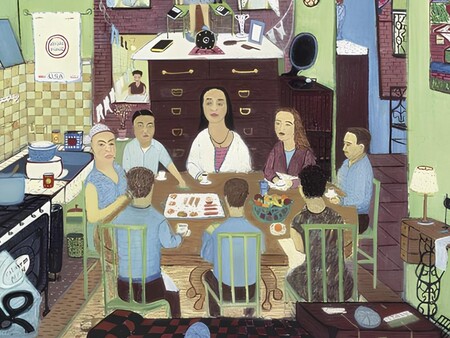
One of the most complete expressions of this experience was the painting Family Supper (1972). It depicts an apartment building within which a scene of a family meal unfolds. Fasanella eschews realistic scale ratios: the apartment occupies almost the entire space of the building, leaving only a small portion of the composition for adjacent rooms and street-level shops. This spatial exaggeration defines the hierarchy of the image. The family dinner—an event outwardly unremarkable—acquires central significance. The artist dedicates more space to the immigrant family’s life than its position in the urban and social structure would suggest.Numerous everyday objects specify the history of the people depicted. A sewing machine, a gas meter, a trunk, kitchenware, and foodstuffs testify to the family’s living conditions as they maintain their own cultural traditions within the American environment. Meanwhile, the figures of neighbors in the surrounding windows place the family’s story within the broader context of the entire urban community.
Ralph Fasenella. Family Supper. 1972.
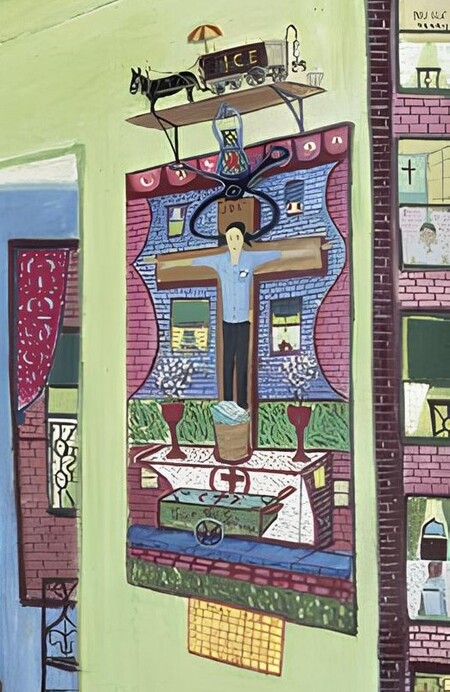
The scene around the table takes on particular significance through religious iconography. The central position of the artist’s mother, Genevra, recalls the composition of «The Last Supper.» She reappears above the table, this time in the guise of a crucified figure. On the opposite wall is an image of her father, Joe Fasenella, crucified, whose profession as an ice delivery man is indicated by his tools of labor.
Yet, the portrayals of parental sacrifice differ substantially. In the series «Iceman Crucified,» the father is depicted as a motionless, suffering figure, whose crucifixion assumes the character of symbolic death. Genevra, in «Family Dinner, ” conversely, continues to care for the children even while on the cross: her hands reach toward them, and laundry lines and household objects link the scene of martyrdom with the mother’s everyday duties. Her sacrifice is presented as continuous, active labor that does not cease even within the space of religious symbolism. This contrast underscores Genevra’s unique place in the family history—she is the one who preserves and sustains the family life, despite the heavy obligations placed upon her.
By depicting the inscription „Lest We Forget, ” the artist calls upon us to remember both individual identities and the national spirit—the arduous labor that forms the foundation of the American Dream, and all those who strove so intently for it. Thus, in one composition, the everyday life of the family and the symbolic representations of parental and national sacrifice are brought together.
To understand this symbolism, one must refer to Fasaniello’s earlier works.
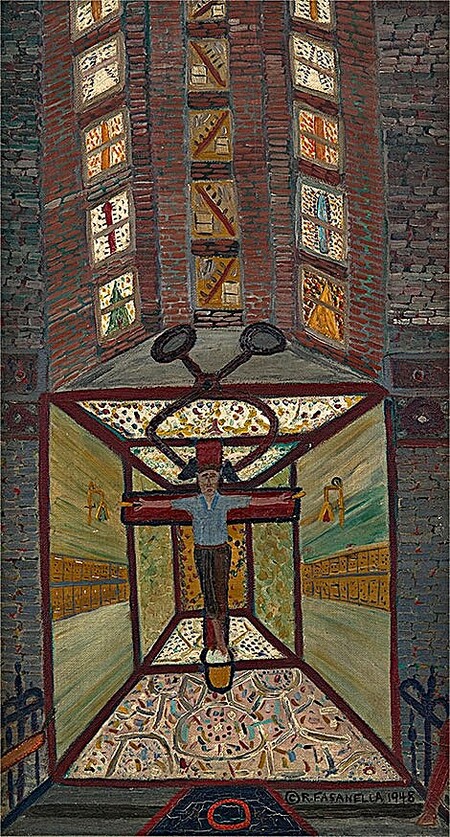
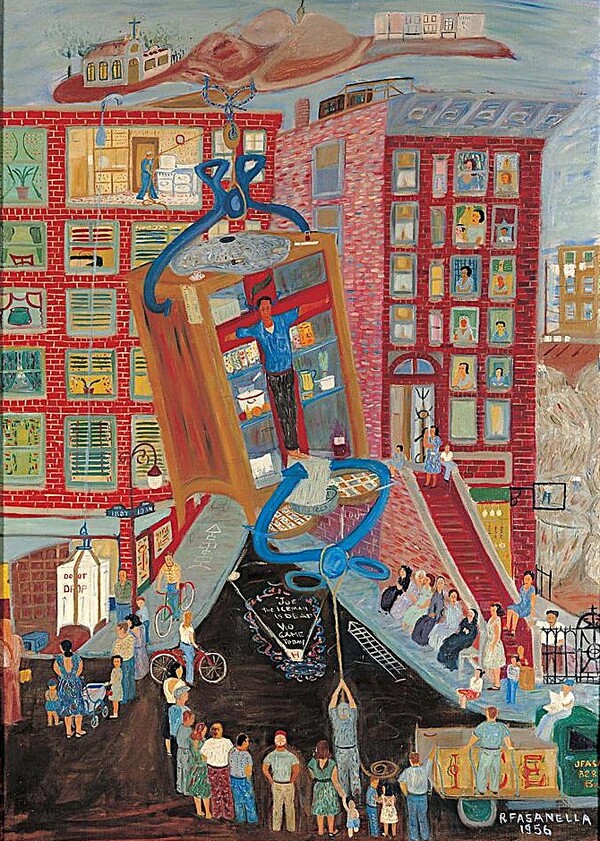
Left: Ralph Fasenella. Iceman Crucified #1. 1948. Right: Ralph Fasenella. Iceman Crucified #3. 1956.
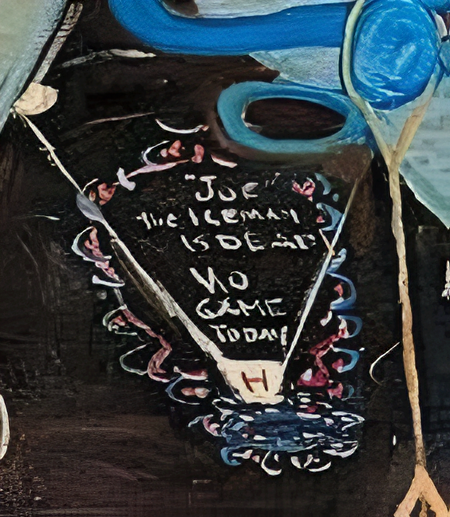
In Iceman Crucified #1 («The Crucified Ice Man No. 1, ” 1948), the artist first depicts his father as a crucified Christ figure. Ice tongs take the place of a crown of thorns, and the tools used for cutting ice transform into instruments of martyrdom. The setting of an ordinary apartment building is transformed into a religious scene. The worker’s figure is placed at the center of a rigid composition. The converging lines of the hallway guide the viewer’s eye toward the crucifixion, and the surrounding architecture emphasizes the immobility of the central character. Fasano utilizes recognizable Christian iconography to imbue mundane physical labor with moral and symbolic significance. In Iceman Crucified #3 („The Crucified Ice Man No. 3, ” 1956), this image takes on a more complex spatial and narrative structure. The crucified worker is situated amidst city buildings, whose residents observe the event from their windows. Individual human figures, street scenes, and architectural elements are unified into a depiction of a collective event. The inscription Joe the Iceman is Dead, No Game Today denotes the symbolic death of the father, connected to his return to Italy in 1954. The worker disappears from the familiar life of the neighborhood, and the residents become witnesses to his loss.
«It seems to me that if you look at the face of a working person, he looks dejected. He resembles Christ.»
— Ralph Fiennes
Ralph Fasannella. Dress Shop («Clothing Store»). 1972.
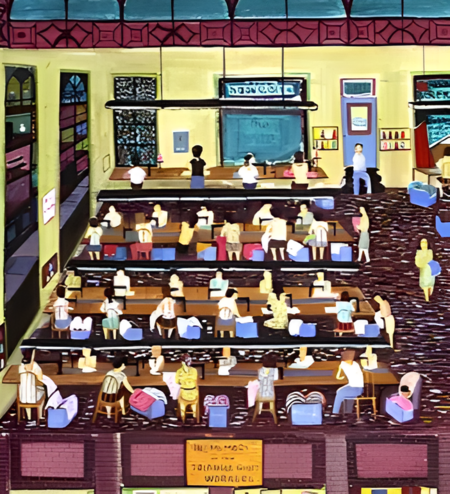
A spatial organization principle similar to that in «Family Dinner» is utilized in Dress Shop («Sewing Workshop, ” 1972), which is dedicated to the world of labor associated with Fasannella’s mother.The artist depicts a building with an open facade, the central space of which is significantly enlarged in relation to the surrounding architecture. Thus, the production process becomes the main subject of the painting. The detailed depiction of the equipment attests to the artist’s attention to the layout of a familiar professional environment. Meanwhile, urban life continues outside the workshop: the windows of neighboring buildings are filled with people and domestic scenes. Fasannella portrays the workers as participants in a broader social world whose lives encompass personal relationships, interests, and communal experience.Of particular significance is the inscription In Memory of the Triangle Shirt Workers, dedicated to those who died in the fire at the Triangle Shirtwaist Factory in 1911. The majority of the victims were young female workers, including Italian immigrants.The memorial inscription connects the artist’s personal memories of his mother’s work with the history of the tragedy—which became a symbol of the fight for workplace safety in the United States. By doing so, Fasannella draws attention to the contradiction between the promise of prosperity through honest labor and the actual living conditions of the working class. By enlarging the space of the workshop and detailing the production activities, the artist highlights the people whose labor ensures societal prosperity but does not always guarantee them a dignified and safe life.
By manipulating scale and perspective and placing ordinary people at the center of the composition, Fasano elevates the everyday life of the working class to a special significance. The artist portrays spaces where people’s histories are formed—histories that typically remain outside traditional notions of American success.
Reflecting on the immigrant experience leads Fasanello to a broader question: what existence can be considered flourishing? In his early works, the critique of societal ideals is often expressed through the contrast between spaces—one representing everyday reality and the other embodying the promise of a better life.
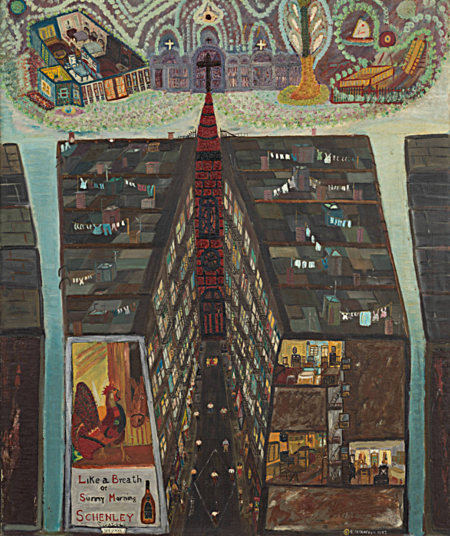
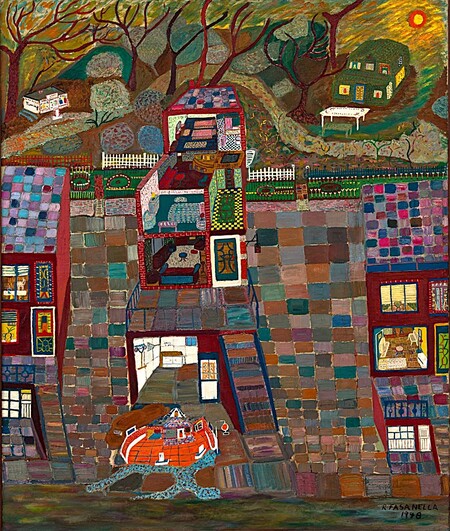
Left: Ralph Fasenella. Pie in the Sky. 1947. Right: Ralph Fasenella. Sam’s Dream. 1948.
In the work «Crane in the Sky, ” the composition is divided into two worlds. The lower portion depicts cramped urban quarters, while above them is a fantastic space featuring well-maintained houses, gardens, and religious architecture.The painting’s title alludes to the promise of happiness that a person will only attain in an indefinite future. Fasanella merges the religious conception of heavenly existence with the widespread post-war ideal of suburban life.
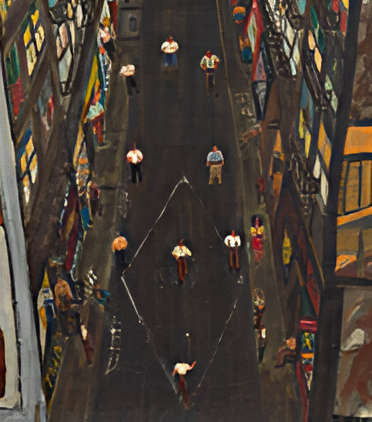
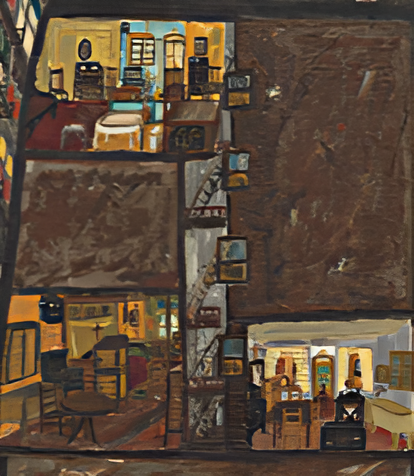
Left: Ralph Fasenella. Pie in the Sky. 1947.