Introduction
Advertising animation from the 1920s and 1930s long remained on the periphery of film studies: it was either viewed as a «practical» genre or as a means to finance «serious» art. However, it was in this segment of film production that processes occurred which radically influenced the visual culture of the twentieth century.
Abstract animation, experiments with color and sound, and techniques of volumetric puppet animation—all of this was refined in short commercial spots long before they appeared on big screens as «serious» art cinema. The commercial film served as a testing ground in the 1920s, and many key innovations in experimental film (in color, sound, and montage) were first trialed in advertising.
The issue raised in this visual study is the entrenched hierarchy surrounding animation: «authorial cinema» is ranked above «commercial product, ” and advertising is dismissed as a compromise or merely a means of selling. Because of this, the central point is lost: for an entire generation of experimental animators, advertising was not menial work, but a genuine laboratory for exciting experimentation. European animators worked differently from those in Hollywood. They had short films, small budgets, and no studio system. However, they possessed freedom in choosing their methods. Sébastien Ruff notes: „Sur un continent dominé par la production américaine de dessins animés, l’Europe et plus particulièrement la France trouve dans le marché publicitaire en dessins animés un débouché avec lequel Hollywood ne peut se mesurer puisque ces films d’animation vantent des produits français financés par des annonceurs locaux“ [1] („On a continent dominated by American animation production, Europe, and especially France, found an outlet in the advertising animation market that Hollywood could not compete with, since these animated films advertised French products funded by local advertisers“) [1]. Hollywood studios could not compete in promoting local French goods paid for by local advertisers.
The temporal scope of this study is the 1920s–1930s. This period encompasses two stages: first, commercial animation becomes an industry—specialized studios, working on commission from advertising agencies, begin to emerge in the early 1920s. Then comes the boom in the interwar years, when European studios and independent animators actively collaborate with advertisers and test new techniques. The late 1930s mark a time of forced migration for techniques and talent: after the Nazis came to power in Germany, many animators left the country, carrying their experience to other nations.
The upper limit—the late 1930s—allows us to pinpoint the moment when advertising animation had already amassed a core set of techniques that would later gain recognition and enter the mainstream in the 1940s.
The scope of the research covers European commercial studios and independent animators who worked on commissions from advertising agencies. This includes France, where Emil Kol started at Atelier Lortac and the generation of Paul Grimault was shaped; Germany, where Julius Pinscher served as a liaison between the avant-garde and the industry, and where Walter Ruttenmann, Oskar Fischinger, and Lotte Reiniger created commercials for chocolate, tires, and cigarettes; Czechoslovakia, where Karel and Irene Dodal not only produced advertisements but also wrote about them as a «new imagined world»; and the Netherlands, where George Pala’s studio in Eindhoven produced advertising for Philips and Horlicks. This group also includes lesser-known but illustrative examples—such as Gerda and Hedwig Otto in Germany, who specialized in puppet advertising.
The central question of this research is: how did short commercial animations allow for the exploration of techniques—abstraction, color, sound, volumetric puppet animation—that were too expensive or ideologically impossible for feature films? How did these techniques subsequently enter the mainstream? To answer this, one must look not only at the films themselves, but also at the conditions of production: how advertising agencies became producers of experimentation, how «non-studio» work was organized, and how the commercials were shown to audiences. The phenomenon of «dual purpose» is worth examining separately—that is, when the same material was used both as advertising and as an art film. This was the case with Dodalov: the abstract middle section appeared in both the soap commercial and the avant-garde film, differing only in the endings.
Topics
1. Introduction 2. Chapter 1. Why advertising became a «ground for experimentation»: production and display conditions. 2.1. Advertising agencies as experimental producers. 3. Chapter 2. Technical experiments: what was tested in advertising (1920s–1930s). 3.1. Abstract animation and «visual music»: Oskar Fischinger and Muratti cigarettes. 3.2. Color: Gasparcolor and the «colorful dream» in advertising. 3.3. Sound: «Chinese Nightingale» and the first sound advertising cartoon. 3.4. Three-dimensional animation: George Pal’s Puppetoon and detail substitution. 3.5. «Dual purpose»: abstraction within soap advertising. 4. Chapter 3. Influence on the mainstream: diffusion channels 5. Conclusion
Chapter 1. Why Advertising Became a «Testing Ground» for Experiments: Production and Exhibition Conditions.
1.1. Advertising Agencies as Experiment Producers
In the 1920s, Europe lacked a unified «animation factory» like Hollywood had. However, there were individuals who understood that advertising could transcend being a mundane image and become genuine cinema. Julius Pinschewer was one of the most renowned producers to pursue this vision in Germany. He began producing advertising films as early as 1911 and by the 1920s, he became a pivotal figure bridging the avant-garde and the film industry. His project was titled «Living Posters, ” and the objective was to imbue advertising with artistic merit. Pinschewer intentionally showcased „the latest cinematic innovations of the day—advanced animation techniques and sound film“ to his audience. He employed experimental artists such as Walther Ruttmann, Lotte Reiniger, Wolfgang Kaschkelain, and puppeteers Herdu and Hedwig Otto. In 1925, he established the company Pinschewer-Film AG. This is significant for our research because Pinschewer wasn’t merely commissioning commercials—he was consciously constructing an environment where the advertising format functioned as a kind of legitimate shelter for artistic exploration.
Frame from a promotional film for the Berlin Exhibition of Cinema and Photography, Julius Pinscher, 1925.
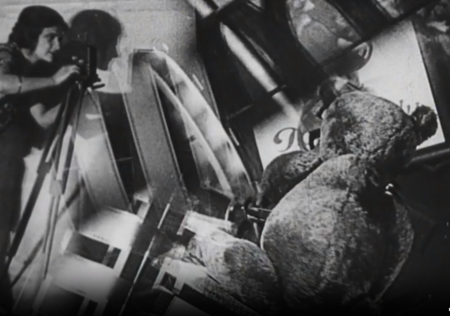
Stills from a promotional film for the Berlin Exhibition of Film and Photography, Julius Pinscher, 1925.
The film for the 1925 Berlin Film and Photography Exhibition (also known as «Kipho» or «Film») is perhaps the most telling example of how Pinsgever utilized the advertising format to showcase the technical capabilities of cinema. It is often described as a «whirlwind» or «fireworks display» of cinematographic techniques, and that is no exaggeration: the four-minute reel incorporates several techniques that were avant-garde for 1925.
The main feature is that all the special effects here are pure «camera tricks» (reine Kameratricks). This means they were created not through drawing on paper, but directly during filming, using manipulations of the camera and film. This is where the «laboratory» aspect comes in: Pinsgever and his cameraman Guido Seeber were testing what the camera could do, not just the animator-artist.
Frame from a promotional film for the Berlin Film and Photo Exhibition, Julius Pinschwer, 1925.
One of the most innovative techniques in «Kipho» is the animated typography. It was the use of «living» text that made the film one of the most interesting and innovative examples of animation technique for its time. For advertising, this was crucial: it wasn’t enough just to display logos and brand names; they had to be integrated into the overall visual flow. Thanks to the animation, the text becomes part of the narrative. This is a direct demonstration of how the advertising objective (showcasing brands) drove technical experimentation (making the text move).
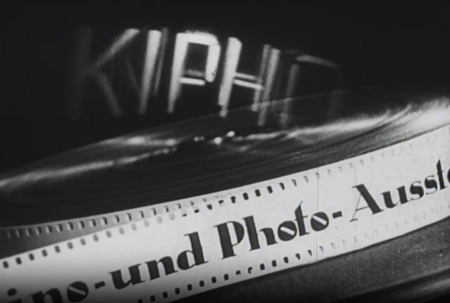
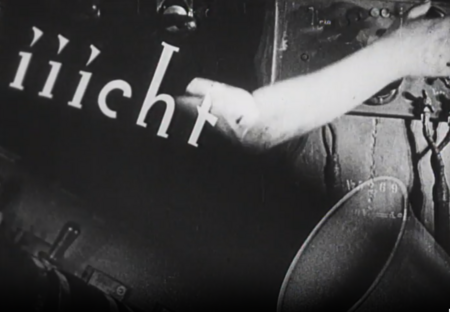
Stills from a promotional film for the Berlin Exhibition of Film and Photography by Julius Pinscher, 1925.
The most visually complex layer of the film is multiple exposure. Zeiber filmed the same scenes repeatedly, layering the images on top of one another. This resulted in complex collages—a «cinematic response» to the collage and photomontage popular in fine art at the time.
The content of these collages is equally revealing. The film stitches together motifs related to film and photographic production: «Kurbels, Spinnräder, Filmrollen» (Kurbels, Spinning Wheels, Film Reels). All of these rotate in «uniform circular motions, ” bleeding into one another. All of this forms a visual metaphor for an industry that functions as a single mechanism. This was perfect for the exhibition’s promotion: the film itself demonstrated that cinema is production.
Still from a promotional film for the Berlin Film and Photography Exhibition by Julius Pinschwer, 1925.
Another technique directly related to «collage» logic is the split-screen. In Kipho, multi-layered screens could incorporate up to seven elements simultaneously. This allowed for the parallel presentation of multiple actions or objects, creating a density and rhythm absent in standard linear editing. For the viewer in 1925, this was a visual marvel; for the advertiser, it was a way to pack maximum information into a short runtime.Zeeber was not merely a cameraman but a recognized pioneer of stunt cinematography in Germany. Specifically, he developed the «split-screen» and mirror trick techniques for the film Prague Student (1913). This expertise was also employed in Kipho. Mirrors allowed for the creation of «doubles,» doubling the image, or combining parts of a frame so seamlessly that the boundaries between them were invisible. This is yet another instance of how advertising absorbed techniques refined in feature films and repurposed them in a more concentrated, «spectacle-like» format.
A frame from a promotional film for the Berlin Film and Photography Exhibition, Julius Pinschewer, 1925.
Ultimately, the structure of the film itself was an experiment. «Kipho» is not a story with a plot; it is a «frenzied montage.» Zeebers combined staged shots from the set, post-production footage, clips from his collection of historical film equipment, and even excerpts from contemporary Ufa films (such as Fritz Lang’s «Nibelungs»).
The editing here did not serve narrative but rather an «almost musical composition.» The fast, mechanical rhythm recalled the operation of a factory or machine, which perfectly matched the objective—to portray the German film and photo industry as a «thriving enterprise.» This technique is directly linked to the advertising psychology of that era: it was believed that strong rhythmic patterning had a particular effect on the viewer and held their attention.
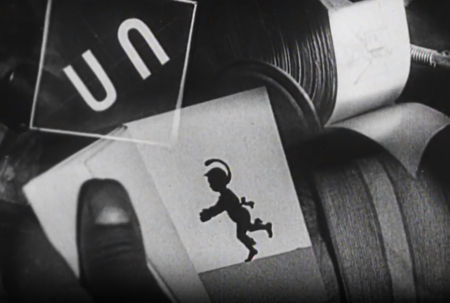
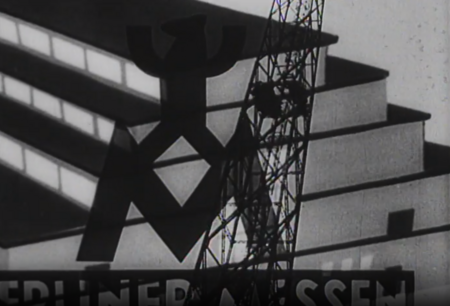
Stills from a promotional film for the Berlin Film and Photography Exhibition, Julius Pinscher, 1925.
Julius Pinscher’s work perfectly encapsulates the central thesis of this visual exploration: «Kipho» was not merely an advertisement; it was an experimental film that showcased cinematic technical capabilities while adopting the format of a commercial. Pinscher and Zieber were able to achieve such a high density of techniques precisely because it was a short, commercial commission. In feature films, such a concentration of experimentation would be either prohibitively expensive or too high-risk. Advertising granted them a «legitimate» space for such an experiment.
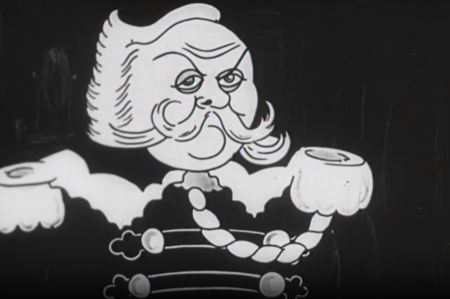
In France, Robert Collar played a similar role, working under the pseudonym Lortac. Discovering the films of Windsor Mackay and inspired by them, Collar began collaborating with the animation studio Publi-Ciné, which produced animated advertisements [1]. His first commercials were shown in Gaumont theaters. Lortac also served as a facilitator/producer: he provided young animators with work and the opportunity to showcase their talents.
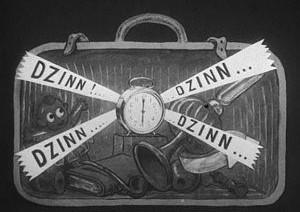
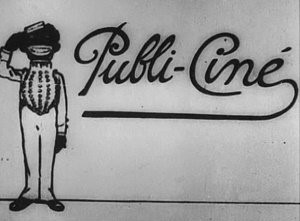
Stills from Robert Collar’s (Lortak) advertising films, 1920s
Lortak was the first animator-artist whose promotional films were shown in cinemas [1]. His first screening took place at Max-Linder and Omnia-Pathé in March 1919. The public was shown three films: one about the Jubol and Urodonal medications, and another about Biette soap [1].
Following significant success and a surge in orders, Lortak decided to collaborate with French animators: Emile Colliot, Ogalop, Antoine Painet, and André Rigal. Colliot had worked with Lortak for four years, and six commercials were created in their joint production, including «Cigarettes Saint-Michel, ” „Machines Dubied, ” and „Biscuits Delta.“ In 1925, Raymond Savignac joined Lortak, who in his autobiography recounts the process of creating commercial cartoons: „[Lortak] contracted with Publi-Ciné. He was the supplier of cartoons for this firm. He developed scripts at his villa, which a small team of caricature artists animated in the attic, which had been converted into a drawing studio. Filming took place in a shed deep within the garden.“ [1]
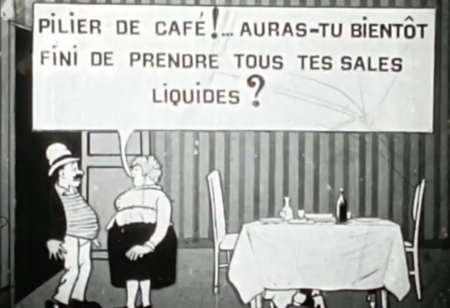
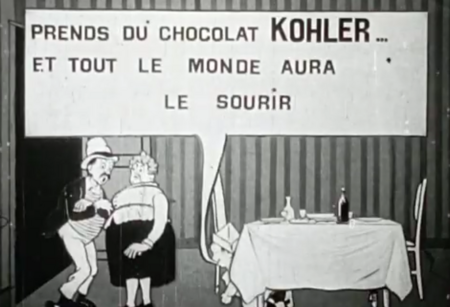
Stills from the Kohler chocolate commercial, Robert Kollar (Lortak), 1920
In 1920, Lortak created two films: one for Kohler chocolate and another for Nestle yogurt. Both spots employed a fresh animation approach: character dialogue was presented in speech bubbles reminiscent of modern comics, whereas characters' speech was typically either unvoiced or relegated to a separate shot on a black screen. Furthermore, the text did more than just advance the plot; it skillfully emphasized key points—the company name and the product itself (chocolate, yogurt) were highlighted in bold and a larger font size.
Still from the Kohler chocolate commercial, Robert Collier (Lortak), 1920