Art
Everything passes. One art
is capable of lasting forever.
Thus the marble bust
outlives cities
Theophile Gautier, translated by Valeriy Yakovlevich Bryusov [1]
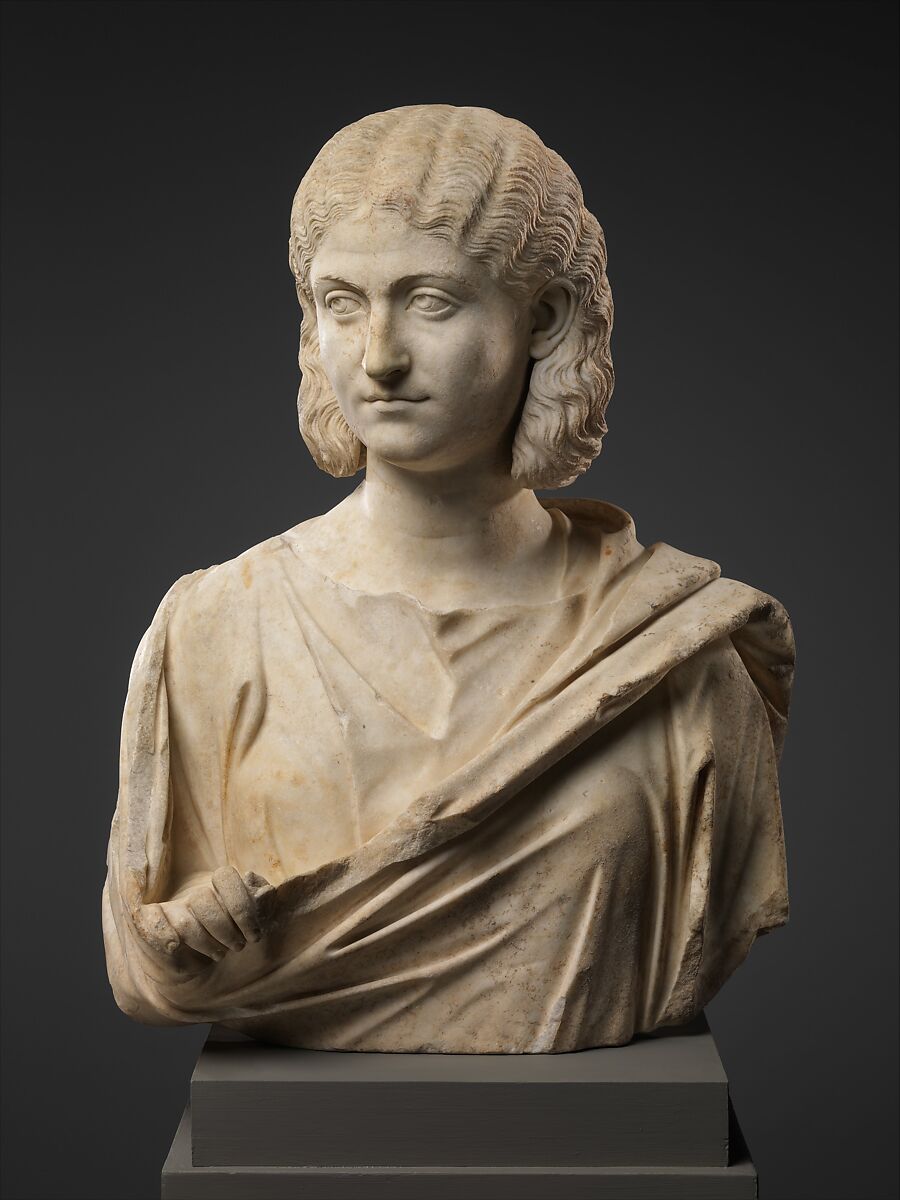
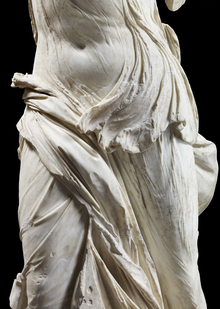
Marble bust of a woman, mid-3rd century CE.
Concept
The art of Ancient Greece and Rome became a vital source of imagery and artistic principles for subsequent eras. Its influence can be found not only in direct quotation but also in the way contemporary authors repeatedly reference the worldviews characteristic of that period.
In turn, metamodernism is forming before our very eyes. Although many works have already been created within this movement, their full contribution to art history will only be able to be assessed in the future.
In my visual research, I aim to bring these two distant eras into sharp focus to answer the question: how do artistic techniques and principles characteristic of antiquity resurface in contemporary art, and how does their meaning change within a new cultural context?
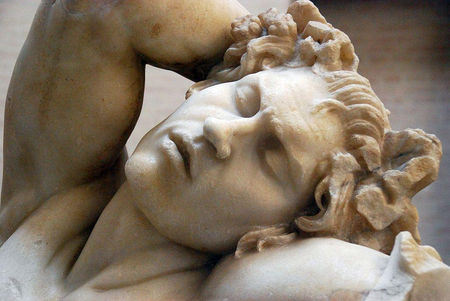
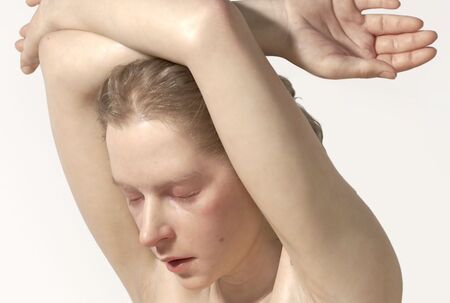
1. «Faun Barberini, ” c. 200 BCE, fragment. 2. Ron Mueck, „Pregnant Woman, ” 2002, fragment.
The primary research method employed was comparative analysis of works from different historical periods. Sculpture was chosen as the medium due to its popularity in antiquity and the large quantity of surviving works. When selecting material, emphasis was placed on the expressive quality of the artistic technique, its significance within the era’s context, and the possibility of substantive comparison with contemporary sculpture.
Not all of the mentioned authors are directly affiliated with metamodernism; the work of some is only indirectly related and is examined within the context of metamodernist thought.
Ancient works were analyzed considering their historical function, mythological content, materials, and specific plastic language. Contemporary works were analyzed from the perspective of the artistic means employed, the author’s intent, and the emerging semantic associations. Particular attention was paid to museum descriptions, scholarly publications, and the artists' own statements.
It is important to distinguish between the direct influence of ancient art and typological similarity. The research concerns a shared artistic strategy, not direct lineage.
In the process of collecting and preliminarily analyzing the material, I identified five areas that became the sections of this study: hybrid beings; emotional expressiveness; canon and its reinterpretation; symbolism and metaphor; and contradiction and duality. Each area is examined using examples from Greek and Roman sculpture, compared with the works of contemporary artists. This organizational principle allows not only for establishing a chronological sequence but also for tracing the evolution of specific artistic strategies.
The goal of my research is to demonstrate, using the example of sculpture, that the evolution of art is not a process of the appearance and ultimate disappearance of artistic techniques; rather, I aim to present cultural heritage as a dynamic space of images, ideas, and strategies in constant motion—a motion that does not cease with the passing of eras.
Hybrid Beings
«Bronze Man and Centaur,» mid-8th century BCE
Hybrid creatures occupied a special place in ancient art. By combining animal and human qualities, they functioned not merely as fantastic beings, but as conduits between different categories of the world—the natural and the supernatural, the anthropogenic and the divine. Their unusual form became a means of transmitting complex mythological and cultural concepts. Authors of metamodernism adopted the ancient principle of synthesizing the animal and the human. However, in contemporary art, this technique assumes a different significance.
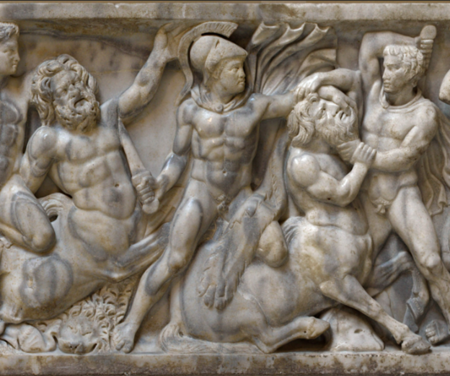
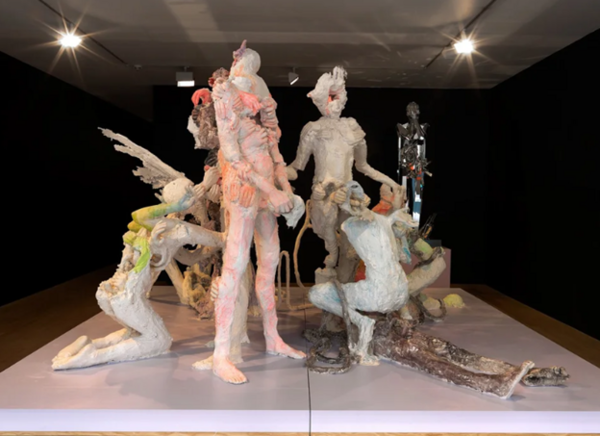
Frontal sarcophagus panel with a scene of Centauromachy, c. 150 CE, fragment. 2. David Altmeyd, «Healers, ” 2008.
It is interesting to compare the scenes featuring numerous hybrid creatures. If centauromachy is a narrative about the power of civilization conquering barbarism, David Altmeider’s work, conversely, contemplates the unstable and vulnerable position of humanity in the modern world—its connection to primal instincts and the flaws embedded by nature.
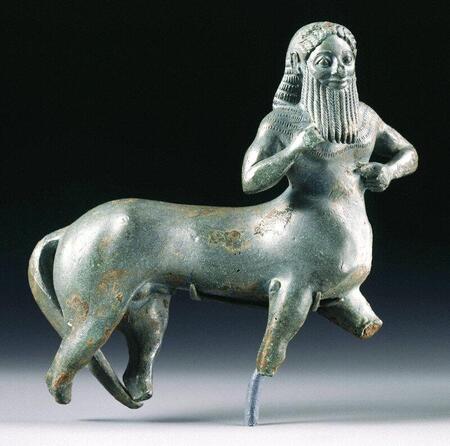
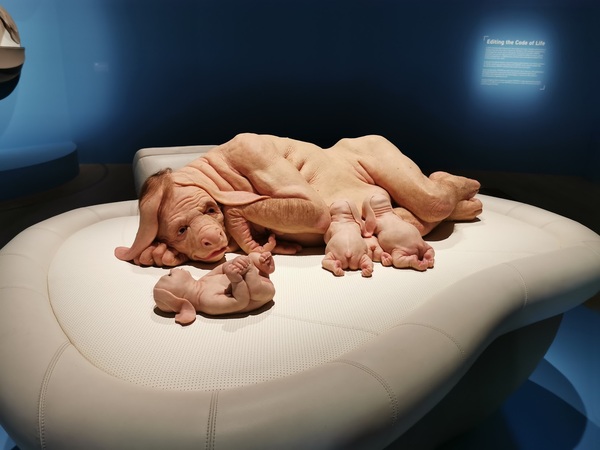
1. Centaur statuette, c. 530 BCE. 2. Patricia Piccinini, «Young Family, ” 2002–2003.
In ancient art, the hybrid was a part of a complex mythological narrative. In contemporary times, the hybrid has become a tool for exploring current themes and narratives. Patricia Piccinini’s work, «Young Family”—a simple and familiar subject about care and maternal attachment. The piece invites the viewer to reexamine the conventional boundaries between the human and the non-human, between external resemblance and the capacity to feel.
Thus, what is returned is not a specific character or myth, but an artistic technique. Although the meaning of hybridity transforms alongside culture, both ancient and contemporary works raise the theme of human dualism.
Emotional expressiveness
Agesander, Afinodor, and Polydorus of Rhodes, «Laocoön and His Sons, ” c. 40–30 BCE.
Ancient sculpture gradually expanded the possibilities for depicting human experience, which became particularly evident during the Hellenistic period. In contemporary sculpture, emotional impact is achieved not only through expressive gesture but also through naturalism, scale, and a sense of bodily vulnerability.
«Dying Gall, ” circa 230–220 BCE
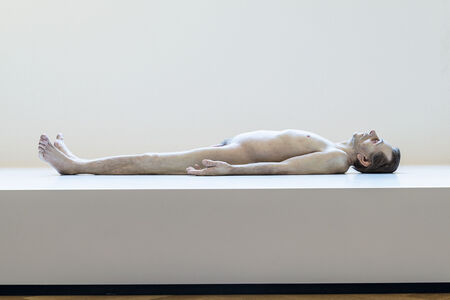
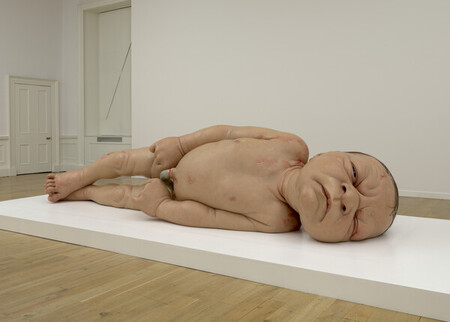
1. Ron Mueck, «Dead Father, ” 1996–1997. 2. Ron Mueck, „Girl, ” 2006.
Comparing ancient works with the pieces of Ron Mueck reveals a renewed interest in the body as a vessel for human experience. While emotionality in Hellenistic sculpture was primarily expressed through dramatic poses, gestures, and muscle tension, Mueck employs hyperrealism and distorted proportions to evoke a sense of intimacy and empathy in the viewer.
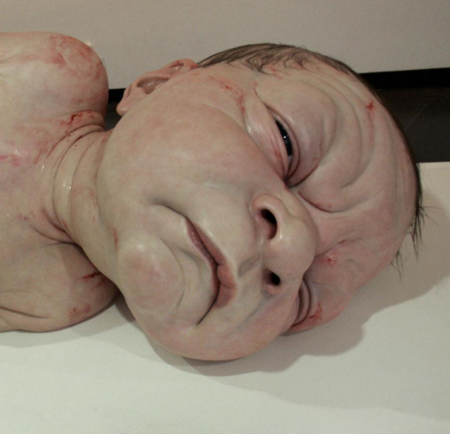
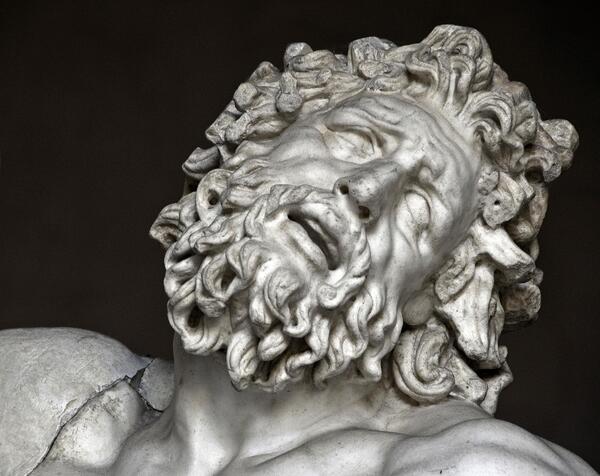
Ron Mueck, «Girl,» 2006. Fragment. 2. Aeschylus, Aphinodes and Polydorus Rhodians, «Laocoön and His Sons,» c. 40–30 BCE. Fragment.
Emotionality remains a crucial facet of sculpture, yet the methods for expressing it evolve alongside the artistic language of each era. In both cases, physical form serves as a vehicle to articulate human vulnerability.
Canon and its Reinterpretation
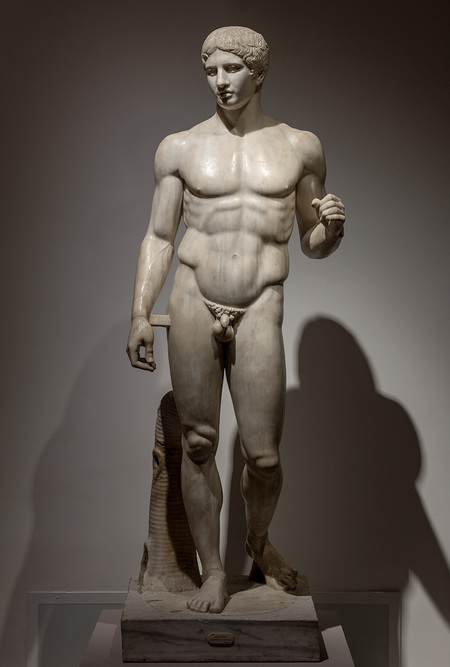
Reconstructed cast of Polykleitos’s «Doryphoros,» circa 450–440 BCE
In ancient Greek sculpture, the human body gradually became the basis of the artistic canon. Sculptors strived to find proportions that could convey the idea of a harmonious and perfect human being. Polycleitus played a special role in this process, having developed a system of human body ratios. His concepts of harmony were embodied in the sculpture «Doryphoros, ” which has become one of the most renowned examples of the classical ideal.