
Concept
While listening to music, we tend to assume that everything that happens with sound is predetermined within the composition itself. The composer selects instruments, records signals, arranges their sequence, and controls volume and rhythm. The listener is left only to experience the result. However, there are acoustic phenomena that challenge this conventional model of interaction between the work and the person.
One such phenomenon is binaural beats.
They occur when two pure tones with slightly different frequencies are presented simultaneously, with each tone delivered separately to one ear. For example, if the left ear hears a 200 Hz signal and the right ear hears a 205 Hz signal, a person, under certain conditions, may perceive an additional pulsation at a frequency of 5 Hz. Importantly, a standalone sound signal of that frequency is not actually reproduced.
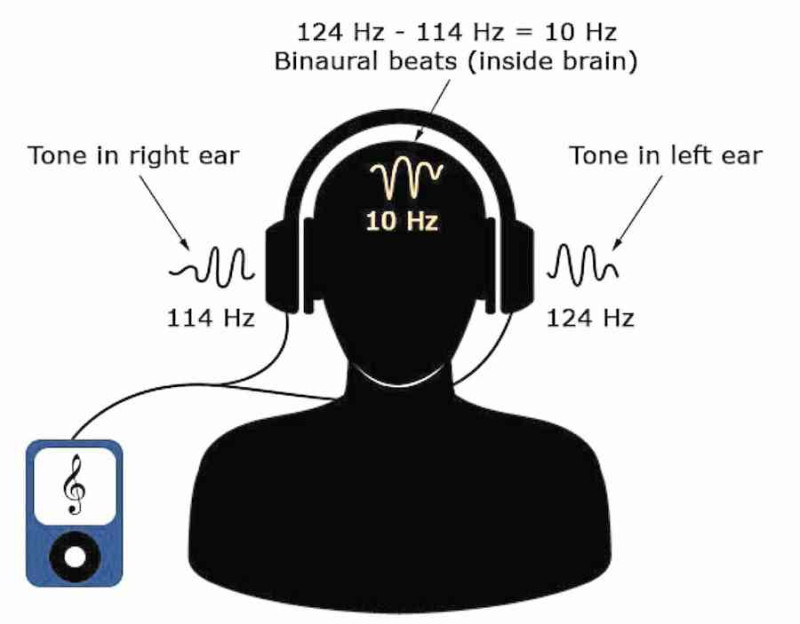
The principle of binaural rhythm generation at a 10 Hz frequency difference. Source: RBC Trends.
Demonstration of a 5 Hz binaural beat. Listen with headphones.
This creates an unusual situation: two people can listen to the same recording, but their perceived auditory experience will depend not only on the composition itself. The structure of the auditory system, the playback conditions, and individual perceptual characteristics become significant. The artist can precisely define the frequencies and placement of the signals, but cannot fully control how the listener will experience the resulting sound.
Binaural beats exist at the intersection of physical sound and its subjective perception. This is what makes them interesting not only to acoustics but also to contemporary sound art.
This very characteristic caught the attention of experimental composers and sound artists. In the 20th century, musical practice gradually moved beyond traditional melodies and instrumental timbres. Artists began working with noise, electronic signals, space, and the subtleties of human hearing.
Binaural beats emerged as one such tool. Some creators use them to alter sonic texture, others incorporate them into ritual practices, and a third group combines them with visual and spatial installations.
Within the scope of this research, we are interested not in how effectively sound can alter a person’s state, but rather why artists turn to such concepts and how they utilize the acoustic mechanism itself in their works.
Research Object — binaural rhythms as an auditory phenomenon utilized in contemporary sound art.Research Subject — the artistic strategies through which creators integrate binaural rhythms into composition, performance, and installation.Research Question: How do binaural rhythms transform from an acoustic phenomenon into an artistic tool, and what purposes do artists using them in their works address?
Navigation
1. From Acoustic Discovery to Musical Experimentation The history of binaural beats, their unique origins, and their transition into experimental music.2. Binaural Beats in Ritual Sonic Practices Rudolf Eb.er and Brainnectar: utilizing sound in working with bodily experience and listener attention.3. Binaural Beats as a Compositional Technique Brian Connolly: working with frequencies, timbre, and the spatial organization of sound.4. Binaural Beats in Audiovisual Art The application of this phenomenon in performances, installations, and artistic explorations of subjective experience.
From acoustic discovery to musical experimentation
To understand the artistic possibilities of binaural beats, one must first comprehend the mechanism of their generation. When two tones of similar frequency are physically mixed, their interaction creates periodic fluctuations in volume. This effect is known as binaural beats. You can hear this, for instance, when two slightly detuned instruments sound simultaneously.
Binaural beats occur differently. Two signals are delivered separately to the left and right ear, and the sensation of pulsation is formed as a result of auditory information processing.In the article «Auditory Beats in the Brain» (1973), Gerald Oster extensively discusses this phenomenon and explains the differences between monaural and binaural beats [1].
Monaural beats
Binaural Beats
It is also important to distinguish between binaural beats and binaural recording. The latter is designed to convey the spatial location of sounds, whereas binaural beats are based on the interaction of signals with differing frequencies. Therefore, stereo sound and spatial audio alone do not confirm the presence of this phenomenon.
The first description of binaural beats is credited to the German scientist Heinrich Wilhelm Dove, who investigated the phenomenon in 1839. Later, it was studied within the context of physiological acoustics and spatial hearing.
Experimental music developed in parallel. With the advent of electronic generators, tape recorders, and sound processing technologies, composers gained the ability to work directly with frequencies, noise, and sonic textures.A crucial stage was the concrete music of Pierre Schaeffer, which emerged in the late 1940s. It proposed perceiving recorded sound as an autonomous material that could be transformed and organized independently of its original source.
Pierre Schaeffer
This approach was not directly linked to binaural beats, but it did contribute to expanding the understanding of musical composition. The foundation could now be set not only by notes but also by acoustic processes.Later, artists began to explore not just the characteristics of the sound signal, but also how sound is perceived by humans.
In the book Listening to Noise and Silence (2010), Salomé Voegelin examines sound art through the immediate experience of listening. This approach takes on particular significance in the case of binaural beats: the perceived pulsation depends on the function of the auditory system.Thus, the artist orchestrates the conditions under which a specific sound can arise in the listener’s perception.
Binaural Beats in Ritual Sound Practices
Swiss artist Rudolf Eb.er is known for his experimental noise music, performances, and his work with the collective Schimpfluch, which was founded in 1987.
His artistic practice is connected to embodiment, ritualistic actions, and the exploration of extreme sonic states. Sound here often becomes not just musical material, but a component of the physical experience.
One of the most representative works is the album Brainnectar, released in 2014.
Brainnectar Cover, 2014.
In the Brainnectar description by Rudolf Eb.er, there is a direct reference to the use of binaural beats, isochronic tones, nature recordings, voices, and extreme sonic textures.
In an interview with Chain D.L.K. (2014), the artist explains that they aimed to create an auditory work connected to psychophysical practices and active listening.
Rudolf Eb.er during the performance
The distinctive feature of Brainnectar is that binaural beats are not presented as an isolated acoustic demonstration. Instead, they are integrated into a rich sonic environment composed of numerous heterogeneous elements. Natural recordings coexist with electronic noise, instrumental sounds, and extreme vocalizations. Some compositions feature sharp textures and contrasts that challenge passive, relaxed listening. In this organization, the binaural beat becomes part of a more complex artistic system; it does not necessarily need to remain constantly in the foreground or be perceived as a distinct pulsation.







