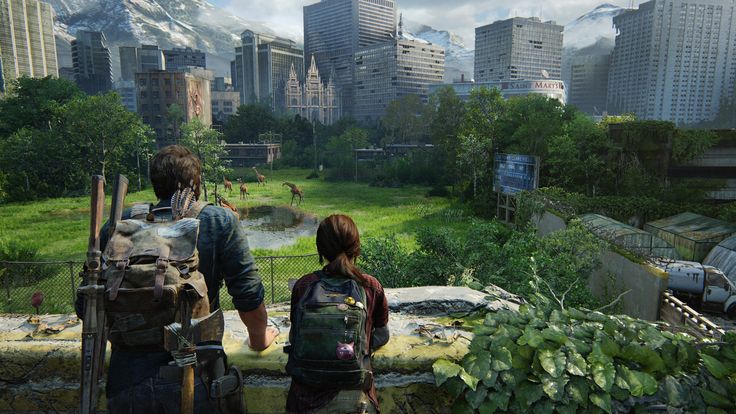
The Last of Us Part I (2013)
Navigator
1. Introduction. A Future You Don’t Want to Live In 2.1 Resident Evil 2.2 Frostpunk 2.3 Pathologic 2.4 Dead Space 2.5 The Last of Us 2.6 Alien: Isolation 3. Six Versions of the Apocalypse 4. Conclusion. What If This Isn’t Science Fiction? 5. Image Sources
Введение
THE FUTURE WE WANT TO LIVE IN
When we mention the future, we usually envision a world of new opportunities, scientific and technological progress, and uncharted discoveries. However, in fictional works, we can often see a completely different picture. The future frequently takes on an opposite nature: instead of a wondrous new world, humanity confronts the consequences of its own decisions. This includes global catastrophes, deadly diseases, uncontrolled experiments, and the breakdown of our familiar social order. These narratives are particularly noticeable in video games. Through video games, we can observe such scenarios both from the outside and literally within them. The player explores abandoned cities, deserted space stations, and devastated territories. In this way, human life gradually loses its value. A characteristic of these worlds is that their stories begin with processes that we recognize. For instance, scientific developments spiral out of control, natural conditions become uninhabitable, and society is unprepared for large-scale disasters.
This visual study aims to prove the following thesis: «The fantastic worlds of video games are a reflection of contemporary anxieties, where the future offers us nothing good, but only sows the seeds of civilization’s destruction.» The hypothesis is that the catastrophes depicted in video games illustrate the real threats and fears of our time. It is the recognizability of the causes of these events that makes the fictional scenarios of the future frighteningly plausible.
The Last of Us Part II (2020)
The methodology of visual research is based on a comparative analysis of video game visuals and their correlation with real-world phenomena and contemporary threats. This approach is premised on revealing the connection between fictional catastrophes and humanity’s relevant global issues.Thus, the research proposes viewing post-apocalyptic worlds as a reflection of modern anxieties and the potential consequences of human civilization’s development.
This study examines six video games featuring different versions of a catastrophic future: Resident Evil, Frostpunk, Pathologic, Dead Space, The Last of Us, and Alien: Isolation.
Despite the differences in genre and setting, they share
one common element: in every universe, we are plunged into the worst possible outcome of the future.
01. RESIDENT EVIL
медицина есть оружие
The global catastrophe is caused by the activities of the pharmaceutical company, «Umbrella.» They maintain an image for the public of a company dedicated to the betterment of humanity. At the same time, however, they are secretly developing biological weapons. Scientific experiments lead to the creation of deadly viruses (T-virus and G-virus). These viruses transform people into zombies, and animals become aggressive creatures with altered anatomy.A localized outbreak of infection gradually escalates into a catastrophe where the consequences can no longer be hidden or fully controlled.The city of Raccoon City is one of the symbols of the failure of genetic reductionism, corporate irresponsibility, and the attempt to use living organisms as weapons.
Resident Evil 2 (1998)
The world is built upon the contrast between the familiar urban environment and its biological decay. Police precincts, hospitals, laboratories, and residential buildings transform into contaminated spaces that exude horror.Sterile medical interiors coexist with blood, ruined rooms, organic growths, and mutated bodies. The high-tech laboratory aesthetic gradually yields to biological chaos.The core theme here is the clash between the rational human world and the nature that humanity attempted to subjugate.
Resident Evil Village (2021)
The fear here is tied to a distrust of social institutions—those we feel should, at first glance, be protecting people. Medicine, laboratories, pharmaceuticals, and scientific research are associated with safety, reliability, and progress. However, in «Resident, ” it is these very fields that are the primary source of danger.
It is particularly unsettling to think that the catastrophe is not a random event: someone is deliberately creating the danger, attempting to cover it up, and continuing experiments for personal gain.
CHANCES OF SURVIVAL: 3/10
The contagion spreads rapidly; the viruses cause unpredictable mutations, and no one can be trusted. There is a chance, but only if you aren’t in the wrong place at the wrong time.
Resident Evil: Revelations (2012)
02. FROSTPUNK
Земля перестала быть домом
Humanity is facing a global climatic catastrophe. Due to a series of intense volcanic eruptions on Earth, an eternal winter is descending. The planet’s temperature is dropping sharply. Familiar conditions for existence are becoming impossible. Now, survival in perpetual cold is necessary.
The center of this new society is a massive generator that provides warmth to the residents. Around it, the last refuge for all of humanity is forming. This city’s existence depends on the constant operation of machines and the continuous extraction of fuel.
However, no one guarantees survival here. Resource scarcity, famine, numerous diseases, and social tension compel people to make decisions that, until very recently, seemed utterly immoral.
Frostpunk (2018)
The visual aesthetic of Frostpunk — the struggle between cold and heat. Vast snowy expanses, mist, icy structures, and an almost monochromatic palette create a sense of desolation.
The only source of warmth is the generator.
Its light, fire, and smoke become a symbol of lingering human hope.
The human figure, meanwhile, appears most vulnerable here—nearly vanishing against the backdrop of immense and hostile nature.
Frostpunk (2018)
Frostpunk depicts a catastrophe where humanity faces no specific enemy. It is impossible to defeat a disease, destroy a monster, or stop a corrupt corporation. The adversary is the world around us.
What is frightening is that survival gradually begins to depend on moral considerations. To preserve society, one must sacrifice someone or something: restricting freedom, introducing harsh laws, and abandoning the interests of individuals for the greater good.
The game raises the question: how far is a person willing to go just to stay alive?
CHANCES OF SURVIVAL: 4/10
Everything depends on the generator and the organization of society. As long as there is fuel and people are willing to work together, there is hope. However, one strong blizzard can easily negate all efforts.
Frostpunk (2018)
03. PATHOLOGIC
болезнь — часть общества
A small, isolated town faces a deadly epidemic—Sand Blight (Sand Plague).
The illness spreads throughout the town. It destroys the established order of life. Medical resources are insufficient. Doctors cannot guarantee patients' survival. The residents gradually lose trust in one another and in existing social institutions.
The main protagonist finds himself in a situation where every day matters. He must search for medicine, help the infected, negotiate with the residents, and decide who gets the limited resources.
The disease in the game is an autonomous entity. It seems to possess a will, penetrating the town and changing it from within.
Pathologic 2 (2019)