Concept
The Garden of Eden is one of the most enduring images in European visual culture. However, its steadfastness is deceptive: beneath the apparent permanence of the iconographic schema lies radical historical variability. This study focuses on one of the most charged periods of this variability—the Counter-Reformation, when the image of paradise became the subject of systematic ideological reframing. The research examines depictions of paradisiacal space in European painting from approximately 1550–1650, as well as earlier works that underwent reinterpretation or censorship during this period. The Counter-Reformation did not ban the depiction of paradise; rather, it recoded it: Eden, once a place of bliss, transformed into an instrument of bodily discipline, the affirmation of Marian cult, and the demonstration of Church authority. This transformation occurred through four interconnected mechanisms—the redefinition of symbols, the substitution of the garden with the figure of Mary, the censorship of corporeality, and the gender binary of salvation.
The goal of this research is to identify and characterize the mechanisms of the visual transformation of the Garden of Eden motif in European painting during the Counter-Reformation (c. 1550–1650) and to determine what ideological functions this transformation served within the Catholic doctrine of imagery.
From the «Garden of Pleasures» to the «Garden of Warning»: The Fate of Bosch
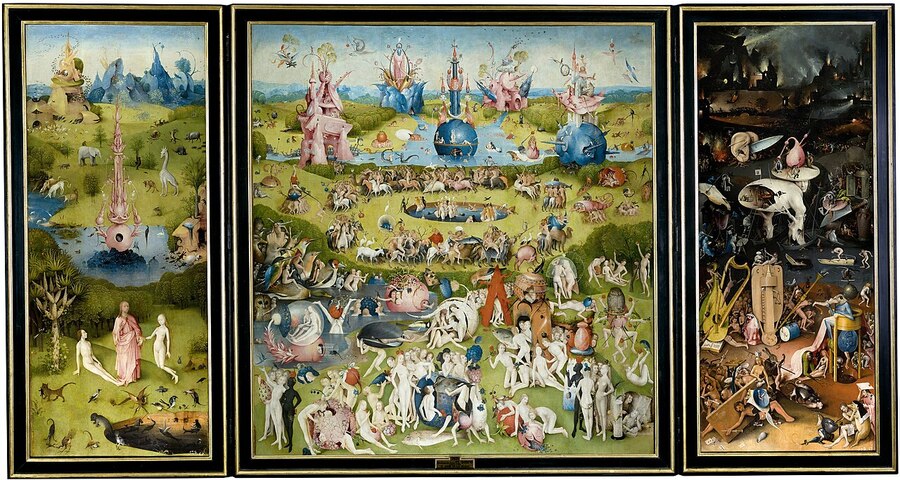
Hieronymus Bosch The Garden of Earthly Delights. 1500–1510
«The Garden of Earthly Delights» by Bosch was created around 1490–1500 for the commission of Engelbrecht II, Count of Nassau. In the second half of the 16th century, it was acquired by the Spanish King Philip II and placed in the Escorial monastery. The movement of the painting itself carries ideological weight: from the court in Brussels, it ends up within the stronghold of the Spanish Counter-Reformation, fundamentally altering its function.
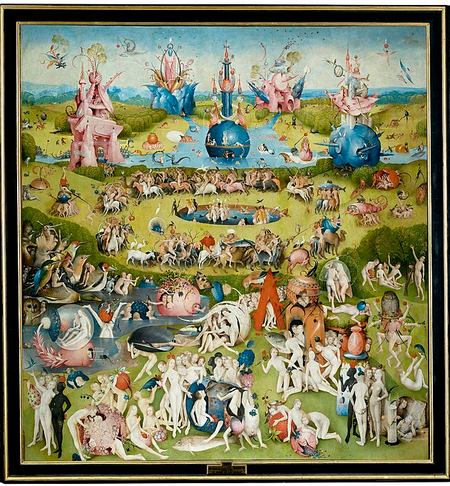
The central panel at first glance presents an innocent natural state: numerous nude figures coexist in a vast garden with animals and plants, fruits abound, and the poses are free. However, it is this very «freedom» that becomes the entry point for a Counter-Reformation interpretation. According to Thomas Aquinas’s theory on the classification of lustful sin, the depicted acts can be systematically correlated with the categories of «uncleanness, ” „bestiality, ” „sodomy, ” and „unnatural couplings.“
In Dutch urban culture around 1500, these images might still have existed in the space between moral warning and folk humor, but upon entering Philip II’s collection, their interpretation was rigidly fixed within the framework of a «false paradise.» El Escorial, as the paramount monastic-palatial complex of the Counter-Reformation in Spain, was designed as a visual weapon against the Protestant «justification by faith.» In Bosch, nudity and sexual acts can no longer be read as a symbol of an «innocent state”—only as a warning of licentiousness: this is Eden that must be rejected because it lacks God. The fruit—the central symbol of the Eden narrative, beginning with the forbidden fruit Eve offers Adam—is re-coded here as a catalyst for lust, rather than as an innocent creation.
The complexity of Bosch’s case, however, lies in the fact that even within the context of the Counter-Reformation, the painting retains an irreducible visual excess. The poses and compositional arrangements of the central panel—which do not fit entirely within Aquinas’s classification—and the ambiguous forms between human and animal, nature and the artificial, lend a certain allure to the «warning.» Perhaps this is the inherent tension of the Counter-Reformation’s visual strategy: to warn against sin, one must depict it; and the more complete the depiction, the closer the warning comes to temptation.
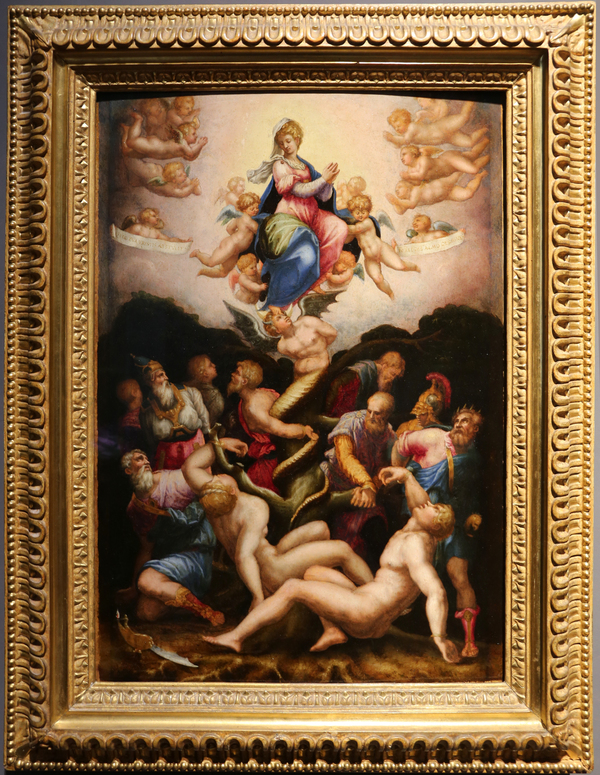
If Bosch’s «Garden of Earthly Delights» illustrates how the Counter-Reformation reinterprets the ready-made Edenic image as a negative example, Vasari’s «Allegory of the Immaculate Conception» presents a different strategy: the creation of an entirely new iconography to replace the previous Edenic narrative.
Giorgio Vasari Allegory of the Immaculate Conception. 1511–1574
The painting was not a product of the cathedral, but the cathedral made it a model. Vasari created a visual schema that connected a dogma (Mary without original sin) with the history of salvation (the liberation of Adam and Eve and the progenitors), and after the Council of Trent, this schema was canonized as a standard and used to affirm and disseminate the Catholic doctrine of salvation. Its inscriptions, composition, and display location—all point to it being precise visual evidence of the Counter-Reformation strategy of «using images to serve doctrine.»
This painting is an authorial reinterpretation of the altarpiece painted by Vasari for the Altoviti family chapel in the Santi Apostoli Church in Florence. The composition centers on the Tree of Knowledge of Good and Evil: a serpent-devil coils around the trunk, the Virgin Mary crushes its head in the heavens, surrounded by angels singing «O gloriosa domina.»
At the bottom, Adam and Eve, along with the Old Testament patriarchs, their wrists bound and contorted into anguished postures, gaze upward with an expression of suffering, yet also of hope. The key to the work is the inscription: «Quod Eva tristis abstulit, tu redis almo germine”—“What sorrowful Eve lost, you restore with a merciful sprout.» This inscription perfectly summarizes the logic of the Counter-Reformation’s Mariological visualization: Eve is the point of loss, and Mary is the path to restoration. The Garden of Eden ceases to be an imaginable geographic space and becomes a «substitutive» function of salvation embodied by Mary. In the painting, the bodies of Adam and Eve are bound to the root, while Mary’s body floats above the crown, trampling the serpent’s head—a visual interpretation of «the seed of the woman will crush your head» from Genesis 3:15, connected to the image of the Woman from Revelation 12:1.
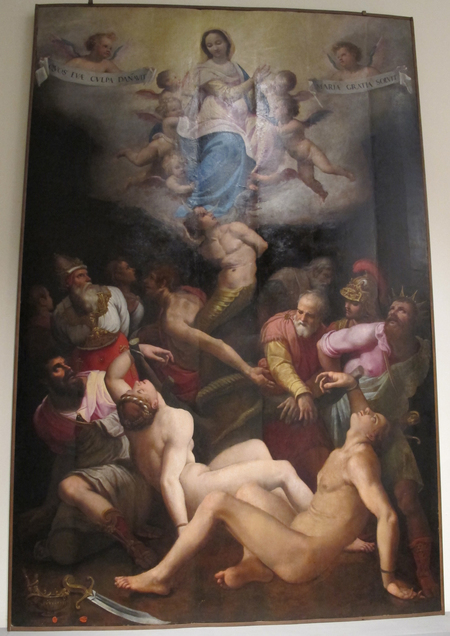
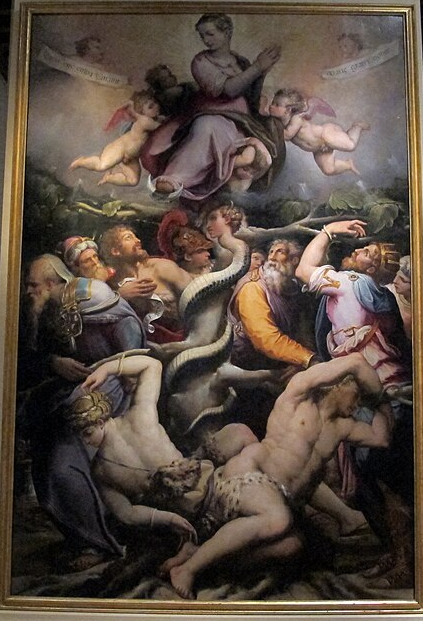
Notably, the painting was commissioned privately, yet its iconographic scheme achieved significant success: Vasari created several variations, and by the late 16th and 17th centuries, this type was adopted and reinterpreted by artists from the Iberian Peninsula and the Americas. This indicates that the Counter-Reformation’s reconstruction of the Edenic image was not confined to Italy; rather, with the expansion of the Catholic reform, it began to transmit as an interregional visual norm. In the new schema, Eve’s sin and Mary’s salvation are condensed into a single visual space, and the meaning of the female body is strictly binary: Eve’s body is the source of the Fall, and Mary’s body is the channel of salvation. There is no intermediate zone between them.
It is important to note that when Vasari created this painting in 1541, the Immaculate Conception had not yet been officially proclaimed as a dogma. However, during the 16th century, this issue became a hot spot in the polemic between Catholics and Protestants. The Council of Trent (1545–1563), during its final sessions, confirmed that original sin is passed on to all people, while simultaneously making a reservation regarding Mary. Therefore, Vasari’s iconography of the Immaculate Conception was created during a period when the dogma was still in its formative stages, and its visual schema—where Mary treads upon a serpent, Adam and Eve are linked, and light liberates—provided a ready-made visual tool for the subsequent official doctrine. Indeed, this schema later spread widely across Europe, including Seville in Spain, and even engravings were created for its mass reproduction.
Protestantism asserted «sola fide"—salvation through faith alone, without the mediation of the Church, saints, indulgences, or sacraments. For the Catholic Church, this was not merely a theological disagreement but a threat to its very existence. Art was intended to visually prove the opposite: salvation is impossible without the Church, without Mary, without saints, and without the sacraments.
This is why Vasari’s «Allegory of the Immaculate Conception» structures the composition so that salvation arrives only through Mary—and Mary is conceived as part of the Church’s system of mediation. The garden, which traditionally represented a place of bliss, is replaced by a figure that points toward the Church as the sole channel of grace. Paradise is not «forbidden"—it is redirected: it is now accessible not through personal contemplation of nature, but through institutional mediation.
«The Hidden Body»: Mazzaccho and the Logic of Censorship
Tommaso Mazzaccio Expulsion from Paradise. 1425–1427
The fresco «Expulsion from Paradise» in the Brancacci Chapel was painted between 1424 and 1425. It depicts the moment Adam and Eve are cast out of paradise by the angels. Masaccio’s decision was revolutionary for its time: Adam covers his face with his hands, his muscles are tense, and the suffering is conveyed through the tension of his body rather than his facial expression; Eve, in the pose of a classical «modest Venus, ” covers her chest and lower body, her eyes are rolled back, and her mouth is open—conveying genuine physical and spiritual anguish. Light falls from the right, highlighting the anatomical details of both figures—a realism almost unprecedented for the 15th century.
In 1670, under Cosimo III, the decorative scheme of the chapel was modified; gilded wooden frames were added to separate the tiers of frescoes. It was then that fig leaves were introduced to cover the genitalia of Adam and Eve. The foundation for this can be traced to a literal reading of Genesis 3:7: Adam and Eve, when their eyes were opened, «sewed fig leaves together and made for themselves loincloths.» However, this «Scripturally accurate» explanation obscures a deeper logic: the Church’s control over sacred imagery during the Counter-Reformation was primarily concerned not with biblical accuracy, but with the potential sensual impact of the image on the viewer.
The Decree of the XXV Session of the Council of Trent (1563) regarding sacred imagery explicitly prohibited depicting anything that «arouses lust.» The nudity of Adam and Eve in Masaccio’s work, viewed within the humanist context of the 15th century, could have been interpreted as a serious depiction of the dignity and fragility of the human form; however, within the moral framework of the Counter-Reformation, it is primarily recognized as a visual object «capable of inciting lust.» The act of veiling thus serves a dual function: it both (selectively) adheres to the biblical text and—more importantly—disciplines the act of viewing itself.
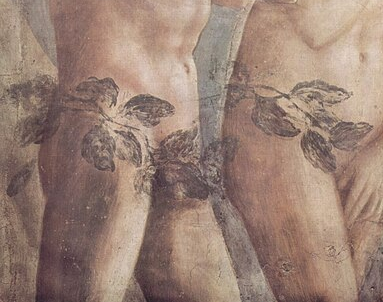
The fig leaf here is not a narrative element, but a sign of visual prohibition: it tells the viewer—do not look here—and this very «do not» confirms the existence and power of what is hidden.
Protestantism rejected celibacy, monasticism, and many practices of bodily abstinence. The Catholic Church, conversely, strengthened bodily discipline after the Council of Trent: the priest was required to observe celibacy, and the layman was required to confess and repent. Art was meant to visually reinforce this discipline. This led to censorship of nudity, the recoding of the «Garden of Delights» into a «false paradise, ” and an emphasis on the shame and suffering of the body. The body in paradise should not evoke desire—it should serve as a reminder of the necessity of controlling that desire. Paradise became not a place where the body was free, but a place where the body was lost—a loss that needed to be mourned and atoned for.
The restoration from the 1980s removed these later leaves, returning Masaccio to his original appearance. The act of restoration itself deserves contemplation: it posits «authenticity» as the ultimate value and treats the Counter-Reformation intervention as «contamination» to be excised. However, from the perspective of reception history, these fig leaves are also part of the work’s history—they document how the 17th-century Church understood and attempted to control the image’s meaning.
The Changes to the Garden of Eden in Art During the Counter-Reformation.
Symbols: From Ambiguity to Clarity.