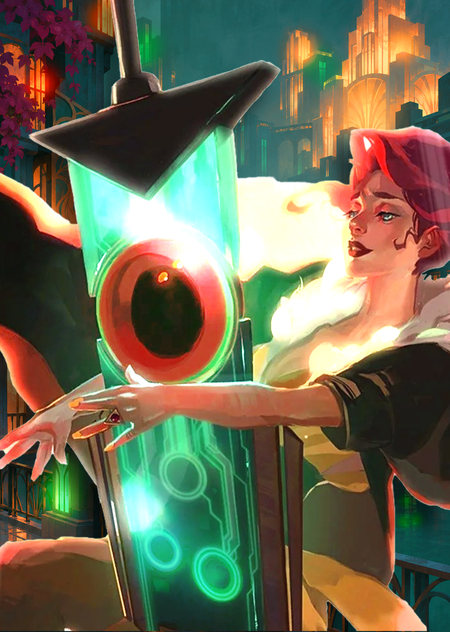
Concept
Transistor begins the moment Red’s ordinary life comes to an end. She stands beside a man’s body, from whose chest protrudes an object resembling a sword. Later, the player learns that Red was a singer before the attack. Now, she cannot speak, but her companion’s voice is heard from Transistor. The city they must traverse gradually loses its former appearance [1].
At first glance, the story suggests a simple interpretation: a creative individual stands against a system that robs them of their voice. However, as the game progresses, details emerge that complicate this conclusion. Cloudbank’s technological device allows the city to change. Transistor retains information about people, giving Red a means of self-defense. The combat mechanics leave the player with choices regarding combinations and sequences of actions. Therefore, it is important in this analysis to determine at what point the ability to create transforms into control over another person’s life.
The selection of this theme relates to how Transistor connects the personal narrative with the mechanics of its game world. The loss of voice is evident in Red’s proximity to her own poster. The disappearance of the city is reflected in the shifting architecture. The relationship to the human element is shown through the juxtaposition of biography and combat function within the interface. These details can be correlated to trace how a single conflict manifests across different parts of the game. This approach maintains focus on the individual—their experience and their capacity for self-expression.
The core research question is: how does Transistor depict humanity’s struggle to create and make decisions within a system that is capable of exploiting the outcomes of one’s life?
The initial hypothesis posits that conflict arises when an individual is denied agency over their own life, and their voice, image, or abilities become available for appropriation by others. It is assumed that Red maintains a connection to creativity through discrete actions whose meaning extends beyond their practical utility. However, the extent to which the mere presence of rules impedes this possibility must be investigated.
The «system» mentioned in the title refers to the order that dictates permissible actions and methods of world alteration. The analysis must distinguish between Cloudbank’s urban mechanisms, the Camerata’s resolutions, and the Process that has slipped beyond its control. The rules of the video game itself are examined separately. These rules define the player’s capabilities but are not considered another participant in the narrative. Creativity is understood as the creation or transformation of a form through which a person expresses their attitude toward the world. Red’s musical performances and the composition of in-game combinations will be addressed separately, as these actions serve different purposes and carry different significance.
The goal of this work is to trace how the constraint on autonomy becomes visible and what enables the protagonist to continue acting. The existential approach here relates to experiencing loss, making choices, confronting one’s past, and the limits of what can be restored. The starting point is Evgeny Fink’s book, «Basic Phenomena of Human Being, ” in which the game is examined as one of the fundamental phenomena of human existence [2, § 21–22]. This provides a foundation for investigating the player’s experience: what an available action signifies to them and why they choose to enact it.
Navigation
1) Who is changing Cloudbank? Urban transformation, the Cameraata concept, and the disappearance of differences.
2) What remains of a person when they lose their voice? Red, her poster, and the representation of self within the interface.
3) How does Red continue to express herself? Melody, player participation, and the personal meaning of performance.
4) Where is the player’s freedom located? Functional combinations, planning, and choice within established rules.
5) What cannot be regained upon acquiring power? The final scene and the limits of restoration.
1. Who is changing CloudBank?
Supergiant Games. Transistor. 2014. Cloudbank. City panorama.
The Cloudbank panorama reveals buildings of varying heights, illuminated windows, and transitions between distinct city sections. The viewer’s gaze continually lingers on small details. Red occupies a minimal amount of screen space. Around it is an environment that existed long before the playthrough began.
On the terminal screen, the weather is presented as an option. The «Tomorrow’s Forecast» header sits next to a «Show Ballot» button. The city addresses Redd by name and invites him to cast a vote. This scene illustrates how a resident accesses the ability to alter the environment. The voting result itself is not yet displayed here.However, its appearance can change. Residents participate in decision-making through terminals, and the city’s technological infrastructure allows these changes to be manifested in the physical space. One example relates to the bridge in Fairview [4].
Supergiant Games. Transistor. 2014. OVC Terminal. Tomorrow’s Forecast Screen.
In a relevant episode, Red gains the ability to approve construction. A transition follows this decision. A connection emerges between the interface decision and the change in the urban environment: what existed as a proposal becomes a navigable space.
Here, the protagonist’s action is crucial. She approves the suggested design, its form already determined. The shot of the finished bridge shows the outcome, and the sequence of interacting with the terminal is established through movement [4]. This episode demonstrates that the Cloudbank system inherently allows for creation. The question then arises around access to it and the authority to determine the final result.
The Camerata attempts to control the transformation of Cloudbank. Its participants tie this effort to their own vision for the city’s future. However, their intervention leads to a situation where the Process spirals out of control and begins to destroy the very environment they sought to change [4; 5].
To analyze this, one must separate intention from consequence. The Camerata has a design. The destroyed city shows visible evidence that control has been lost. Therefore, the white spaces in the later episodes cannot automatically be considered the precise realization of what the group members wished for Cloudbank.
Supergiant Games. Transistor. 2014. OVC Terminal with disappearance counter.
A counter for disappearances appears on the other terminal. The Red figure remains next to it, but the information now pertains to resident losses. Comparing the two screens reveals a shift in the role of the urban network: it allows users to participate in voting and then learn about the unfolding disaster. One screenshot captures the counter’s value; its increase over time must be shown through a sequence of frames.
Supergiant Games. Transistor. 2014. Fairview. Space after the Process’s impact.
In Fairview, familiar details yield to white geometric forms. The preserved parts of the environment appear fragmented. Although one can still recognize the urban space through them, it becomes more difficult to envision its daily life.
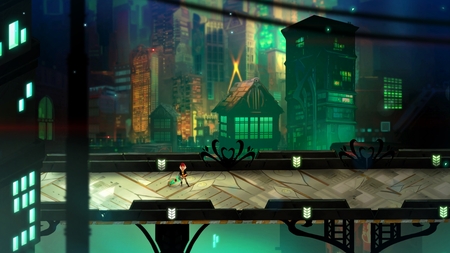
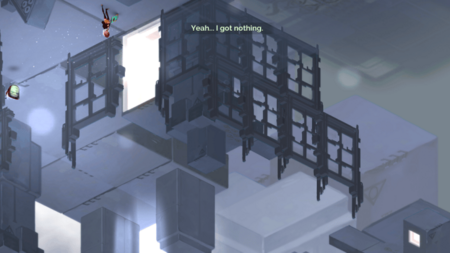
1. Supergiant Games. Transistor. 2014. Cloudbank. City Panorama. 2. Supergiant Games. Transistor. 2014. Fairview. Space After the Process.
In the panorama, individual windows, transitions, and silhouettes help differentiate one part of the city from another. In the processed space, attention shifts to repeating forms. Comparison highlights the transition from a multitude of differences to an environment where they become increasingly scarce.
This allows for reading Cloudbank’s decay as the erasure of the human trace. This interpretation is based on visual comparison. The game illustrates the loss of architectural features, and the connection between these features and the memory of people’s lives emerges during analysis.
Thus, the conflict begins with a question of participation. The possibility of transforming the city exists, but decisions regarding its fate gradually become inaccessible to those who live there. In Red’s history, this situation becomes much closer: they take away her ability to express herself, even though her image remains part of Cloudbank.
- What remains of a person when they lose their voice? Red, her poster, and the presentation of identity within an interface.
Supergiant Games. Transistor. 2014. Microphone stand. Stage setting.
In the image, Red stands at a microphone. Her hand positioning, dress, and the lighting connect her figure to the performance. Her voice defines what she does and how she occupies this space. This image helps reveal how much her position has changed since the beginning of her journey.
Supergiant Games. Transistor. 2014. Ship’s hull interior. Opening scene.
The opening scene shows Red next to the body of an unknown male player. A Transistor protrudes from his chest. The heroine pulls it out, and soon the object becomes her weapon and the source of her companion’s voice. Red herself cannot speak after the attack [1; 4].

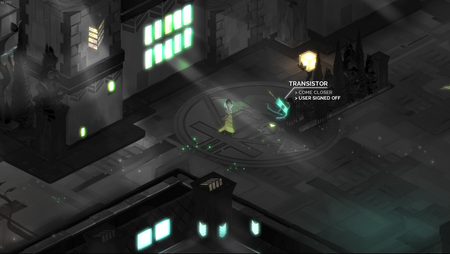
There is another way to describe the beginning of the story. Next to the Transistor, the player sees the technical designation USER SIGNED OFF. The loss of a person occurs adjacent to a change in the user’s status. Correlating this with the image of the assault makes this proximity noticeable: what is happening affects Red’s life, while the interface communicates the device’s condition.
When comparing the scenes, attention is drawn to the objects and posture. On stage, Red is standing in front of a microphone. At the beginning of the game, she leans toward a person’s body. Instead of her usual performance, she must fight and find a way out of the situation.
Thus, the loss of voice becomes apparent even before the plot is fully explained. The very situation in which the protagonist finds herself has changed. She continues to act, but her actions are now linked to danger and the need to defend herself.
Supergiant Games. Transistor. 2014. Edition with your portrait on the poster.
This is best felt in the scene with the poster. Red looks at a billboard of herself. The player simultaneously sees a large image of the singer and a small figure standing next to her. The former image still occupies the urban space, even though Red’s life has changed.The poster retains her recognizable face. However, it offers no indication of the attack or her loss of voice. The image remains exactly as it was created previously. A distance emerges between it and the person standing before it.This scene illustrates a distinction crucial to the theme. A work of art and the image of its creator can continue to exist even after the person themselves has lost their familiar ability to act. The mere existence of the image says nothing about the condition of the person depicted on it.
Supergiant Games. Transistor. 2014. Function Card Crash () with Editor Biography.
If you open the information for Crash (), the player will see Red’s portrait and details about her background. Her appearance and biography are contained within the Transistor interface. To learn more about the character, you must access the function menu.
Every element on the screen has its place. The portrait helps you recognize the person, the name indicates who is being discussed, and the text conveys a part of their story. A character is given a record that can be opened and read.
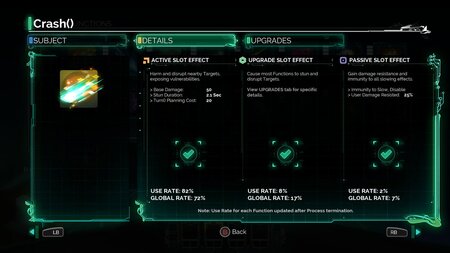
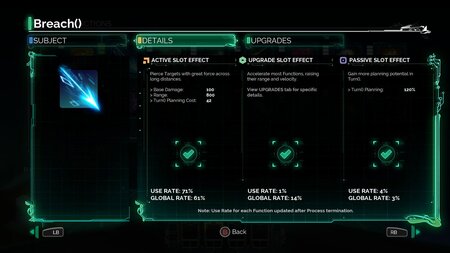
1. Supergiant Games. Transistor. 2014. Crash () Function Screen. 2. Supergiant Games. Transistor. 2014. Breach () Function Screen.