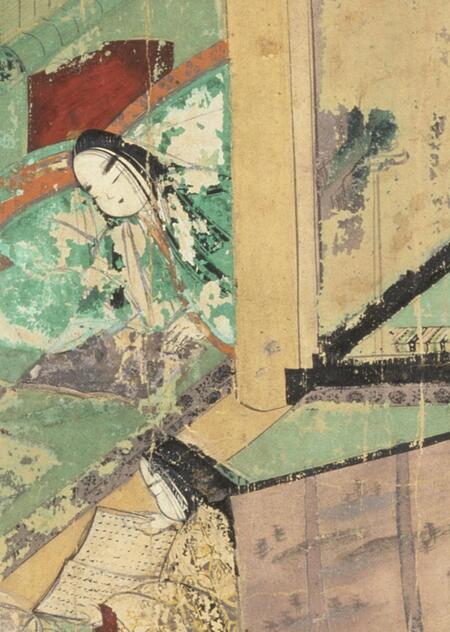
Emakimono (emaki) are horizontal Japanese scrolls featuring images and text, where the narrative unfolds progressively as the work is unrolled. Unlike a single painting, this scroll is designed for sequential viewing: the viewer moves from one scene to the next, effectively «reading» the image. The foundation was paper or silk. The sheets were joined, reinforced with backing, finished with a decorative border, and mounted on wooden rollers [2; 3]. Emakimono depicted literary, historical, and religious themes, and the painted scenes were often accompanied by written descriptions [2].
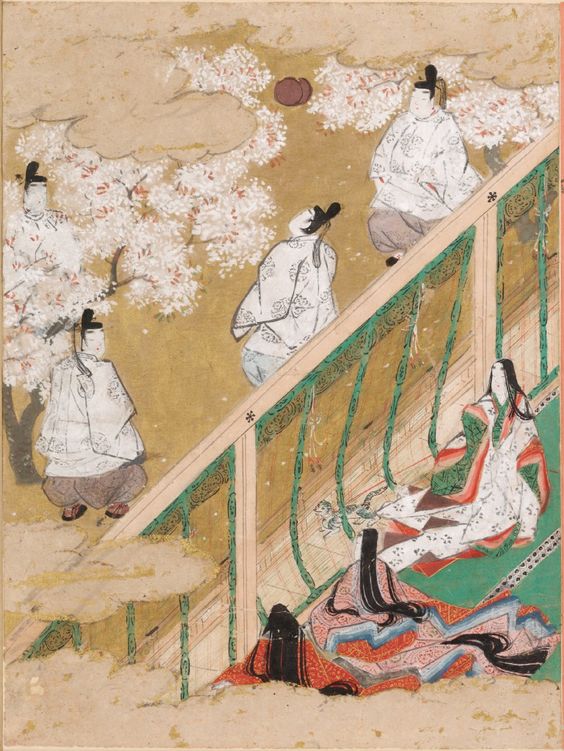
From the novel «The Tale of Genji,» the plot of «Spring Shoots I»
The tradition began to form in Japan around the 7th century, gaining particularly noticeable traction between the 11th and 13th centuries. The height of scrolls was typically about 30 cm, while the length could reach 9–12 meters; individual pieces ranged in height from 20–50 cm and up to 20 meters in length [2; 4]. Larger pieces could consist of multiple scrolls. Typically, emakimono were stored rolled and tied with silk cord. Reading proceeded from right to left: one section of the scroll was opened, while the section already viewed was rolled up simultaneously [2].
In many works, text and imagery alternate such that a written segment corresponds to the adjacent scene [2, 3]. There have also been scrolls where painting played the sole major role. While the format has Chinese origins, it gradually acquired its own distinctive characteristics after being brought to Japan [3].
During the Heian period, emakimono were extensively used to illustrate courtly literature and religious texts. Complex decorative solutions emerged: paper was adorned with images of flowers and birds, gold, and silver, and the text and paintings were integrated into a unified composition. The themes of early Japanese scrolls were related to waka poetry, seasons, court ceremonies, and landscapes. Later, the range of subjects expanded to include military history, folk tales, and Buddhist writings [3].
Emakimono Classification
The thematic diversity of emakimono allows them to be classified by content and artistic form [3]. Broadly speaking, they are divided into secular and religious works.
The following are considered «courtly» genres: • Courtly novels and diaries (monogatari, Nikki) dedicated to love, court life, and historical events; • Folk legends (setsuwa monogatari); • Military tales (kasen); • Works about Waka poets (kasen); • Depictions of rituals and annual ceremonies; • Realistic images and portraits (nise); • Otogi-zoshi—traditional and fantastic tales, especially popular in the 14th century [3].
The religious group comprises: • illustrations for sutras and religious teachings (koten); • illustrated biographies of Buddhist monks and clergy (kosoden, eden); • histories of temple foundations (engi); • joshi—collections of Buddhist stories and anecdotes [3].
Materials and Construction of the Scroll
For emakimono, paper was primarily used, and silk less often. These materials were known in China, but Japanese washi paper distinguished itself with greater density and stiffness due to the unique nature of its fibers [3]. Its production utilized bark from the kozu plant and hemp fibers [4].
For the painting, mineral pigments were used: azurite provided the blue, cinnabar the red, realgar the yellow, and malachite the green. These dense paints, known as iwa-enogu, required a thick binder. Since the work was constantly rolled, the paint was applied thinly and evenly, avoiding impasto strokes that could crack upon folding [3].
After the painting was complete, the base was reinforced with additional layers of paper, stretched, adhered to the support, and dried [3]. Then, a wooden jiku rod and a hyoshi protective cover were attached to the scroll. Cedar or pine was used for the rod; the finished piece was stored in a box or wrapped in fabric [4].
Origin of the Format
The narrative horizontal scroll arrived in Japan from China around the 7th century. By this time, Chinese culture already had extensive experience in creating sequential imagery, and painted scrolls had existed for about two centuries. Initially, this form was closely tied to Buddhist tradition—illustrated works helped recount the lives and deeds of religious mentors [4].
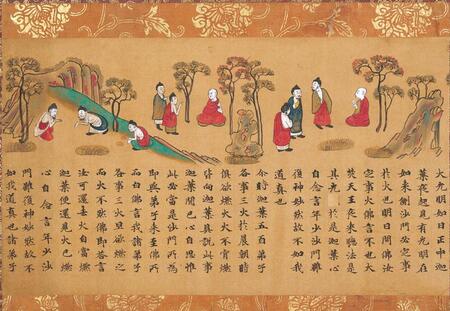
During the Nara and early Heian periods, Japan’s contact with China was particularly intense; consequently, texts and artistic forms traveled alongside Buddhist ideas [4]. One early Japanese example is the «E Ingakyo, ” dating from the Nara period [3; 4]. In this work, the text was placed at the bottom, while the illustrations were above the text [3]. It is hypothesized that this layout was influenced by Tang Dynasty Chinese illustrated sutras. Although the original Chinese prototype has not been preserved, similar manuscripts are known from finds in Dunhuang.
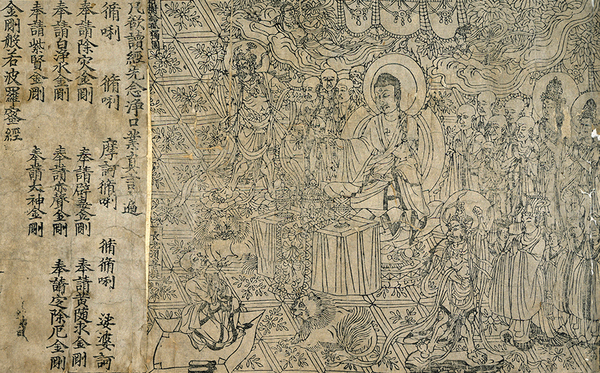
The principle of continuous horizontal narrative was also highly significant. Examples from China traditionally associated with Gu Kaizhi include the «Admonitions of Court Ladies» and the «Nymph of the Luo River.» Similar works may have influenced Japanese masters. However, by the 12th century, Japanese emakimono had developed a distinct character, and during the 10th–12th centuries, it increasingly addressed secular subjects and human life [4].
Development of Style: Yamato-e
Yamato-e became the primary movement associated with Japanese emakimono. This concept was positioned in contrast to Kara-e, a painting style focused on Chinese artistic tradition. Yamato-e developed during the Heian period, when Japanese culture was actively cultivating its own distinct artistic language. This style was particularly evident in illustrations for literary works, including «The Tale of Genji.»
Within the scope of Yamato-e, two styles from the Heian period are distinguished: onna-e («women’s painting») and otoko-e («men’s painting») [3; 4].
Courtly Style Onna-e
Onna-e is connected to the aesthetics of the courtly environment. This style is characterized by refinement, restraint, and attention to inner emotional life. Primarily, it is associated with works of court literature, especially illustrations for The Tale of Genji [3].
Figures in Onna-e typically appear static; their faces deliberately lack strong individual character, and the overall decorative effect is considered more important than external dynamism [4]. Scenes are often organized as discrete episodes. The technique of tsukuri-e—or «constructed painting”—is particularly characteristic of Onna-e [3].
Tsukuri-e Technique
Tsukuri-e is one of the characteristic methods of working in emakimono, particularly associated with onna-e. Initially, the master would draw the outline with ink, then apply dense, opaque paints, and after drying, refine the lines and fine details. The characteristics of the mineral pigments and the binder directly influenced the working technique [3].
As a result, color became a vital element of composition. In the «Gendai Monogatari Emaki,» the overall color scheme of individual scenes helps convey the emotional state of the characters [3].
Otoko-e Folk Style
Otoko-e is characterized by greater line freedom and active dynamism. Military events, historical chronicles, epic, and religious themes are particularly common here. Instead of dense, multi-layered painting, the artist uses a flexible ink line, a calmer palette, and leaves certain areas of the paper untouched [3].
While Heian-e primarily expressed courtly aesthetics, Otoko-e addressed the world of monks, warriors, and common people [4]. In these works, the narrative usually unfolds continuously, and the expressiveness of the line helps convey movement. The «Shigisan Engi Emaki» and «Ban Dainagon Ekotoba» demonstrate this style particularly clearly: the characters appear more lifelike, and humor and burlesque take up a notable place [3].
Realistic Painting of the Kamakura Period
During the Kamakura period, interest in the realistic depiction of reality intensified in emakimono. Artists meticulously portrayed weapons, armor, clothing, and human behavior. Military details are shown with particular care in the Heiji Monogatari Emaki, while the scene of the fire at the gate in the Ban Dainagon Ekotoba depicts over two hundred panicked figures [3].
A special place is held by Nise-e—the portrait genre. Its development is linked to Fujiwara no Takanobu, his son Fujiwara no Nobuzane, and their successors. Simple clothing forms and a drive for the most accurate depiction of the face are characteristic of these images. The collection «Tenno Sekkan Daijin Eizukan» features 131 images of emperors, rulers, ministers, and high-ranking court officials [3].
Composition and Narrative Techniques
Emakimono combines a relatively low height with significant horizontal length. Therefore, the artist must organize a sequence of events in a horizontal direction [4]. The viewer perceives the work gradually, and the physical movement of the scroll becomes an integral part of the narrative itself.
The characteristic technique, the fukinuki-yatai («blown-off roof»), allows the viewer to see the interior space of a building from above. Because of this, the audience simultaneously sees the room and the action taking place within it [4].
Another technique involves depicting the same character multiple times within a single overall scene. This allows for the conveyance of several sequential moments without segmenting the composition into separate frames [4; 5]. Changes in scale, the use of diagonal lines in buildings and landscapes, the direction of figures' movement, and the gradual transformation of space also play a vital role. In the «Shigisan Engi Emaki,» diagonal structures help guide the viewer’s eye from one episode to the next. Diminishing birds are used to create a sense of spatial depth—a technique linked to Chinese painting [5].