Topics
[1] Concept [2] Imperfection and Photographic Truth [3] Between Documentation and Staging [4] The Contemporary Russian Case of Planta Rosa [5] Conclusion
Concept
Fashion photography shapes perceptions of beauty, attractiveness, and the desired lifestyle. However, the expressiveness of fashion imagery is not always tied to external perfection. Everyday settings, awkward poses, harsh light, or unconventional framing can become the basis of a visual solution. Such photographs retain a connection to the world of fashion while simultaneously evoking personal archives.
The aesthetics of imperfection unify various ways of deviating from the assumed norm of the ideal image. This manifests in the handling of light and color, composition, gestures, facial expressions, and the selection of space. Here, the concept of imperfection refers to the manner in which people and objects are presented. Individual physical traits are not examined merely as flaws; rather, what matters is which viewer expectations the photograph disrupts.
The central research question is how visible imperfection creates a sense of closeness and authenticity in fashion photography. The hypothesis is that this effect arises from details that maintain the impression of a specific situation—such as traces of daily use in a space, an unfinished gesture, or the interaction between body and clothing. Meanwhile, the sense of chance can also be the result of deliberate staging and careful selection. The primary material consists of photographs from the 1990s and subsequent decades. The work of Nan Goldin and Corinne Day illuminates the significance of intimacy and everyday environments. Jürgen Teller’s photographs take center stage, allowing for a comparison of bodily specificity, awkwardness, and humor across personal projects, magazine shoots, and advertising. The works of Cindy Sherman, Wolfgang Tillmans, and Mark Bortwick expand this comparison, showcasing different relationships between staging and the feeling of ease.
The study is divided into three sections. The first is dedicated to the relationship between imperfection and the concept of photographic truth. The second examines specific series and methods of image construction. The third section focuses on the photographs of Slava Porozhny for Planta Rosa. This example allows us to trace the use of the aesthetics of imperfection in contemporary Russian fashion branding and raises the question of the boundary between authorial observation and reproducible stylization.
The research methodology is based on comparing individual shots and sequences, taking into account their intended purpose and publishing context. The analysis covers space, light, composition, character behavior, and the role of clothing. Documental circumstances of the shoot are separated from the visual indicators of authenticity. Sources include museum collections, personal archives, interviews, and published materials. The theoretical framework is built upon the works of Siegfried Kracauer, Charlotte Cotton, and Jonathan Schroeder’s study on applying the aesthetics of the instantaneous photograph to brand communication. [1–3]
[1] Imperfection and Photographic Truth
Why a Random Photo is Easily Believable
In this photograph of children by the sea, taken by an unknown author around 1890, the figures are distributed unevenly within the circular frame. The front girl draws more attention than the others, and the space continues beyond the edge of the image. The print is associated with early Kodak amateur practice. Its everyday subject matter and the discordance of the gestures can be read as indicators of an event that exists independently of the photographer. Yet, one image is insufficient to determine whether the author asked the children to stop.
Unknown photographer. Children paddling in the sea. Circa 1890
It is this very capacity to complete the narrative that makes amateur photography vital for further discussions on fashion. The viewer mentally places the subject into a space where something was happening before and after the shot. As a result, the clothing, facial expression, and surrounding objects are perceived as parts of a single moment. This connection can be preserved even in meticulously staged photography, provided the photographer does not eliminate all traces of the everyday environment.
Visibility of Events and Photography Composition
«Self-Portrait as a Drowned Man» by Ippolyt Bayar from 1840 illustrates how early photography began merging verisimilitude with fiction. The artist depicts his own death, an event that never occurred. Conversely, in Harold Edgerton’s «Milk Crown» from 1957, a real physical event takes place, but it is inaccessible to the naked eye in that form—its visibility is enabled by the technical apparatus of the capture. Neither the external plausibility nor the unfamiliarity of the image itself determines its relationship to fact.
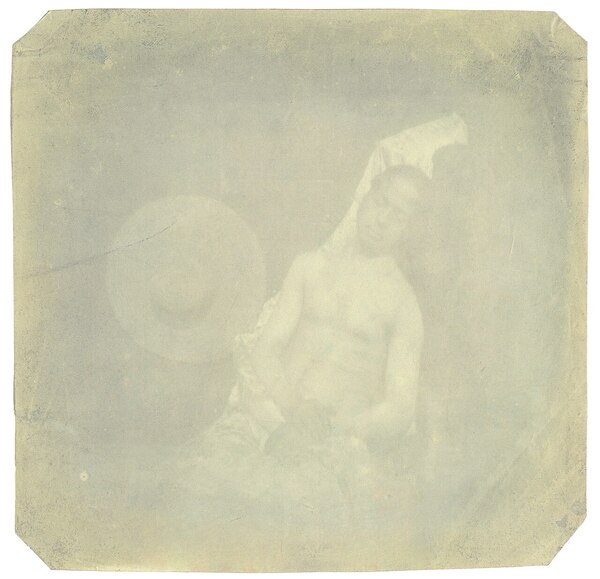
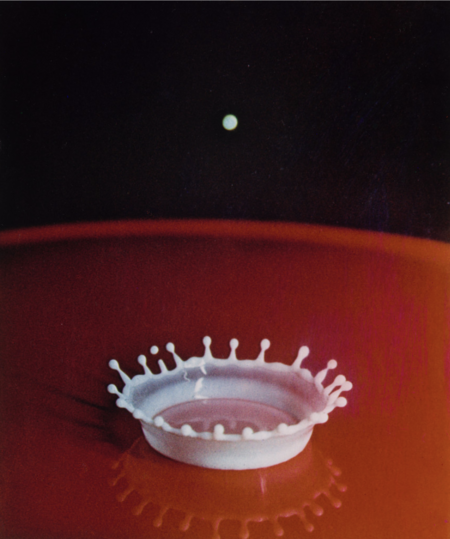
Ippolit Baiyar. Le Noyé / Self-Portrait as a Drowned Man. 1840 / Harold Edgerton. Milk Drop Coronet. 1957
In the first chapter, «The Nature of Film, ” Krauss examines the realistic and formalistic tendencies of photography. For this study, such a distinction is important as a way to see both the connection of the image to the physical world and the author’s involvement in organizing it. Fashion photography especially clearly reveals this combination: the camera captures real bodies and objects within a situation that may have been specially prepared. [2]
The sense of authenticity emerges when viewing a photograph. The conditions of its creation require separate documentation.
Therefore, going forward, I am examining not only what seems «natural» but also the mechanisms by which that impression is created. A visible flash, crumpled textile, or unsteady posture allow one to describe an image. Assertions about shooting without retouching, without a crew, or without staging begin to relate to the production of photography. For those, interviews, working materials, or authorial commentary are necessary.
[2] Between Documentation and Concept Development
Nan Goldin and the Space of Intimacy
Nan Goldin. Nan and Brian in Bed, New York City. 1983
In Nan Goldin’s photograph, «Nan and Brian in Bed, New York» (1983), the tension is created by the distance between the two people and the misalignment of their gazes. The warm tones of the room, the bed, and the tight framing lend a sense of intimacy. Here, the domestic setting participates in the depiction of the relationship; it does not serve as a neutral backdrop that could be replaced without loss by a studio set. This shot belongs to Goldin’s personal archive and is not an advertisement for clothing.
Matsuda. Naked New York. Autumn–Winter 1996
Matsuda’s 1996 publication, «Naked New York,» demonstrates that Goldin also worked within the context of fashion. The International Library of Fashion Research connects the book to her photographs for this project and lists participants, which include David Armstrong and designer Hideki Nakajima. Therefore, the cover and spread here should be viewed as the result of a collaborative publishing project. The proximity to Goldin’s personal photograph prompts a question regarding the transposition of authorial voice while maintaining the distinction between the purposes of the images.
This possibility of transposition is linked to the viewer’s interest not only in the object’s form but also in the way of life surrounding it. The room, gesture, and relationships between people expand the content of the fashion image. The MoMA exhibition «Fashioning Fiction in Photography since 1990» specifically examined the use of snapshot aesthetics in commissioned photography and the mutual influence of artistic and commercial practices. Consequently, their intersection is already part of the history of the fashion image. [4]
Corinne Day and the Banality of the Fashion Body
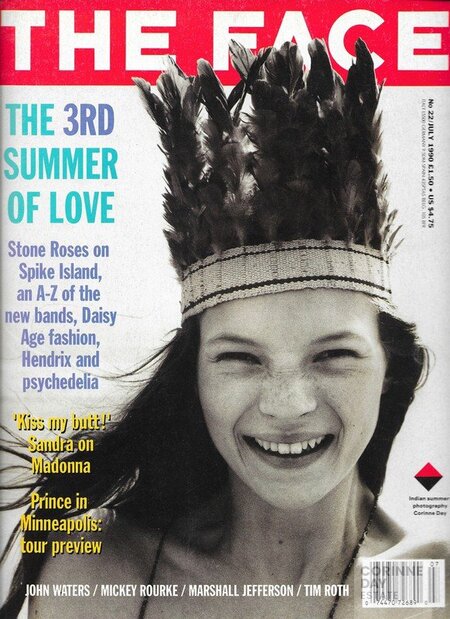
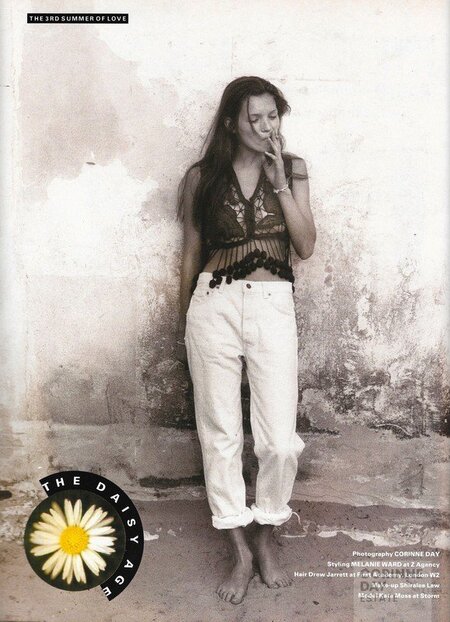
Corinne Day. 3rd Summer of Love. The Face. 1990
In Corinne Day’s 1990 series «3rd Summer of Love» for The Face, Kate Moss is depicted in various states: she is smiling on the cover, while on another magazine page she stands barefoot by a worn wall. A transition occurs between these images—from an expressive close-up to a commonplace spatial setting. The disheveled hair, loose clothing, and lack of a formal pose create the impression that the subject has not yet fully transformed into the magazine archetype.
The image by the wall is particularly striking: the body’s weight is shifted onto one leg, the hands are occupied with a subtle gesture, and the gaze is directed to the side. The wall retains its spots and irregularities, so the model is not isolated from the environment. These details allow the scene to be read as a moment of waiting. Concurrently, the magazine layout reminds us that this is already selected and published material. A sense of ease emerges within a very defined media presentation.
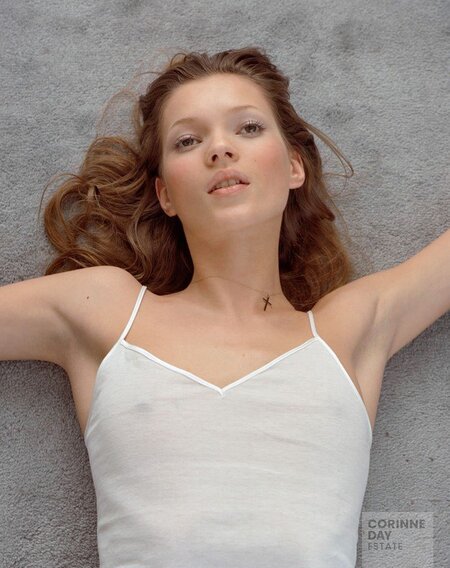
In «Underexposed,» published in British Vogue in June 1993, Day photographs Moss in her West London apartment—a detail confirmed by the author’s archives. The chosen frames feature a dresser, a bed, a blanket, and the room’s confined space. In one photograph, the subject stands with her back to the camera; in another, she is wrapped in a blanket. Objects of domestic life become part of the same image that features lingerie.Corinne Day. Underexposed. British Vogue. June 1993
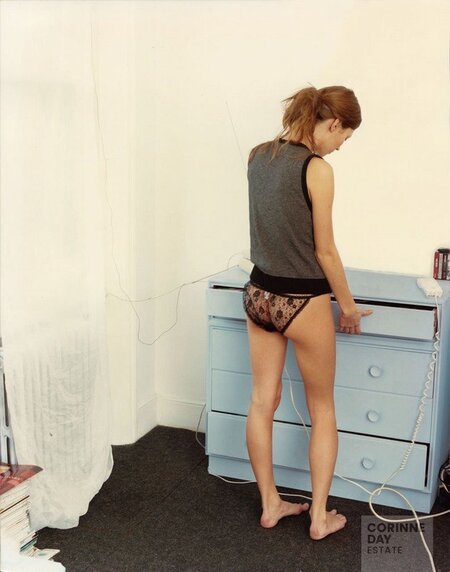
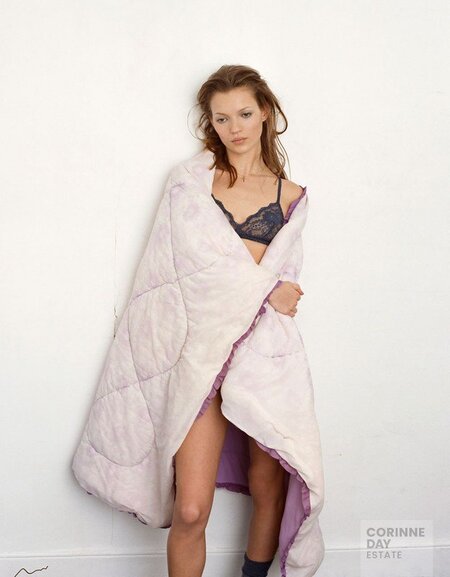
Corinne Day. Underexposed. British Vogue. June 1993
Juxtaposing three frames reveals how the mundane is held within the series. The setting does not morph into an idealized backdrop, nor is the body’s posture reduced to showcasing a single flattering angle. The blanket partially conceals the figure while simultaneously lending it weight and volume. The clothing interacts with gestures and the room’s objects. Under this reading, the human presence within a specific situation becomes paramount, rather than an isolated presentation of the garment.
The everyday detail becomes expressive when it alters the relationship between a person, an object, and space.







