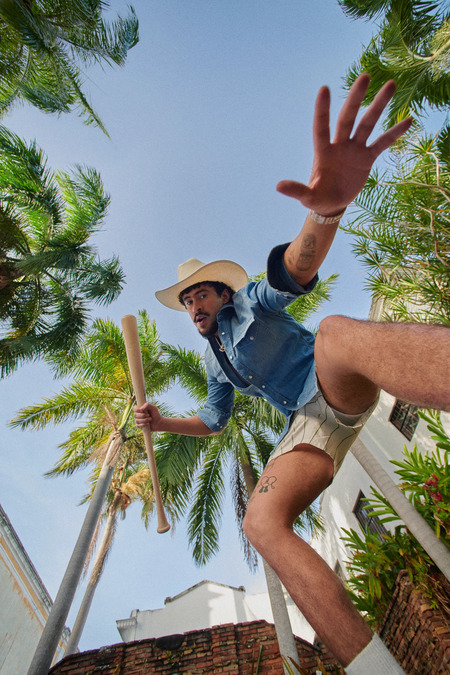
«I should have taken more photos of when I had you»
«I should have taken more pictures when you were around»
Sometimes a single photograph can transport you back to a moment you thought you’d almost forgotten. A familiar courtyard, old chairs, music drifting from a neighboring house. For Bad Bunny, all of this isn’t just memory—it’s pieces of his native Puerto Rico. Through his music, music videos, and persona, he strives to preserve what time might otherwise erase.
Navigator
1. Research Concept
2. Creating Bad Bunny
3. Off-Stage Identity
4. The Island as Protagonist
5. The Aesthetics of Absence
6. Politics of Memory
7. Visual Nostalgia
8. The Album as Brand
9. Architecture of Memory
10. Puerto Rico on the Global Stage
11. Conclusion
Concept
Today, musical artists create not just songs and albums, but entire worlds complete with characters, narratives, and recognizable aesthetics. Album covers, music videos, stage costumes, photographs, and concerts all become part of one large concept. Through these elements, artists can tell their story, convey mood, and even raise social and political issues. One of the most fascinating examples of this approach for me has been the Puerto Rican artist Bad Bunny.
Over his career, Bad Bunny has undergone a noticeable evolution. His early work was dominated by bright colors, unconventional costumes, fantastical characters, and computer graphics. He actively experimented with his image, dismantling conventional ideas about the male stage persona, and captured attention with unexpected artistic decisions. Over time, the culture of his native Puerto Rico began to occupy more space in his work. Instead of imaginary worlds, real streets, homes, natural landscapes, local traditions, and the stories of ordinary people have come to the forefront.
This transition is especially evident in the album DeBÍ TiRAR MáS FOToS, released in 2025. Its title translates to «I Should Have Taken More Photos, ” and the theme of memory forms the basis of the entire concept. The cover features two ordinary white plastic chairs amidst tropical greenery—no elaborate sets, no fantastical characters, and not even the artist himself. Yet, the photograph conveys the feeling of a familiar place where people once gathered, talked, and spent time together.But the album is not dedicated solely to personal nostalgia. Through his music and artistic imagery, Bad Bunny addresses the history of Puerto Rico, issues of gentrification, migration, and the shifting of familiar cultural landscapes. For example, in the short film accompanying the album, an elderly man recalls his youth and observes how much the world around him has changed. Furthermore, the historical music visualizers, which use archival photographs and texts, introduce viewers to the island’s past events. Thus, personal memories become intertwined with the history of an entire people.
In my research, I aim to trace the evolution of the Bad Bunny persona from the start of his career up to 2026. I will first examine his early album covers and music videos, then transition to his stage style, fashion experiments, and the emergence of Puerto Rican motifs. The main body of the work will be dedicated to the DeBÍ TiRAR MáS FOToS era—examining the album design, photography, short film, music videos, and promotional materials. Finally, I will analyze how the album’s concepts are realized in his concert staging, his residencies in Puerto Rico, and his performance at the Super Bowl in 2026.
I will pay particular attention to the artistic techniques used to evoke a specific impression: composition, lighting, color, typography, costumes, and spatial design. I am interested in understanding why ordinary everyday objects can evoke strong emotions, how the atmosphere of memory is constructed, and how national symbols become integrated into contemporary pop culture. I also plan to compare the artist’s early and late projects to see which choices he maintains and which he gradually discards.
For my research, I will use music video clips, album covers, concert photographs, interviews with Bad Bunny, and materials from the people who have worked with him. I will also delve into the history and culture of Puerto Rico to better understand the origins and deeper meaning behind various imagery. I am interested not simply in examining beautiful visuals, but in dissecting why the artist chooses specific colors, costumes, locations, and objects, and how all of this contributes to narrating his story.The central question of my research is: How has Bad Bunny transitioned from a vibrant and unconventional stage persona to a creative output centered on his home island and its culture? I hypothesize that over time, the artist has begun to speak less about himself and more about the place he comes from. This is particularly evident in DeBÍ TiRAR MáS FOToS, where ordinary photographs, homes, and familiar childhood objects become more significant than elaborate sets. I want to demonstrate how nostalgia and simple, everyday imagery can be used to discuss profound themes: memory, loved ones, homeland, and the fear of losing it all.
Creating Bad Bunny: From Stage Persona to Visual Brand
Bad Bunny’s visual identity has been constructed since the very beginning of his career through a combination of shock value, experimentation, and a rejection of the conventional reggaeton artist persona. Vivid colors, unusual accessories, surreal imagery, and unconventional costumes helped the artist create a recognizable character that exists not only in his music but also in graphic design, fashion, and public space.
Between 2018 and 2023, his visual language underwent numerous shifts: from psychedelic graphics and fantastic characters to nostalgic childhood imagery and a more restrained aesthetic. These changes allow us to trace how the Bad Bunny brand gradually formed and which artistic techniques were later developed during the DeBÍ TiRAR MáS FOToS era.
Fraser Harrison. Bad Bunny at the American Music Awards. October 9, 2018. Photo: Getty Images.
One of the first recognizable elements of Bad Bunny’s external image is the third eye, which the artist began using during public appearances in 2018.
The artificial eye on his forehead, narrow red glasses, a brightly patterned shirt, and shaved designs in his hair create an image built on visual excess. It blends elements of street fashion, surrealism, and the grotesque.
The third eye transforms the human face into a fantastical image and becomes an independent symbol that can be replicated in graphics, illustrations, and stage design.
This example illustrates how Bad Bunny began to form his own visual language through recurring symbols, rather than solely through clothing and appearance.
Sergio Vasquez. Poster for Bad Bunny’s concert in San Juan. Created in 2018–2019 for the March 2019 concert.
Puerto Rican illustrator Sergio Vasquez played a significant role in shaping Bad Bunny’s early visual identity. For the concert poster in San Juan, he utilized psychedelic graphics, intricate interlocking forms, and the motif of the third eye.
The composition is built upon a sense of continuous motion. Decorative elements surround the artist’s figure, creating a densely graphic space with virtually no empty areas.
This approach recalls the aesthetic of underground comics and concert posters, where expressiveness is achieved through the exaggeration of forms and a high density of detail.
The significance of this work is that a singular graphic motif transcends the boundaries of the poster to become part of the musician’s public persona. Thus, the illustration begins to directly influence the formation of his stage character.
Sergio Vasquez. Album cover for Bad Bunny’s «X 100PRE.» 2018.
The cover of the debut album X 100PRE develops the motif of the third eye, transforming it into the central element of the graphic composition.
The image is almost entirely built on the contrast of black and white. Numerous drawn details form a complex surface, in the center of which a vibrant eye stands out. Its colored iris becomes the main point of visual attraction.
The absence of the artist’s portrait allows the cover to function as a standalone artistic image. Instead of a traditional photo of the artist, the viewer is presented with a symbol that evokes associations with fantasy, altered perception, and surrealism.
This approach demonstrates that even at an early stage, Bad Bunny used album art not merely as decoration for the music, but as a means to create a recognizable visual identity.
Piink Studio / Paranoiia Productions. Album cover for «YHLQMDLG.» 2020. Creative Director: NAVS. Photography: Stillz and NAVS.
On the cover of YHLQMDLG, a boy on a bicycle is centrally featured against a backdrop of a fantastical cityscape.
The composition is built using a low camera angle and pronounced perspective. The child’s figure approaches the viewer, while the surrounding environment is filled with unusual details: cars, fire, electrical wires, and a rich blue sky.
Unlike the abstract graphics of X 100PRE, this piece presents a concrete character and a space reminiscent of childhood memories transformed by imagination. The everyday urban environment merges with fantastical elements.
This example is particularly important for research as it showcases Bad Bunny’s early engagement with nostalgia.
Cliqua and Stillz. A frame from Bad Bunny’s music video «La Difícil.» 2020.
In Bad Bunny’s music video «La Difícil,» he references the pop culture aesthetic of the late 1990s and early 2000s. The blue tracksuit, light hair, narrow glasses, and monochromatic space of the studio set all evoke the visual language of music television from that era. The rounded interior shapes, artificial lighting, and wide-angle optics create a feeling of stylized television reality. A key technique is the juxtaposition of a nostalgic image with contemporary self-irony. The artist is not merely reproducing past fashion trends; instead, he exaggerates their characteristic elements, turning his own appearance into part of an artistic staging. This example shows that Bad Bunny’s engagement with the past existed long before «DeBÍ TiRAR MáS FOToS.» However, here the nostalgia is primarily directed toward the aesthetic of mass culture rather than the preservation of historical memory.
Bad Bunny. Cover art for the album «El Último Tour del Mundo.» 2020.
The cover for «El Último Tour del Mundo» presents a cinematic composition, centered on a massive truck set against a red sunset sky.
The low viewing angle emphasizes the vehicle’s scale, while the symmetrical arrangement of its elements creates a sense of monumentality. The contrast between the warm sky, the cool metallic body, and the artificial lighting intensifies the dramatic character of the image.
The artist’s figure is almost lost against the backdrop of the truck. Instead of a large portrait, the entire scene is used here, suggesting the existence of a fictional world beyond the cover.
Unlike «X 100PRE,» where a distinct symbol formed the foundation of the visual identity, here it is shaped through space, atmosphere, and narrative. This principle will be further developed in Bad Bunny’s later projects.
Adrian Hernandez (Ugly Primo). Album cover for Bad Bunny’s «Un Verano Sin Ti.» 2022.
In the album «Un Verano Sin Ti, ” Bad Bunny’s visual language undergoes a noticeable shift. Dark, fantastical compositions give way to vibrant illustration featuring a tropical landscape and an anthropomorphic heart.
The image is built on a combination of saturated reds, pinks, yellows, and greens. Simplified forms, grainy textures, and an intentionally naive drawing style evoke the feeling of a childhood memory of summer vacation.
The central character—a red heart with one eye—appears simultaneously amusing and melancholic. The contrast between its expression and the carefree landscape conveys mixed feelings of joy and nostalgia for the past.
The depiction of tropical nature becomes particularly significant. Palms, the sea, and the sunset transform into recognizable symbols of the Caribbean region. Moving forward, Bad Bunny will transition from a conceptual illustrated island to a more concrete and documentary portrayal of Puerto Rico.
Bad Bunny. Album cover for «Nadie Sabe Lo Que Va a Pasar Mañana.» 2023
The cover for «Nadie Sabe Lo Que Va a Pasar Mañana» demonstrates a shift toward a more restrained and minimalist visual language.Against a light, solid background, a rider on a horse is depicted. The illustration is rendered with loose, uneven strokes, and the handwritten typography enhances a feeling of immediacy and incompleteness.Compared to previous albums, the composition contains significantly fewer details. The abundance of negative space focuses attention on the single image, which takes on a symbolic quality.The image of the rider can be interpreted as a metaphor for independence and movement. Furthermore, the departure from photography and the use of a stylized character continue Bad Bunny’s characteristic tradition of building a visual identity through artistic imagery.The minimalism of this cover becomes an important stage before «DeBÍ TiRAR MáS FOToS, ” where ordinary objects and space finally take center stage.
During the period from 2018 to 2023, Bad Bunny’s visual identity went through several stages of development. Psychedelic graphics and sensational stage personas were gradually complemented by cinematic compositions, nostalgic illustrations, and more restrained artistic solutions.
Despite the differences between releases, common principles run through them: the use of symbolic characters, a departure from the traditional artist portrait, experiments with visual styles, and a drive to create an independent artistic world around each album.
Of particular significance is the gradual strengthening of the role of space and memory. If early visual projects focused predominantly on shaping a recognizable Bad Bunny image, the motifs of tropical landscape and nostalgia appear in «Un Verano Sin Ti, ” which later become central to the aesthetic of „DeBÍ TiRAR MáS FOToS.“
Identity Beyond the Stage: Fashion, Photography, and the Public Image
Bad Bunny’s visual brand is shaped not only by his musical releases but also by his appearance, photoshoots, public appearances, and social media presence. Unlike a static stage persona, the artist regularly shifts his clothing style and methods of self-presentation while maintaining recognizability.
A key characteristic of his image is the blending of menswear and womenswear, incorporating elements of high fashion, street culture, and national symbolism. Gradually, his clothing transcends being merely a means of attracting attention and increasingly becomes a medium for expressing personal and societal ideas.
This transformation is particularly evident when comparing his early, experimental looks with his public appearances in 2025, where traditional elements of Puerto Rican culture become integrated into the international fashion landscape.







