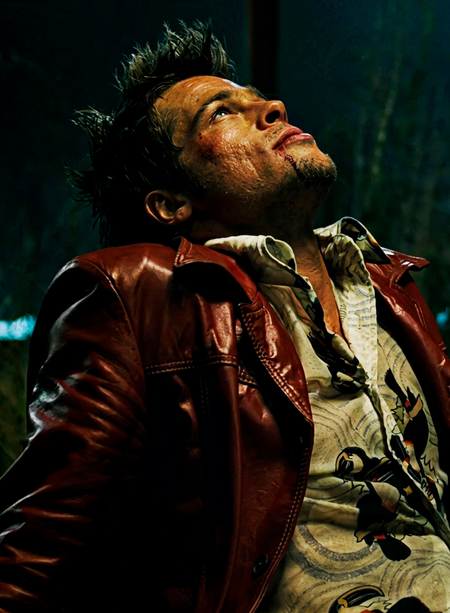
Our philosophy of aesthetics began with what seems like a simple question: what is beauty, what is this beautiful thing? In the process of reflection, we drew upon nature, art, taste, and emotion. Initially, it seems like this topic is about harmony, contemplating tranquility, and tenderness, but Kant, at the close of the 18th century, stated that the question has two sides.
The theme touches upon a peculiar sense of awe—a trembling before something unattainable, something enigmatic or even frightening. It is that special feeling when your heart starts to beat faster and you breathe heavily while gazing into an unfathomable depth or at a natural element that cannot be controlled.
Kant referred to this experience as the sublime and decided to separate it from the beautiful. How can this feeling be compared to the sensations derived from a beautiful flower or a work of art?
Cinema offers the most intuitive medium for exploring this theme through imagery. Directors give visible form to what is invisible and abstract. In my opinion, the most striking film that embodies my topic is David Fincher’s Fight Club (1999)—a movie that has sparked debate for decades while deliberately engaging with ideas of beauty, the body, objects, and meaning. The film reveals the contrast between beauty as harmony and polish and harmony through explicit chaos and ugliness.
In this visual study, «Fight Club» is examined through the prism of Immanuel Kant’s aesthetics, one of the principal philosophers of beauty. His Critique of Judgment (1790) provided the language that philosophy still uses to discuss taste—the boundary between the beautiful and the sublime, disinterested pleasure, and the role of genius.
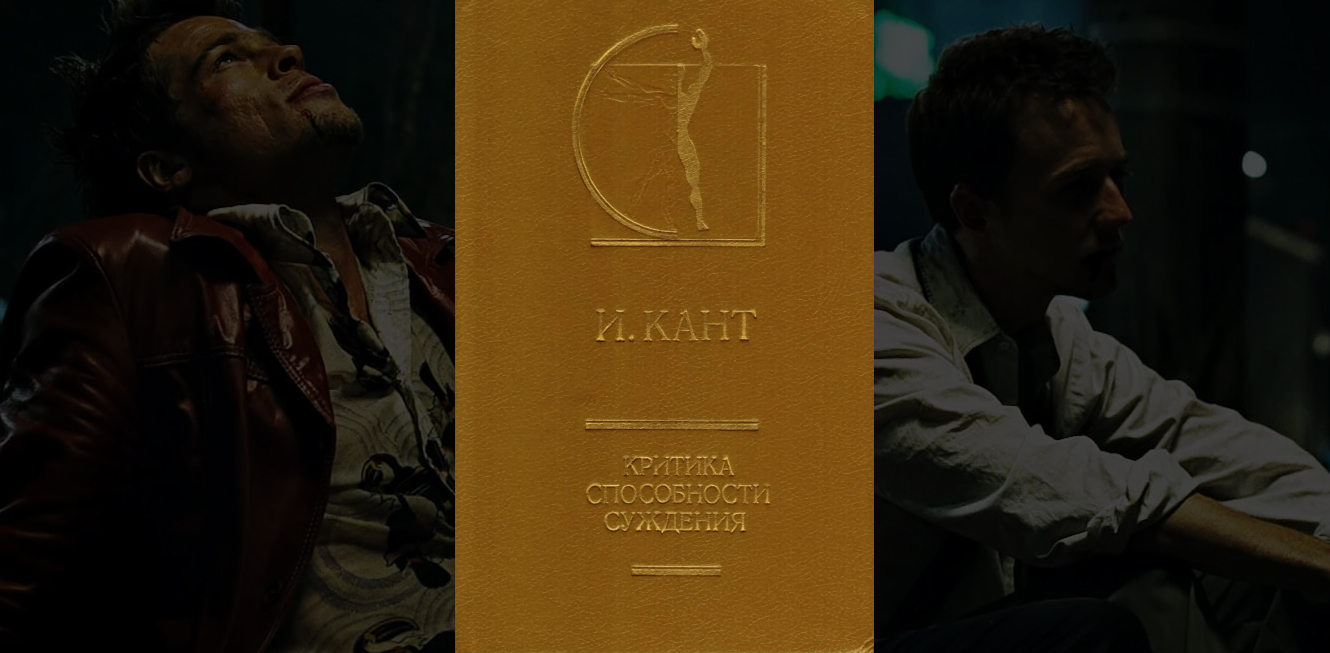
Goal
Show how the film organically conveys Kant’s categories of the beautiful and the sublime, and how the narrative conflict embodies a specific conflict of aesthetics—the aesthetics of order versus the aesthetics of destruction. The characters bring to the screen the very debate that Kant waged in philosophical discourse.
Posing the Question
Kant distinguished between two types of aesthetic judgments of taste: the beautiful is related to the form of an object and its harmony, while the sublime relates more to boundlessness and that which surpasses the capacity of our perception. The beautiful belongs to the finite, something commensurate with human experience, whereas the sublime unfolds where human measure proves insufficient. «Fight Club,» consciously or intuitively, constructs both of these lines and drives them into open confrontation.
The research task is to trace how these two aesthetics coexist in the frame, how the director visually unifies them, and how Kant’s philosophical theory explains the strangeness that both elicit genuine pleasure from the viewer.
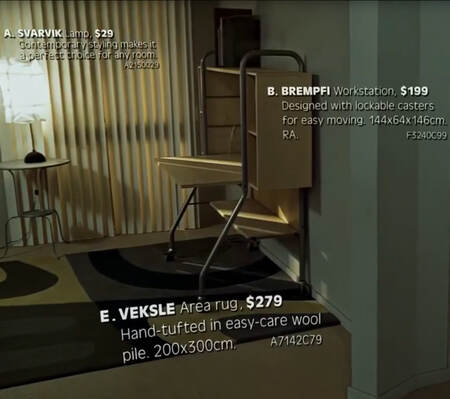
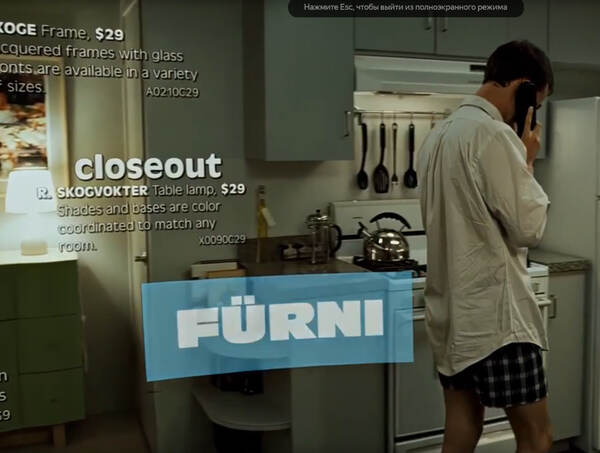
In the film, two worlds collide. One represents the sterile world of consumption: an IKEA catalog, a pristine apartment, «individuality through things,» the insomnia and longing of the office worker. The other reveals itself as the grimy, chaotic underground world of Tyler Durden: ruins, scars, violence, destruction, and the rejection of possessions. The first is the territory of the beautiful; the second is the territory of the sublime.
The director presents this visually beautiful world as stark: cool, light tones, symmetrical composition, and the flat, sterile light of the office and apartment. The clinical sheen of the interior is a deliberate technique—Fincher presents beauty as a lifeless form. There is no room for play in Jack’s world. The perfect form turns out to be a form devoid of life: it leaves no room for freedom and slowly suffocates. Jack’s voiceover remarks about insomnia, where the world is too «perfect» and resembles a prison, are particularly telling.

Film stills
Jack shows us his interior and ironically remarks, «I am a little spinning side table.» Here, Kant’s concept of «purposefulness without purpose» is turned inside out. Objects created as household items cease to serve any real function and transform into pure status symbols—into identity itself… The person (Jack) constructs himself from a catalog and measures himself with furniture. The beautiful, detached from life, and made into a convention ceases to be an experience and becomes a duty of consumption.
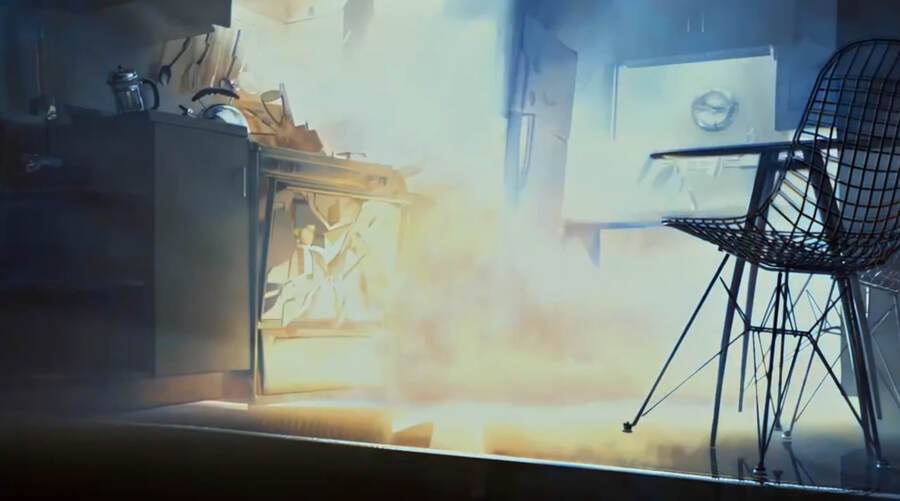
Film stills
Subject justification form without presentation of any specific goal
The object appears as if it were created for a specific purpose, yet it is not presented to us as a practical function. This is why beautiful «pleases everyone» and is not reducible to utility: beautiful things are uncomfortable to use as tools—they can only be admired. From this arises Kant’s thesis of disinterestedness: the judgment of taste is not concerned with the existence of the object, but only with the form of its presentation. The beautiful serves as a free play between imagination and reason.
Sublime
If the beautiful rests on boundaries, the sublime begins where those boundaries shatter. Kant distinguishes between two types of the sublime: the mathematical and the dynamic.
We can also define the sublime from this perspective—that is, through its vastness—as mathematically sublime, and from the perspective of its power in nature—as dynamically sublime.
Mathematics relates to magnitude, to the sensation of infinity and a scale that surpasses the capacity of imagination; the dynamic relates to the might of nature, to the force before which the body is powerless. Both of these poles are vital for understanding the film.
We call sublime that which is unequivocally great (without comparison).
The depiction of a catastrophe presented as an aesthetic spectacle. The viewer experiences a «negative pleasure, ” which Kant describes in relation to the sublime: a momentary halt of life forces followed by an outburst. Fear and exhilaration converge. Here, the sublime presents itself in both Kantian designations simultaneously: the colossal scale of the collapsing towers overwhelms by number (the mathematical), while the explosion and the ruin of the sky demonstrate a power before which the human body is helpless (the dynamic).
Final film shot
The sublime in the film is not limited to the finale. The ruins of the house on Bumazhnaya Street, the chaotic basement space, the broken possessions, the daily life of Tyler in the house slated for demolition.
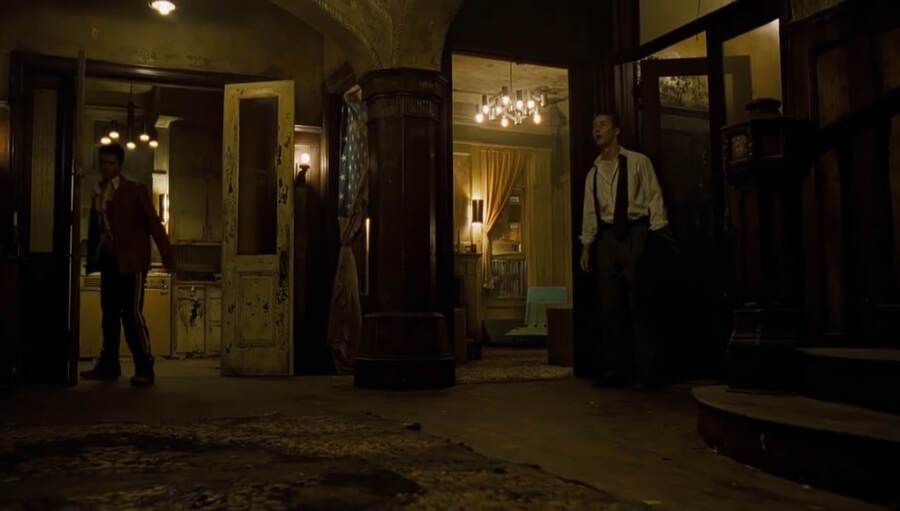
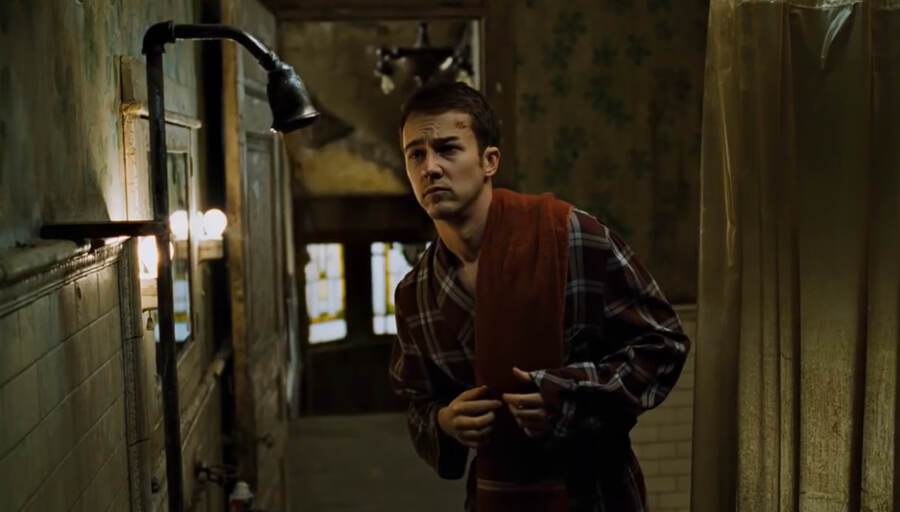
Film stills
These are images that have broken free from the constraints of order. The collapse of skyscrapers in the opening sequence, the destruction of offices and shops, the actions of the «RAZGM» project. Each such event propels the characters into a territory where the familiar harmony of the world crumbles, giving way to a frightening yet captivating infinity.
It is important to note that the Sublime, according to Kant, is not an inherent property of the destroyed objects themselves, but rather a reaction of our soul.
Therefore, the basement and ruins are not mere set dressing—they are spaces where the characters relearn how to feel: the fear of destruction transforms into an awe before power, which is precisely the Kantian mechanism of the Sublime.