Navigation
- Concept
- The Birth of Vogue
- Modern Aesthetics
- Vogue Artists
- From Modern to Art Deco
- The Evolution of Graphic Design
- Conclusion
1. Concept
Vogue magazine, throughout its history, has reflected not only shifts in fashion but also the prevailing artistic tastes of its era. Its covers have served as a space for experimentation in illustration, color, composition, and typography.This study covers the period from 1892 to 1939 and is dedicated to the transition from the decorative aesthetic of Art Nouveau to the geometric and expressive solutions of Art Deco. Using the covers and the work of Vogue artists as examples, it examines how the magazine’s graphic language evolved under the influence of art, culture, and new conceptions of female beauty.The central idea of the research is to demonstrate how the visual design of Vogue allows one to trace the evolution of artistic movements and the development of editorial graphic design.
2. The Birth of Vogue
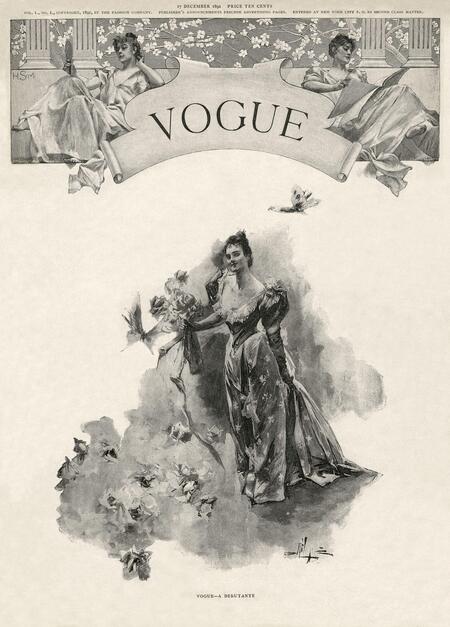
Vogue began on December 17, 1892, in New York. It was founded by Arthur Baldwin Turnure. Initially, the magazine was published weekly and covered the lives of high society: fashion, theater, literature, art, and social events.
In the late nineteenth century, illustrated magazines shaped public taste. Vogue reflected the lifestyle of an affluent audience for whom fashion was not only a means of self-expression but also an indicator of social standing.
The first cover of Vogue features a young woman in an elegant gown, surrounded by floral motifs. Her image reflects the culture of social debuts and the atmosphere of high society.
The decorative border unites the illustration with the magazine’s title, creating a composition characteristic of late nineteenth-century graphic arts.
First covers and design features
In the 1890s, Vogue had not yet established a cohesive graphic style. The covers were primarily based on illustrations depicting fashion and scenes of high society. Through costumes, poses, and settings, artists conveyed notions of elegance and good taste.
Typography also evolved; the Vogue masthead utilized various decorative fonts and gradually became an integrated element of the overall cover composition.
1. 1893 — Vogue. «Two Ladies on a Stroll» 2. 1894 — Vogue. «Encounter in the Winter Forest» 3. 1895 — Vogue. «Woman with a Fan»
The comparison of early Vogue covers is built upon three elements: the placement of the title, the character of the illustration, and negative space. They demonstrate how the magazine’s visual style gradually evolved.
The Vogue cover was not merely an image of fashion, but also a reflection of the high society culture of its time.
In the late 19th century, illustrated magazines disseminated artistic imagery and fashion trends. For early Vogue, the image of the elegant woman was central—an image that reflected not only fashion but also social traditions.At the turn of the century, elements of Art Nouveau began appearing in the magazine’s design: fluid lines, ornamental motifs, and decorative compositions. Despite this, traditional methods of magazine illustration were maintained.
1. 1893 — Vogue. «Two Ladies on a Stroll» 2. 1894 — Vogue. «Encounter in a Winter Forest» 3. 1895 — Vogue. «Woman with a Fan»
Comparing covers allows us to identify similarities and differences in artistic styles through composition, line quality, typography, and the interaction of decorative elements with the image.
In 1909, Condé Montrose Nast acquired Vogue, gradually transforming the society magazine into a fashion-focused publication. The magazine increased its frequency to twice a month, and cover design became more sophisticated.
During the 1910s and 1920s, Vogue began actively collaborating with illustrator artists. Expressive silhouettes, bold colors, and new compositional techniques defined the magazine’s artistic identity.
1. 1905 — Vogue. «Two Women in Hats» 2. 1909 — Vogue. «Dress Specialties & Textiles, ” March 18 3. 1910 — Vogue. „Lady with a Red Umbrella“
A comparison of the covers before and after 1909 reveals a gradual evolution in Vogue’s visual style: traditional illustration merged with more contemporary graphic solutions. Early magazine illustrations and decorative graphics from Vogue laid the foundation for the publication’s ongoing visual evolution—from Art Nouveau to Art Deco.
3. Modern Aesthetics
At the turn of the 19th and 20th centuries, Art Nouveau spread throughout graphic design, characterized by fluid lines, organic ornamentation, and decorative silhouettes. Artists strove to unify illustration, typography, and page layout into a single composition.
In Vogue, the influence of Art Nouveau emerged gradually. The cover evolved into a standalone piece of art, where the arrangement of figures, color, and the interplay between the illustration and the magazine’s title played a vital role.
1902 — Vogue. «Winter Fashions, ” November 6. Artist Ethel Wright.
In early Vogue covers, illustration and typography complemented each other: the drawing depicted a female figure or a social scene, while the magazine’s title was placed at the top of the composition. A flowing line—a hallmark of Art Nouveau—accentuated the curves of the female form, fabrics, and botanical motifs, unifying the image into a single composition. The ornamentation served not only as decoration but also as a method for organizing space.
From illustration to independent artistic composition.
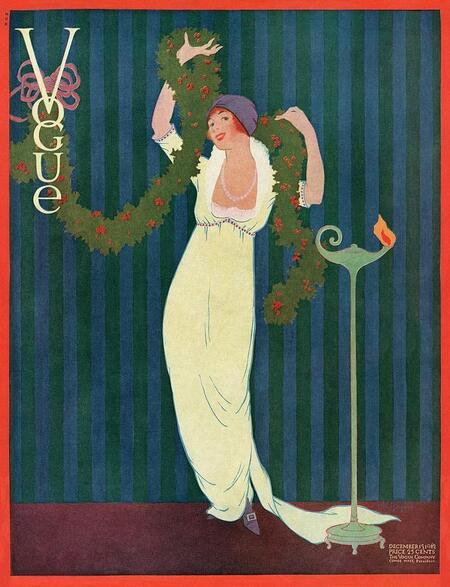
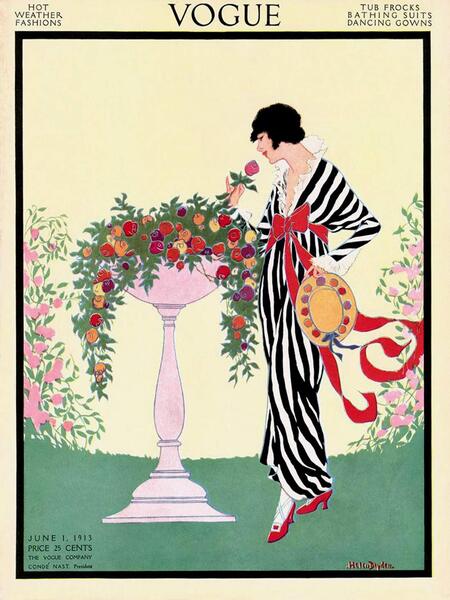
1. 1912 — Vogue. Helen Dryden. Woman in a Black Dress 2. 1913 — Vogue. Helen Dryden. Woman with a Rose
On the 1912 cover, expressiveness is created through the contrast between the dark dress, the bright background, and the sharp silhouette. In the 1913 work, the flower plays the main role, emphasizing the softness of the female image.The comparison illustrates two Modernist techniques: the contrasting silhouette and the interaction of the figure with the plant ornamentation.In Modernism, the female figure became part of the decorative composition: special attention was paid to the silhouette, gestures, hairstyle, and surroundings.In Vogue, these techniques helped convey the ideals of elegance through the combination of fashionable clothing, pose, and artistic atmosphere.
1. 1912 — Vogue. July Cover 2. 1913 — Vogue. George Woolf Plunk. May Cover 3. 1913 — Vogue. Helen Dryden. Winter Fashions Number
The three covers display different approaches to portraying women: through silhouette, decorative surroundings, and seasonal fashion.
George Woolf Plank created fairytale-like and theatrical compositions, while Helen Dryden placed more emphasis on costume and the expressiveness of pose. Both artists transformed fashion illustration into a cohesive artistic vision.
In the 1910s, color became an important element of Vogue’s design. Contrasting combinations and large color blocks accentuated the female silhouette.
Space became more stylized: realistic backgrounds were gradually complemented by geometric forms, repeating lines, and stylized elements.
The woman becomes not only the heroine of the illustration but also the central artistic motif of the magazine.
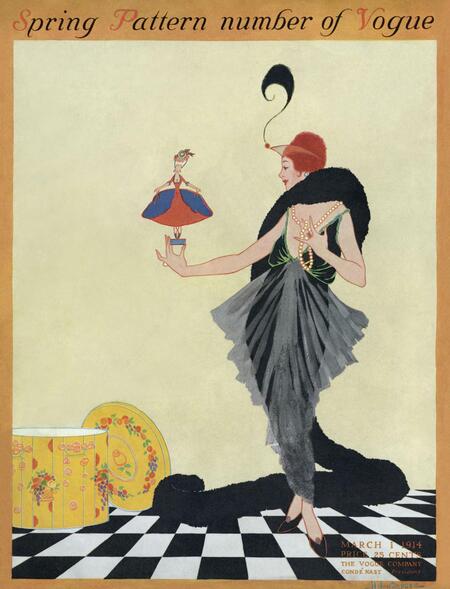
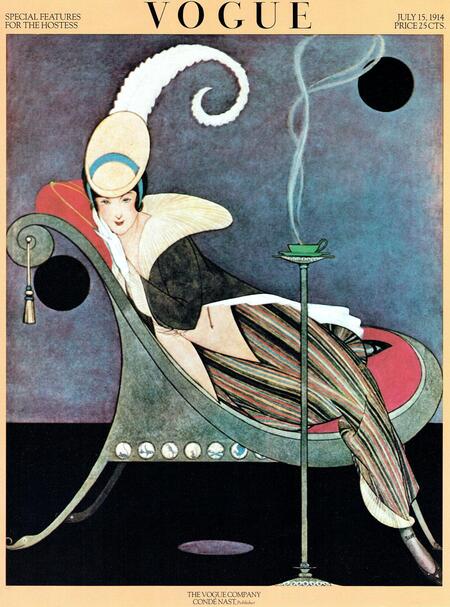
1. 1914 — Vogue. Helen Dryden. March Cover 2. 1914 — Vogue. Helen Dryden. July Cover
On the March cover, a geometric floor pattern contrasts with a fluid feminine silhouette, while on the July cover, a decorative interior becomes part of the composition.Both pieces showcase a fusion of Art Nouveau aesthetics with modern graphic stylization techniques in Vogue.The title Vogue gradually became a key element of the magazine’s visual identity. In the early 20th century, artists experimented with form, color, and letter placement, integrating typography and illustration into a single decorative composition.
Vogue, September 1914. Cover associated with Helen Dryden.
In the layout of Vogue, typography and illustration gradually merged into a unified composition. The magazine’s title could stand out on its own or interact with the figure and decorative elements.
By the mid-1910s, Vogue’s graphics became more varied: decorative lines and natural motifs were combined with bold colors and free composition.
George Wolf Plunk and Helen Dryden used fantastical landscapes, architecture, and decorative backdrops, transforming fashion illustration into a cohesive work of art.