Concept
In modern cinema, large-scale scenes—battles, city squares, stadiums, chaotic flight sequences—are no longer solely the result of on-set production planning. Where crowds were previously created exclusively on location—using extras, military units, and background performers—the advancement of visual effects has introduced digital methodologies: 2D duplication of filmed people, autonomous AI agents, procedural generation, and volumetric capture. Each of these methods addresses the task in a distinct way: to fill the frame with a vibrant, believable mass whose behavior is not uniform and remains cohesive even when the camera moves.Creating virtual crowds has become especially critical in films where the scale of the scene exceeds the physical capabilities of any location. In such cases, visual effects specialists face a complex challenge: how to render thousands or tens of thousands of characters while preserving the plausibility of their behavior, the diversity of their movements, and their interaction with each other and their environment.
In this work, I aim to demonstrate a study on the evolution of mass scene creation technologies in cinema. The research examined films that utilized both digital and practical methods for creating crowds, as well as the technologies employed to achieve these effects with and without computer assistance. The study was based on the films «Star Wars: Episode I — The Phantom Menace, ” „Gladiator, ” „The Lord of the Rings: The Two Towers, ” „Troy, ” „War of the Worlds Z, ” and „The Lion King.“ These projects incorporated diverse approaches to constructing large-scale crowd scenes: practical models, 2D duplication of filmed extras, autonomous agents with behavioral patterns, procedural generation, and volumetric capture.
Star Wars: Episode I — The Phantom Menace
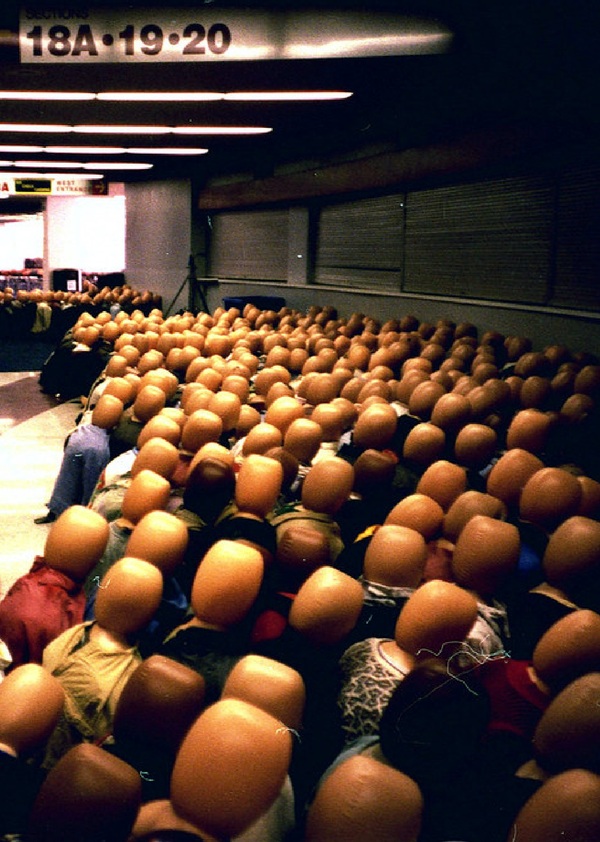
In Star Wars: Episode I, the stands of the Mos Espa arena during the pod races were filled with 450,000 painted cotton swabs inserted into a miniature arena. Model creator Michael Lynch constructed this scene so that the swabs would read as a dense mass of spectators. To make the crowd look lively, air was blown from beneath the swabs by fans—they oscillated, creating the illusion of cheering fans in motion. This scene is in the Guinness Book of Records as the miniature scene with the largest number of miniatures in cinema history. However, according to Cinefex #78, the footage of the cotton swab scene was not included in the final film: «For an extremely long view, the model crew dressed miniature stands with Q-tips painted different colors, hit with fans to provide minimal movement — although the footage was ultimately not used.»
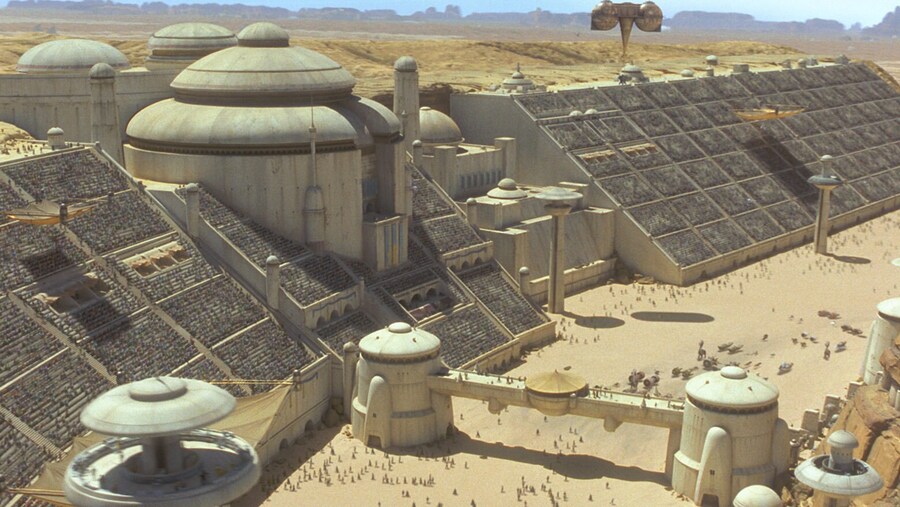
Mos Espa Gran Arena
Cotton Swabs on the Arena
Casting Arena with Extras
The ground battle between the Gungans and droids on the plains of Naboo was created differently. Nearly 150 frames of the battle were shot against static backgrounds—Muren photographed the hills and sky and composited them digitally. The crowds were animated using a library of cycles: animators created the movements in Softimage and Caricature, arranged them in Maya, and a tool, guided by Michael De Como and Christopher Perry, randomly distributed actions among hundreds of characters—such as «10% walk, 20% run, 30% shoot.» Some movements were recorded via motion capture: Jeff Light for the Gungans and James Tully for the droids; Tom Burton managed the sessions, and John Horn wrote Mojo to clean the data. To render thousands of characters, the RenderMan «level of detail» feature was utilized—farther characters received simplified geometry.
Invasion of Naboo
Gladiator
To create the arena in «Gladiator» (2000), part of the Colosseum was constructed from clay and brick on Malta, while the entire arena was completed using computer graphics. Jean-Léon Gérôme’s painting served as the inspiration for the scenes; based on it, the velarium and lighting effects were created to convince the viewer of the period’s authenticity. The artists in Max’s department built a small model of the Colosseum where all effects—light, sound, and the digital parts of the building—were tested against the constructed model.
Gladiator Arena
To fill the stands, approximately 2,000 extras were employed, strategically placed to fill 4,000 seats. However, in certain scenes, every seat had to be occupied by Romans in traditional attire. When the camera circles the main character and other gladiators, showing a 360-degree view of the Colosseum packed with gesturing and waving spectators, 70,000 computer-generated characters were created—this effect lasts for nearly half a minute.
Scene with aerial overview of the arena
The Lord of the Rings: The Two Towers
In the film «The Lord of the Rings: The Two Towers,» the crowds were created using Massive, a program developed by Stephen Regelous; the crowd simulation supervisor was Jon Allitt. The program generated agents capable of autonomous behavior. In the scene where Saruman addresses the army from Orthanc’s balcony, Geoff Tobin populated Isengard with 9,500 Massive agents—Uruk-hai animated with a shifting gait. Fifty-five hours of motion capture were recorded for Massive for the film.
Isengard army of orcs
The agents were divided into three levels of detail. C-level was only used in shots featuring 10,000 or more characters. B-level included secondary dynamics—such as flowing hair and clothing—and remained close to the camera. A-level was constructed only when necessary. In the shot departing Orthank, C- and B-level blended through layers of 2D smoke.
Battle made in Massive
Massive Interface
Massive was used in other scenes as well: for the crowd in Edoras, for the Rohirrim in aerial shots, for the Ents in the deep background, and for the Haradrim on the Mumakil platform—there were 40 agents captured via motion capture. The background Ents were tethered to splines on the 3D terrain, and the motion capture performers wore prosthetics that altered their gait: insoles, weighted boots, a neck brace, and arm extenders.
Haradrim Army
Rohan’s Riders
March of the Ents to Isengard
For sound, Peter Jackson, along with sound engineers, came to the New Zealand versus England cricket match and, with the consent of 25,000 spectators, recorded the roars of orcs: black orc speeches were projected onto screens, the crowd repeated the rhythm, and the women spoke in deep voices.
Troy
For «Troy» (2004), the mass scenes were created by The Moving Picture Co. (MPC) studio under the supervision of visual effects supervisor Chas Jarrett—approximately 425 shots. The Massive licenses were unsuitable: the available version was simplified, and each one cost $40,000, requiring 20 units. Therefore, a team of 10 programmers wrote its own software over 15 months, consisting of about 40 applications. The key components were the motion capture database Emily and the animation program Alice. They recorded 90 movements; Emily segmented these into eight-frame segments—1,000 clips—yielding 100,000 combinations. This ensured that the two characters never walked or ran the same way.
Embarkation on ships
In the CG animation, the soldiers were represented as skeletons, and the geometry was added in the shader (CG Supervisor Gary Brozenich). Theoretically, there were 50,000 Greeks against 25,000 Trojans, but the number changed frame by frame—reaching up to 150,000 soldiers in a single shot. Individual skirmishes were created using motion capture with stunt performers (Digital Effects Supervisor Rudi Holtzapfel).