
Concept
Media art is an art form that utilizes contemporary media and technologies in its creation and presentation. It integrates various artistic disciplines, such as video, sound, computer art, interactive installations, and virtual and augmented reality technologies. Media art pushes the boundaries of traditional art, affording artists unique opportunities to experiment with new materials, forms, and ideas. It reflects modern technological advancements and societal trends while also posing questions about the interaction between humans, technology, and the surrounding world. Media art can be provocative, interactive, multi-sensory, and often requires active audience participation. It opens up new avenues for the expression and perception of art, simultaneously stimulating dialogue and discussion within contemporary society.
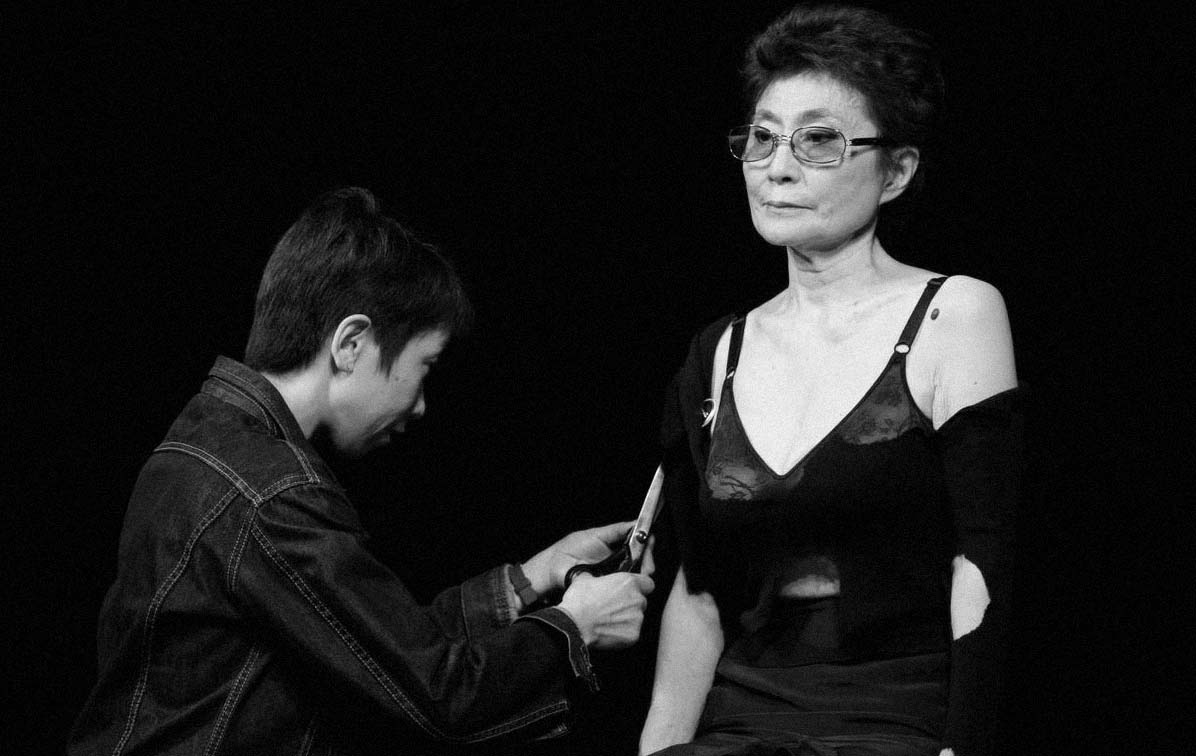
Cut Piece. Yoko Ono. 2003
Fluxus is indeed one of the first artistic movements to play a pivotal role in the genesis and evolution of media art. Fluxus artists actively experimented with the new media and technologies of their time in their work, forging novel paths in art. Fluxus stood in opposition to traditional art forms. Fluxus artists utilized a wide spectrum of media—including sound, light, video, film, and television—to create their pieces and performances. They integrated emerging technologies and media into their work to provoke an explosion of creativity and audience participation. The movement also emphasized the importance of mass communication and social networks. They used radio, television, and other mass media outlets to disseminate their ideas and messages; they conducted radio shows, broadcast performances on television, and produced art publications.
In many fluxus performances, spectators transitioned from being passive observers to active participants and creators of art. Fluxus played a significant role in shaping core tenets of media art, such as interaction, audience participation, the utilization of new technologies, and the investigation of media’s role in contemporary society, thereby opening new horizons for art.
Emerging during a period of intense social and cultural upheaval—marked by volatile political events and mounting public dissatisfaction—this era became fertile ground for revolutionary artistic ideas and experiments. Fluxus drew inspiration from diverse sources, including Dadaism, Constructivism, avant-garde movements, and various philosophies. It united artists who sought to dismantle traditional artistic boundaries and evoke novel perspectives and experiences in the audience. Key figures in Fluxus included George Maciunas, Yoko Ono, Nam June Paik, Monte Young, Alison Knowles, and others, all of whom made substantial contributions to the development and popularization of this movement.
The History of Fluxus
Founders of Fluxus: George Maciunas, Yoko Ono, Nam June Paik, Monte Young
Fluxus was not merely an art movement; it was a philosophy advocating for democracy, collaboration, and active audience participation. It called for cooperation, the dismantling of hierarchies, and the inclusion of casual observers in the creative process. Many Fluxus performances and installations encouraged active engagement with the artworks—asking participants to contribute and become co-creators rather than simply passive viewers. Fluxus performances were one of the most characteristic forms of expression for this movement.
Fluxus Manifesto. George Maciunas. 1963.
Artist George Maciunas proposed creating a new art movement in 1963. Like many other avant-garde artists and their predecessors, he expressed his ideas in the form of a manifesto. The manifesto itself was a work of art and contained several definitions of the word «flux, ” from which the movement took its name—Fluxus. Following the definitions were handwritten notes detailing various meanings of the word. Beneath the definition related to the clarification or separation of liquids, Maciunas wrote in firm script:
«Cleanse the world of bourgeois sickness—of intellectual, professional, and commercialized culture; cleanse the world of dead art, imitation, artificial art, abstract art, illusionistic art, mathematical art—cleanse the world of Europeanism!»
Founders of Fluxus: Alison Knowles, Joseph Beuys, Dick Higgins, Charlotte Moorman
The artists and other creative figures who coalesced around Maciunas’s idea of radical new art were as diverse as the works produced by the Fluxus movement. Many were inspired by John Cage, an outstanding artist, composer, and musician. Through his creative achievements and charismatic teaching, he demonstrated that art and life can coexist harmoniously. In his musical compositions, he incorporated chance, including ambient sounds and noise—even the coughs and restlessness of the audience members—sometimes inspiring the performers. Cage’s drive to find artistic potential in everyday life resonated with the Fluxus artists.
Performances
Performances were one of the most characteristic and notable forms of expression within Fluxus art. They were distinguished by their dynamism and the interaction between artists and audience members. Fluxus artists invited spectators to take an active role—to play parts, contribute their ideas, and influence the course of events. This cultivated an atmosphere of spontaneity and unpredictability, where everyone could become a co-creator of art. Fluxus performances incorporated various elements, such as sound, movement, text, objects, and visual effects, specifically to create a vivid and dynamic stage. The artists experimented with absurd situations, unconventional actions, and randomness, striving to dismantle conventional notions of art.
Left: Cut Piece. Yoko Ono. 1964. Carnegie Recital Hall, New York / Right: Cut Piece. Charlotte Moorman and Nam June Paik. 1966. Galerie Aachen, Aachen, West Germany
Cut Piece. Yoko Ono. 1964
Yoko Ono sat on the stage in complete isolation, holding scissors before her. She invited the audience to approach her and cut a piece of her dress. While she remained almost motionless and showed no visible emotional reaction, various members of the audience complied with this instruction—sometimes, unfortunately, displaying aggression and overtly violating the artist’s boundaries: they cut the straps of her bodice and even her hair.
«People kept carving away the parts of me that they disliked; in the end, only the stone that was within me remained, but they were still not satisfied and wanted to know what was inside that stone.»
Ceiling Painting/Yes Painting. Yoko Ono. 1966
Another performance by Yoko Ono, in which she invited the audience to climb a ladder and write a small «Yes.»
Yoko Ono screams during a performance at the Museum of Modern Art in Louisiana. 2013
Half a Breath. Yoko Ono. 1967. Gallerie Lissone, United Kingdom
«Half a Wind» — a recurring element in many exhibitions that could have easily evolved into a distinctive performance, but regrettably, it never did. The concept involved dividing all objects within the space in half: from the most commonplace and minor to the large and unusual.
«George Brecht’s Drip Music.» Dick Higgins. November 23, 1962. Copenhagen
Brecht himself described his art as a way to make «the details of everyday life—the random combinations of objects surrounding us—stop going unnoticed.» This realization, which presented itself to casual viewers with a refreshing immediacy, crystallized Brecht’s vital mission.
Fluxus’s «Drip Music» Performance at White Cube. Jeff Winston. 2015.
This was an exercise with meditative properties, reflecting the Fluxus artists' program, which Marjorie Perloff describes here as «a series of questions about where sounds should be placed in time and space and how they relate to the objects and actions that produce them.» Despite Fluxus’s strategies of avoiding the mainstream, this attractive, elegant 1959 piece is pared down and undeniably minimal in its essence. The instruction, much like in many of Brecht’s «event scores, ” is a brief phrase that the performer must interpret. In this case, it states: „The water source and the empty vessel are placed so that the water enters the vessel.“