CONCEPT
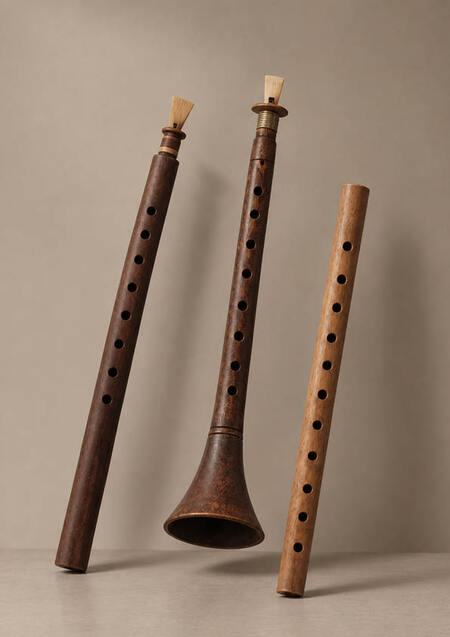
This research focuses on traditional Armenian wind instruments—the duduk, zurna, and blulu. I am interested in examining them not merely as part of musical culture, but as objects where form is intrinsically linked to the manner of sound production, the instrument’s character, and its intended function. The central question of this work is: how does the construction influence the sound, and how can this relationship be traced through the exterior appearance?
Three instruments, notably distinct in their construction, were selected for this study. The duduk features a wooden body and a double reed; its timbre is often described as soft and deep. The zurna is also a reed instrument but possesses a louder, brighter sound and a bell-shaped end to its body. The bulul is a transverse flute, where the sound is produced by directing an airstream across the edge of a hole. Comparing these instruments will allow an examination of different design principles within a single musical tradition. I am also interested in understanding how significantly the structural differences manifest in the external perception of each instrument.
The visual component will focus on studying the instruments. I plan to compare their proportions, materials, body shapes, the placement of playing holes, mouthpieces, reeds, and other details. Photographs, historical images, museum pieces, and schematics will help examine not only the overall silhouette but also the subtle features that are difficult to notice upon first viewing the instrument. Particular attention will be paid to the fine construction elements, as these largely determine the individuality of each piece.
A crucial element of the work is the relationship between external form and acoustic properties. I aim to determine which structural components influence the sound production method and timbre, and how these differences manifest during performance. To achieve this, visual materials will be compared with instrument descriptions and audio examples. The objective is not to assert that appearance alone entirely dictates sound, but rather to illustrate the interplay between form, construction, and musical function. This comparative analysis will help better understand why instruments belonging to the same tradition can possess such distinct sonic characteristics.
The role of the duduk, zurna, and bulul in Armenian musical tradition will be examined: under what circumstances were they used, what performance practices they are associated with, and how they are utilized today. The historical development will be traced through available images, museum materials, and written sources to distinguish confirmed changes from assumptions. I am also interested in tracking which instrument characteristics have been preserved over time and how the traditional form continues to exist within the contemporary musical landscape.
Through this, I aim to create a visual comparison of three instruments where photographs, details, diagrams, and text complement one another. The research should demonstrate that within a single musical culture, there are diverse methods of organizing the instrument and its sound, and that its form is not merely an external decoration, but an integral part of its musical character. This visual exploration will allow viewers to examine these instruments not only from a musical perspective but also from a material design standpoint, paying close attention to their construction, manufacturing features, and formal expressiveness.
DUDUK
See
1a