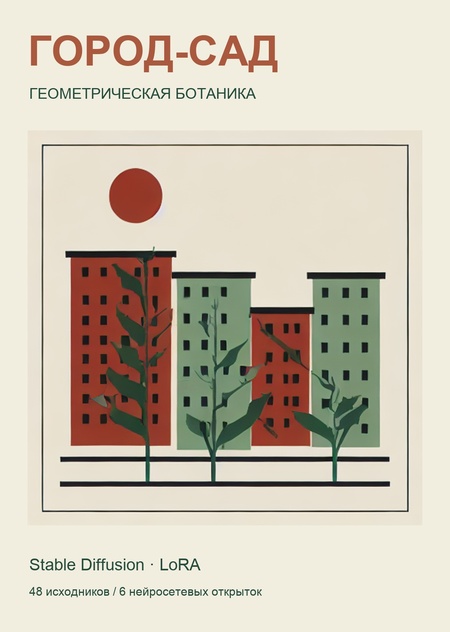
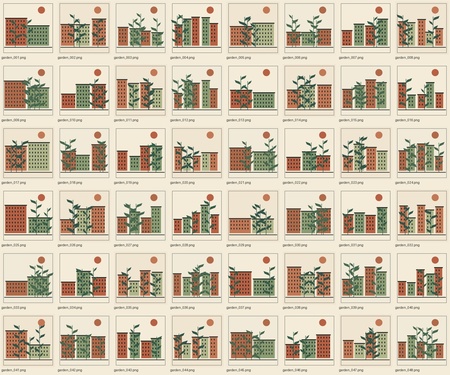
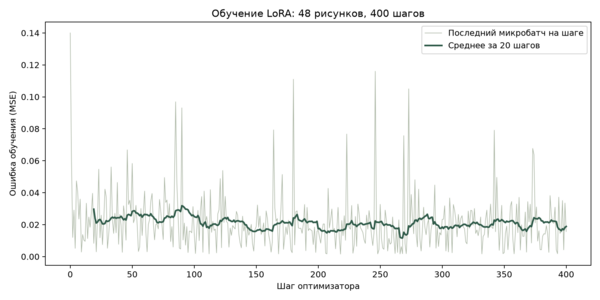
Garden City: Geometric BotanyA series of postcards depicting an imagined city where architecture and plant life speak a common language of simple forms. This is a training project to further train Stable Diffusion using the LoRA method.CONCEPT In this city, plants are often perceived as mere additions to buildings. Here, the greenery becomes an equal element in the composition: the verticality of the plants echoes the verticality of the structures, leaves interrupt the window grid, and green and terracotta planes coalesce into the image of a garden city.The aesthetic language of the geometric postcard was selected: a cream-colored background, terracotta, and shades of green, square windows, large plant silhouettes, a rectangular frame, and a circular disk. The goal is to transfer these visual rules to the model and test them in new compositions.SOURCE SET Forty-eight original algorithmic illustrations, sized 512×512, were prepared. They were created specifically for this project using the code make_dataset.py, which was developed with the help of ChatGPT. No external works or photographs were used. These are algorithmic drawings, not original Stable Diffusion generations.The code varies the height and number of buildings, the placement of stems and leaves, and three close color palettes. The frontal perspective, framing, and window rhythm are kept consistent. This set facilitates the transfer of recognizable features but limits the diversity of spatial solutions.TRAINING The base model is Stable Diffusion 1.5. The LoRA was trained at rank 8; the text encoder was not trained separately. The source captions include the marker «grdnpost style» along with descriptions of the palette and geometry.Training was conducted in Google Colab on an NVIDIA T4: 400 optimizer steps, batch size of 1, gradient accumulation of 2, effective batch size of 2, learning rate of 0.0001, resolution of 512×512, seed 42, fp16, and gradient checkpointing. The dataset volume is approximately 800 images with repetitions, equivalent to 16.7 passes over the set of 48 works.The final weights are saved in pytorch_lora_weights.safetensors. training.log confirms the completion of 400/400 steps, and training_config.json contains the launch command. The graph below shows the loss of the last microbatch and the moving average; a separate validation set was not used.
FINAL SERIESSix pieces were created following the training. The prompts described a house with a rooftop garden, a bus stop, a bridge, a courtyard, a conservatory, and a library. The results indicate that the model adopted the style more readily than it interpreted the differences between the subjects. For generation, seeds 100–105, DDIM, 30 steps, and a guidance scale of 7 were used.01. Facades and Two Discs. Terracotta and light-green structures nearly fill the frame. Two circles and a large geometric roof demonstrate the model’s free combination of the source motifs. The conceptual rooftop garden is weakly expressed—the architecture dominates the foliage.02. Three Verticals. Two terracotta volumes frame a central green one. Side plants and circular accents maintain symmetry. The requested bus stop is not clearly legible; the image functions as a standalone postcard.03. Foreground Foliage. Botanical shapes enlarge and overlap the window grid. This is where the vegetation most actively interjects into the architectural order. However, the requested bridge and canal are not clearly realized.04. Space Between Buildings. The varying heights of the houses and elongated stalks leave more open cream space. The lower horizontal elements compose a serene urban fragment. This composition is the closest to the relationships between buildings and plants in the course material.05. Dense Urban Fabric. The windows form an almost continuous grid; the vegetation is occasionally lost on the facades. The circles vary in size and density. Instead of a distinct conservatory, the model reverts to a familiar group of rectangular buildings.06. Terracotta Field. The active background, white circle, and dark roofs create a stronger contrast. Plants are concentrated at the base of the buildings. The library lacks a distinct visual marker, but the color palette and framing maintain the series' unity.The works are presented below in order 01–06.
WHAT CHANGED AFTER LoRA
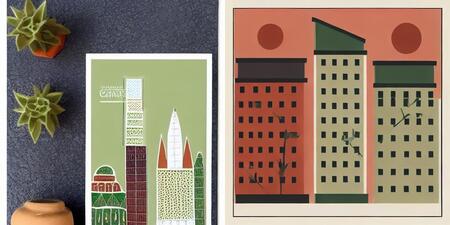
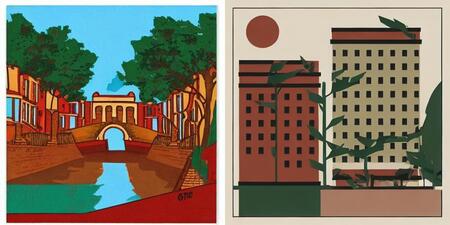
For each concept, two versions were generated using the same prompt, seed, number of steps, and guidance scale: one without LoRA and one with LoRA. In the comparisons below, the baseline model is on the left, and the fine-tuned model is on the right.
In the first pair, the baseline model showed a postcard next to real plants and a vase. After LoRA, the flat composition filled the entire frame: a border, large rectangular buildings, square windows, and a familiar color palette appeared. Both the objects and the way the image was organized changed.
Color relationships, the border, and the character of the facades remained consistent across all six pieces. The scale, arrangement, and number of buildings, the background, the size of the plants, and the circles all changed. Sometimes the disc doubles, the border becomes uneven, and the leaves become fragmented. This is not an exact geometric reconstruction of the source code.
LIMITATIONS AND DEVELOPMENT
The main achievement is the consistency of the visual language. The primary limitation is the weakening of distinctions between prompts. The training images share a similar frontal perspective and almost identical captions: the model successfully reproduces a familiar type of composition but struggles to adapt it to a bridge, a bus stop, or a conservatory.
Separate testing for memorization and independent generalization evaluation were not conducted. We cannot claim that the model has mastered the style independently of the subject matter. The next step is to incorporate different urban objects, angles, ratios of greenery to architecture, and individual captions for the drawings.
DESCRIPTION OF GENERATIVE MODEL APPLICATION
ChatGPT (https://chatgpt.com/) was used for conceptualizing, coding algorithmic drawings, the training notebook, and the project text. The final series was run using Stable Diffusion 1.5, fine-tuned with LoRA: https://huggingface.co/stable-diffusion-v1-5/stable-diffusion-v1-5. The original algorithmic drawings and the neural network series are presented separately; the conclusions are based on the actual image pairs.
CODE AND MATERIALS
The completed notebook 04_Обучение_LoRA.ipynb, the final weights, all 48 source images, the journal, and the prompts are available here: https://drive.google.com/drive/folders/1mI7jWcA75-fsufJ8ri6sEYOGStmZi2ZL
The exam materials are in the file 04_Финальный_проект_материалы.zip. The notebook is also saved in Colab: https://colab.research.google.com/drive/14KubCPgdiEHKCAbkZdHv4rUNUwmXUvgN. To download the code, please use the shared folder; access is open.