Comics are traditionally understood as a form of narrative built upon a sequence of images and text; however, their expressive potential is significantly broader. Unlike an objective depiction of reality, the visual language of comics allows us to present the world as an individual perceives it—a world that can be mutable, filled with memories, associations, fears, and fantasies. Since internal experiences lack a concrete visual form, artists employ graphic devices to make them visible—they distort space, break perspective, and utilize symbols and visual metaphors. Through these techniques, familiar reality acquires entirely different contours, reflecting the character’s subjective perception. It is particularly fascinating to observe how these methods form an independent visual language, enabling the portrayal not only of what is happening to the hero but also of what is transpiring within their consciousness.
Topics
- Concept
- Distortion of Reality: Dream Space and Perspective
- Attach Card Memory: Non-linear Narrative and Visual Associations
- Depicting Emotions and Psychological States: Visual Metaphor
- Stream of Consciousness: Graphic Representation of Thoughts and Associative Thinking
- Conclusion
Concept
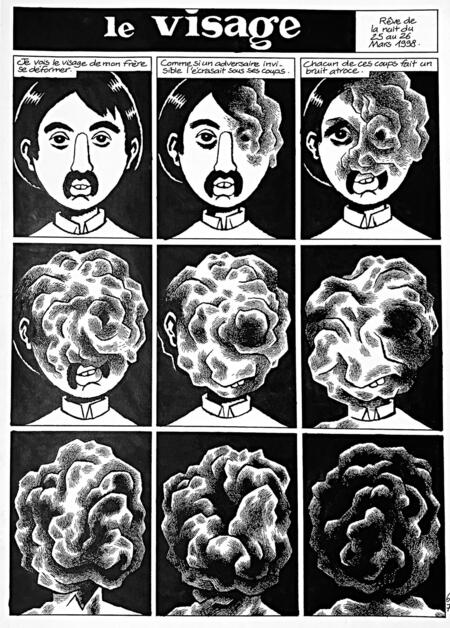
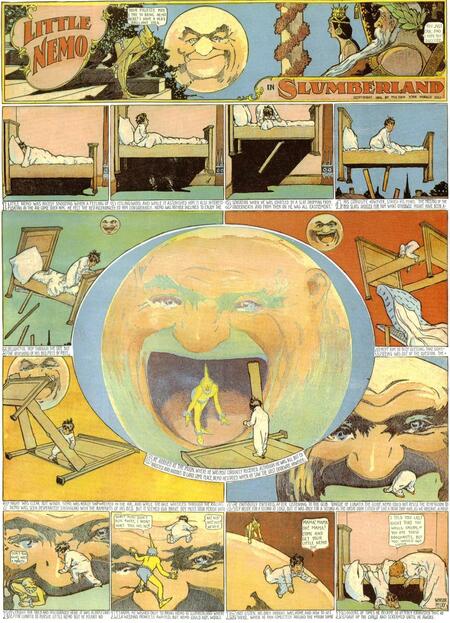
«Epileptic, ” David B., 1996 „Little Nemo in Slumberland, ” Winsor McCay, 1905
Comics can illustrate not only external events but also a character’s internal perception of reality. Feelings, memories, dreams, fantasies, and emotional states can be conveyed not just through text or dialogue, but through alterations in the visual structure of the work.Topic Selection is motivated by an interest in the graphic language of comics and its expressive capabilities. Special attention in the research is paid to how artists transform conventional elements of visual storytelling to represent the immaterial processes of human consciousness. The deformation of space, the disruption of perspective, the fragmentation of images, the use of visual metaphors, and changes in color palette—along with unconventional panel layouts—allow for the creation of a unique graphic reality that reflects the character’s individual perception.Relevance of the Study lies in the ability to examine the comic not only as a means of narrative delivery but as an independent visual system capable of conveying complex mental states. Studying such techniques allows us to identify how artistic and compositional decisions shape the reader’s perception of the narrative.Research Material consists of graphic novels and comics by authors whose works feature the character’s internal state playing a significant role in the visual narrative. The Main Selection Criterion is the presence of expressive graphic techniques used to depict dreams, memories, emotions, and fantasies. The selection of works is based on the diversity of their graphic solutions, which will allow for a comparison of different ways of visualizing various states.
The key research question is as follows: how do comic authors use graphic and compositional elements to visualize human subjective reality, and how do these elements alter the reader’s perception of the narrative?
For the theoretical foundation of this research, I utilized scholarly articles and academic publications focusing on visual storytelling and the graphic language of the comic book. When selecting sources, preference was given to works dealing with the depiction of memory, dreams, emotions, and the internal worlds of characters. The research aims to identify the primary methods for visualizing subjective experience, define the characteristic graphic techniques associated with them, and compare how different artists leverage the comic book medium to represent the human inner self.
Research Hypothesis: Comics allow for the conveyance of a person’s inner world not only through text and imagery but also through the specificities of their visual organization. Altering composition, color, perspective, and panel structure helps artists represent memory, emotion, dreams, and subjective perception of reality.
Deformation of Reality: Space and the Perspective of Dreaming
One of the most expressive ways to depict a subjective world in comics is by distorting familiar space. In reality, humans perceive the surrounding world as a relatively stable system governed by the laws of perspective, scale, and physics; however, in a dream or in fantasy, these patterns can be disrupted: objects change shape and size, and buildings may acquire unusual layouts.
Deformation of Spaces
This technique involves intentionally altering familiar proportions, geometry, and spatial relationships between objects. For example, buildings might become disproportionately tall, rooms might seem infinitely large, and individual items might acquire unusual dimensions.
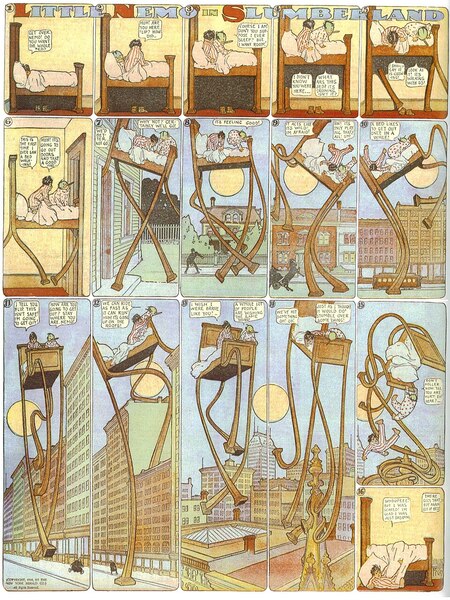
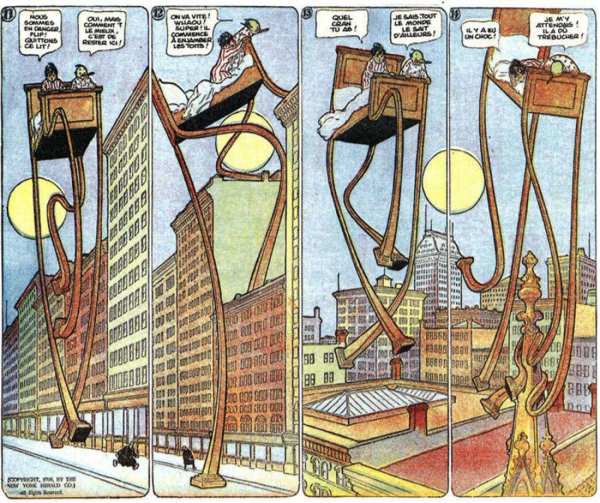
«Little Nemo in Slumberland, ” Winsor McCay, 1905
A striking example of this technique can be seen in the American artist Winslow Macke’s comic, «Little Nemo in Slumberland.» The work chronicles the adventures of the boy Nemo in the fantastical world of dreams, leading the artist to create unconventional architectural spaces where familiar buildings and objects are in constant flux. In certain episodes, Nemo’s bed begins to move on its own, its legs gradually lengthen, and the surrounding objects alter their proportions. A common piece of furniture transforms into a dynamic element that disrupts the conventional understanding of space and the physical properties of objects.
Scaling and Page Composition
«Little Nemo in Slumberland, ” Winsor McCay, 1905
The contrast between the realistically rendered architecture and impossible events heightens the dreamlike impression, while the alteration of conventional character proportions directly signals that the action is unreal. This technique is most often accompanied by changes in the page composition and the shape of the panels. It is precisely because the panels change size, elongate, merge, or adopt an unusual form that the visual contrast between the dream and reality is emphasized and intensified.
«Little Nemo in Slumberland, ” Winsor McCay, 1905
Metamorphosis
«Batman: Arkham Asylum: A Home for the Mentally Ill, ” Dave McKean, 1989
Another characteristic technique is metamorphosis—the gradual or sudden transformation of one object into another. Unlike a simple change in scale, metamorphosis alters the very shape and purpose of the subject or character. This technique allows for the depiction of the instability of the dream world, where objects lack permanent qualities and can transform depending on what is happening. In the graphic novel «Batman: Arkham Asylum: A Serious House on Serious Earth, ” written by Grant Morrison and drawn by Dave McKean, this artistic transformation is conveyed through the blurring of boundaries between reality, madness, and the heroes' subconscious. The space of the psychiatric clinic itself loses its architectural rigidity and transforms into Batman’s sinister inner labyrinth of the mind.
«Batman: Arkham Asylum: A Home for the Mentally Ill,» by Dave McKean, 1989
A key characteristic of Mackin’s visual approach is the use of mixed media. He combines painting, photography, and collage to create multilayered images with an unusual texture. As a result, each page of the comic resembles an independent artistic composition. Visual elements are often layered upon one another, the borders of the panels become less distinct, and individual images are partially obscured by shadows and textures. This approach complicates the unambiguous perception of space, generating a sense of anxious, unstable reality.
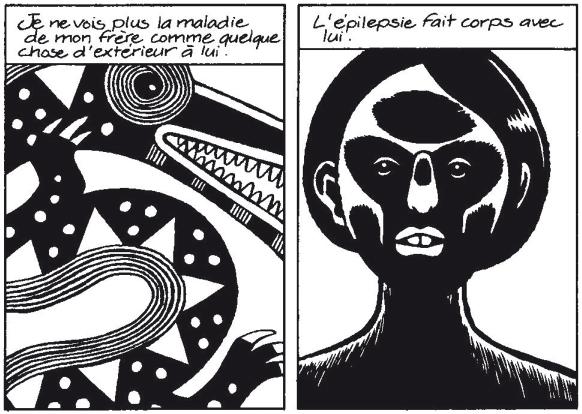
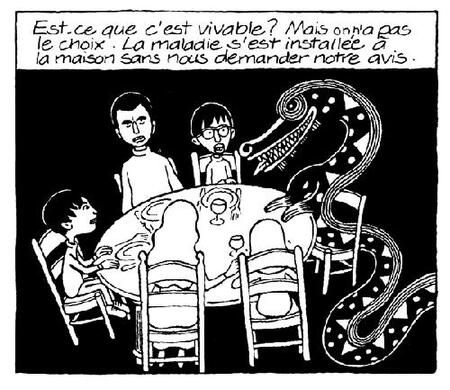
«Epileptic, ” David B., 1996
Another example of using fantastic imagery to convey subjective experience can be found in the graphic novel «Epileptic» by the French artist David B. The artist turns to symbolic and fantastical imagery to communicate the fears, experiences, and complex emotional states associated with epilepsy, which a loved one is suffering from.
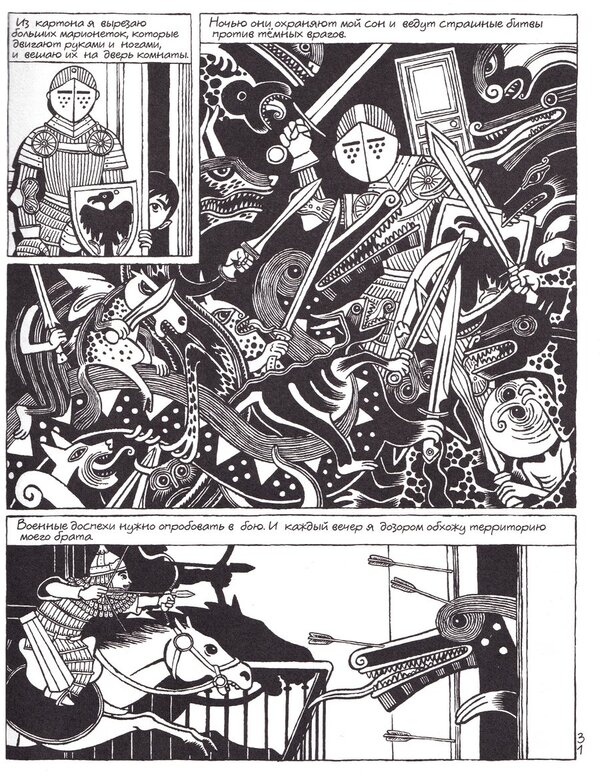

«Epileptic, ” David B., 1996
The visual language of the work is characterized by an abundance of decorative details, ornaments, and fantastical creatures. Real events intertwine with imagery that reflects the author’s internal experiences. The image of the dragon holds a special place, connected to the theme of illness and its impact on family life. The fantastic depictions serve as visual metaphors through which the artist conveys personal experience and the subjective perception of the events.
Memory: Non-linear Narrative and Visual Associations
In a comic, memory is depicted as a collection of discrete images, events, and impressions that do not always coalesce into a chronological sequence. To convey this characteristic, artists employ fragmented narratives, repetition of visual motifs, shifts in temporal planes, and the incorporation of photographs.
Fragmentary Structure of Memory
Narrative fragmentation is a technique that involves dividing a story into discrete episodes that are not always presented chronologically but are connected thematically or emotionally. Unlike linear narrative, where events unfold from beginning to end, a fragmented structure mirrors the nature of memory: an individual may return to specific past moments, skip certain events, and pause extensively on others.