Navigation
- Concept
- Grid: Lines as an Instrument of Isolation — Edward Hopper — Francis Bacon — Alberto Giacometti
- Pressure of Planes: Blind Angles and Distorted Perspective — Giorgio de Chirico — Adrian Ghenie — Bernard Buffet
- Architecture of Suppression — Tsui Cze
- Conclusions
- Bibliography and Sources
Concept
Human existence within the context of the modern metropolis is intrinsically linked to the transformation of its spatial experience. Processes of rapid urbanization, which began in the twentieth century and intensified in the twenty-first, have radically altered the nature of daily life, shifting it toward cramped housing, standardized architecture, and enclosed spatial capsules. Overcrowding in cities has paradoxically fostered a phenomenon of total isolation within the crowd, where the private room, apartment, or workspace has simultaneously become both a refuge and an isolator. The culture of the Modern Era reacted acutely to these shifts in public consciousness, turning away from the classic portrayal of interior design as a sign of status and comfort toward representing space as a source of oppression, anxiety, and claustrophobia. My choice of the research topic—“The Interior as a Cage: Geometric Pressure and the Isolation of Humanity in 20th–21st Century Painting”—seemed compelling from the perspective of how visual art visualizes the psychological impasse of the urban dweller.
The focus is not merely the theme of solitude, but a specific set of tools—geometric grids, tension lines, and distorted perspective—which artists utilize to create a psycho-optical effect of enclosed space.
The relevance of this study is supported by the interdisciplinary nature of the problem, which encompasses the sociology of urbanism, psychoanalysis, and visual analysis. This approach allows for the identification of how spatial composition impacts the viewer’s emotional state through the effect of somatic empathy.
For the visual investigation, I selected paintings by Edward Hopper, Francis Bacon, Alberto Giacometti, Giorgio de Chirico, Ed Adrian Geni, Bernard Buffet, and Cui Zhe. The choice of these artists stems from their ability to vividly illustrate the evolution of urban claustrophobia over the past century. The starting point of this work is the painting of the first half of the 20th century, when the foundations for deconstructing perspective were laid and the first images of empty urban «boxes» emerged.
Next, I examine post-war Expressionism and its radical spatial violence against the human figure. The final layer of material consists of contemporary artists from the 21st century, who capture human solitude against the chaotic rhythm of the city. The primary criterion for selecting these paintings was the presence of a rigorous geometry—lines, angles, window, and door frames—that functions not as mere decoration but as a frame constricting the character’s body.
I structured the investigation not by artist, but by the specific geometric techniques of pressure they employ in their works. The first section focuses on the phenomenon of the rigid linear frame and the orthogonal grid as primary tools of isolation. Using Francis Bacon’s spatial cells, Edward Hopper’s sharp window mullions, and Alberto Giacometti’s linear web as examples, I analyze how the intersection of axial vectors physically severs the character from the outside world, trapping them in a geometric snare.
The second conceptual block is dedicated to studying the pressure of planes and the optical narrowing of the frame. Based on the works of Giorgio de Chirico, Ed Adrian Geni, and Bernard Buffet, I examine how these artists deliberately distort classical Renaissance perspective, making room corners and solid walls encroaching—depriving the painting of air and pushing the viewer’s gaze toward a dead end.
In the third part, the material is based on the work of the 21st-century Chinese artist, Cui Zhe. Her pieces document a radical stage of urbanization where space ultimately transforms into a chaotic, infinite geometric grid, and the metropolis becomes an attractive yet isolating cell for the individual.
The fundamental principle guiding my work with textual sources was a synthesis of art historical, philosophical, and psychological concepts that allowed for the interpretation of geometric visual language. Primarily, I drew upon works concerning the philosophy of space and the phenomenology of corporeality, which helped describe how a person inhabits or rejects their surroundings. To explain why rigid, artificial lines induce a subconscious sense of anxiety in individuals, I utilized research in perception psychology and psychosomatics, specifically theories related to muscle tension and the encapsulation of stress under external threat.
At the core of this visual inquiry lies a key question: How and through what specific geometric and compositional techniques have artists of the twentieth and twenty-first centuries transformed the depiction of interior spaces from a harmonious environment into an aggressive instrument for conveying claustrophobia and existential solitude, and how does this altered geometry of the canvas affect the viewer’s psychophysical perception?
The research hypothesis posits that the spatial pressure and rigid geometry of the grid in Modernist painting function not merely as a formal experiment or background, but as a direct visual code for collective urban trauma. Artists intentionally distort perspective, overlap horizontal exits from the painting with parallel lines of walls, and confine characters within intersections of visual vectors—all to evoke in the viewer a physical sensation of suffocation and dead ends through the mechanism of somatic empathy, thus transforming the contemplation of art into a personal, embodied experience of isolation.
Grid: Lines as a tool for isolation
Edward Hopper
The primary chronicler of urban loneliness in 20th-century American art. His interiors lack domestic warmth and coziness; instead, they are sterile, sharply delineated geometric boxes. Hopper’s primary device is the use of perfect rectangular forms (windows, doorways, wall panels) to divide space. The geometry in his paintings artificially separates people, preventing them from connecting with one another or with the outside world, forcing the viewer to feel like a detached observer.
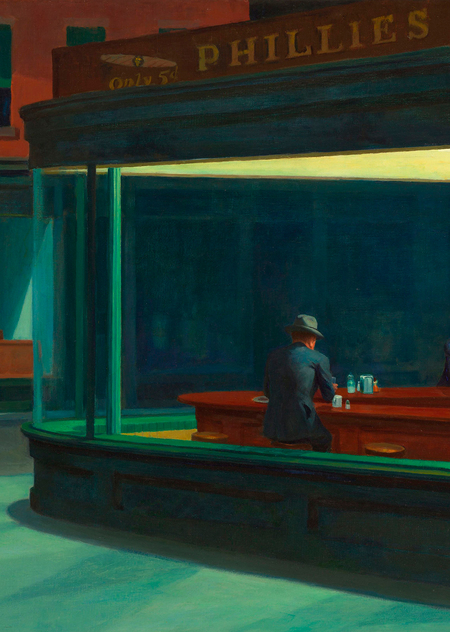
Edward Hopper, «Nighthawks,» 1942
The composition of the painting «Night Owls» is built upon the contrast between the muted, dark street and the brightly lit triangle of the night cafe. The characters are confined within a glass «aquarium, ” whose shape resembles a sharp angle piercing the space of the night city. The cafe’s enormous curved glass creates an insurmountable physical and optical barrier between the viewer and the figures. The horizontal lines of the bar counter, the long windowsill, and the building’s roof run strictly parallel, stretching the space and transforming it into a closed corridor.
The painting lacks any soft contours—everything conforms to the rigid rectangular grid of the window frames in the background and the sharp angles of the furniture. The human figures appear to be an integral part of this geometric composition. The vectors of their gazes do not intersect: the man and woman are seated near each other, but their hands are separated by the parallel line of the bar stand, and the bartender is cut off from them by the triangle of the workspace. The presence of triangular and rectangular segments «slices» the interior into separate, isolated zones, depriving the characters of the ability to communicate and creating a sense of absolute vacuum.
Edward Hopper, «Sun in an Empty Room, ” 1963
«Sun in an Empty Room, ” one of Hopper’s later works, completely abandons the human figure, making the space itself the protagonist. The room is structured by the sharp intersections of vertical walls and the horizontal lines of the floor and ceiling. The entire canvas plane is divided into contrasting rectangular areas of light and shadow. The window admitting light does not reveal the street—only greenery is visible beyond it. The viewer’s gaze fixes on a solitary corner in the right portion of the painting where the wall lines converge. Hopper constructs the perspective so that these planes shift and compress the room. Sunlight falls onto the wall in harsh, fractured geometric bands. This light, it seems to me, does not warm; rather, it emphasizes the cold tectonics of the empty box. The grid of light patches and shadows divides the wall into sectors, creating the visual sensation of a lattice and evoking in the viewer a feeling of existential void and spatial impasse.
Francis Bacon
Unlike the contemplative Hopper, Francis Bacon works with the radical, aggressive deconstruction of corporeality, placing the figure in a situation of spatial violence. His interiors are abstract, sealed-off rooms without windows or doors, resembling torture chambers or operating theaters. Bacon’s signature compositional technique—"the cage"—involves deliberately outlining his deformed, screaming figures with thin, perfectly straight geometric lines of a cube or parallelepiped suspended in emptiness, thereby denying the character even the slightest chance of escape.
Francis Bacon, «Three Studies for Figures at the Base of a Crucifixion,» 1944
In this famous triptych, Bacon explores the theme of primal dread and postwar trauma, using spatial confinement as a catalyst for anxiety. All three anthropomorphic figures are trapped within claustrophobic interiors set against an aggressive, blood-orange backdrop. The space in each of the three panels is defined by the lines of the room’s corners. In the central and right panels, Bacon draws thin white and black lines to form three-dimensional geometric cages around the figures.
The cubic lines depicted in the painting function like transparent yet impermeable cells. The geometric grid of the cube clashes with the organic, curved form of the characters' bodies. In the left panel, the figure is unnaturally bent and trapped between the line of the chair and the overhanging corner of the ceiling. On the right panel, the screaming creature stretches its neck strictly along the vertical axis of the frame. Bacon intentionally disrupts classical perspective: the lines of the floor and walls converge too abruptly, creating the effect of a narrowing funnel. The rigid geometry of the frame fixes the character’s body in space, preventing movement—a sensation that transmits to the viewer the physical feeling of suffocation and the impossibility of escape.
Alberto Giacometti
Alberto Giacometti is primarily known for his attenuated sculptures, but his oil paintings possess a unique language of spatial pressure. The space in his paintings is a dense, viscous, and aggressive environment. Giacometti renders interiors using hundreds of chaotic yet strictly structured intersecting lines. The figure in his paintings always finds itself under this heavy linear graphic quality, which literally consumes the form, transforming the interior into a mental prison.
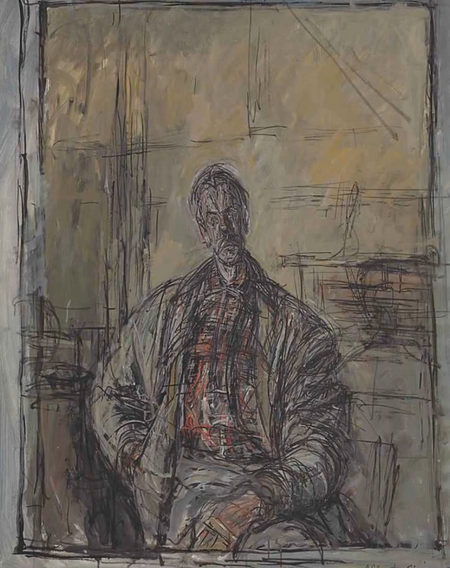
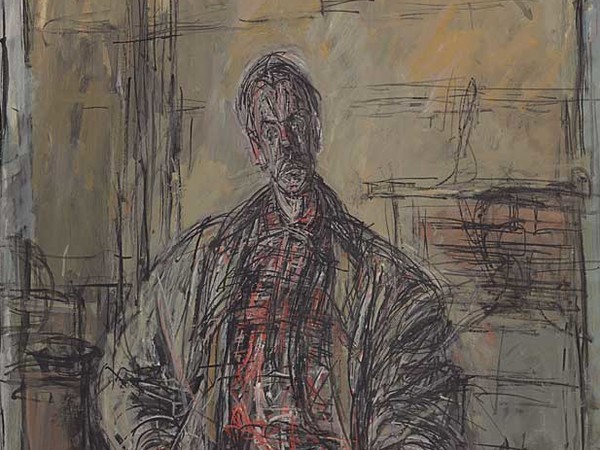
Alberto Giacometti, «Diego in a Jacket, ” 1953
On this canvas, the artist’s brother is depicted seated in the center of an empty studio. The portrait completely abandons its classical function, transforming instead into an investigation of spatial isolation through the total dominance of a gray-and-black graphic grid.
The space surrounding Diego’s figure is composed of numerous vertical, horizontal, and diagonal lines, applied with swift brushstrokes. Jacquemati repeatedly outlines the edges of the walls, easels, and furniture, causing them to double and overlap. The human figure in the center of the canvas is diminished, as if compressed from all sides by the chaos of lines. The character’s head is enclosed in a peculiar frame—Jacquemati draws rectangular contours around it. The viewer observes geometry dissolving and consuming the hero’s individuality, turning him into a frozen, paralyzed object trapped within a graphic lattice.
Plane Pressure: Blind Corners and Distorted Perspective
Giorgio de Chirico
Creator of metaphysical painting, in which interiors and urban imagery transform into anxious, liminal spaces. The artist’s main compositional technique is the radical distortion of classical perspective. De Chirico intentionally breaks the logic of converging lines: he makes room corners unnaturally sharp and floors steeply tilted, which causes the objects to exert a considerable psychological weight on the viewer. De Chirico’s interiors are cluttered with diverse geometric constructions, frames, and drafting tools, which emphasize their absurdity and alienation.
Giorgio De Chirico, «Metaphysical Interior» (Interno metafisico), 1916
In this painting, the room’s space does not quite resemble an interior; rather, it seems transformed into a warehouse of wooden structures. As I perceive it, the composition is built on the aggressive collision of planes. De Chirico constructs a closed space where the floor and walls meet at an unnaturally steep angle. The perspective sharply shoots upward, making the room resemble a small wooden crate.
The canvas is filled with geometric drafting triangles, frames, and stretcher bars pressed tightly against one another. The rectangular planes of the paintings within the frame and the triangular frames overlap, creating an optical labyrinth. The viewer experiences a sense of disorientation; the straight lines do not organize the space—they compress it.