Navigation
1. Concept
2. Introduction
3. From Observation to Self-Observation
4. Hassan Elahi. Archive Without a Self-Portrait
5. Paolo Cirio and Alessandro Ludovico. Portrait on Someone Else’s Page
6. Loren Lee McCarthy. A One-Day Subscriber
7. Who Grants Consent for Observation
8. Conclusion
9. Sources
Concept
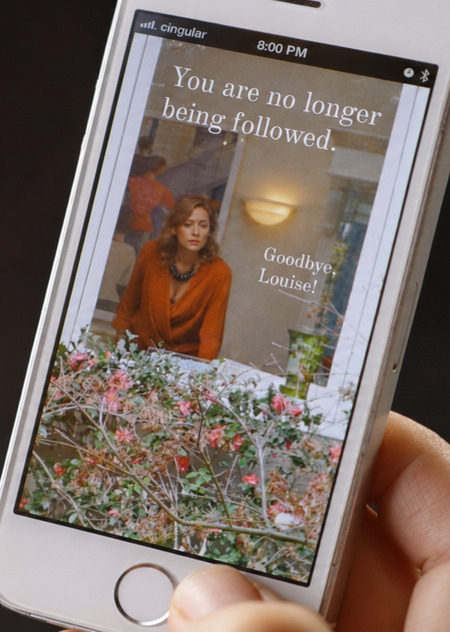
In social media, a follower almost always appears as a name or a number. Lauren Lee McCarthy suggests imagining this person actually following you down the street. They see what typically remains outside of a post: the roads, the bus stops, the chance encounters. Yet, this presence is communicated by a single line on the phone. This gap between a brief notification and what it signifies for the individual became the starting point of the research. Central to the work are everyday online actions that make a person the object of someone else’s attention, and artistic projects that provide an opportunity to view that attention from the outside.
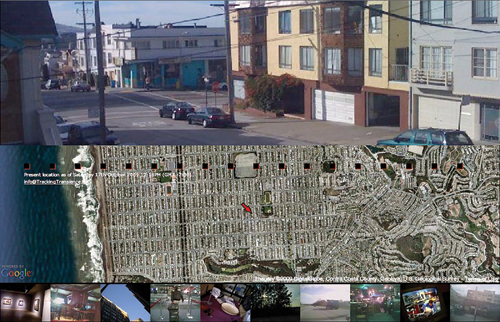
Hasan Elahi. Tracking Transience, 2003.
The research examines three projects where the internet is integral to the very structure of the work. Hasan Elahi publishes photographs of his travels, meals, and the places he visits, transforming his own life into an open archive and deciding for himself what makes it into the frame. Paolo Cirio and Alessandro Ludovico transplant photographs from public Facebook profiles onto a fictional dating website. The images remain recognizable, even though the person who posted them neither chose the new platform nor the reason for being viewed. McCarthy moves a typical online subscription into physical space, prompting the participant to live one day with an invisible observer.
Lauren Lee McCarthy. Follower, 2016. Exhibition view.
Special attention is given to how the observation is made available to the viewer. For Elahi, a single photograph says little about a person, but a series of consistently structured frames compels the viewer to seek out routes and habits. For Cirio and Ludovico, neighboring images and the category to which the portrait is assigned give a new meaning to the portrait itself. In Follower, the interval between the notification and the final photograph the participant receives is important. In every case, the interface only reveals a part of the relationship between the observer and the observed. Juxtaposing screens, photo series, and exhibition views helps reveal what is happening in the rest of that situation.
The research question is how net art makes digital surveillance palpable through human participation. It is hypothesized that the artwork allows viewers to understand the mechanism of observation when they assume a specific role within it. They might collect data about themselves, search for others' traces in a public archive, sort faces on a screen, or wait for a photo taken by a stranger. These roles offer varying degrees of control. Therefore, it is crucial in this study to distinguish between them: some participants decide for themselves what will be visible, while others discover that this has already been decided for them.
Introduction
Food photography can document a trip. The same photograph in an archive, where dates and coordinates appear nearby, allows for the indication of a route. A profile picture helps acquaintances recognize a person, but on a dating site, it begins to look like an invitation to connect. In both cases, the changes happen around the frame itself. Simply changing the publishing location, sorting method, or intended audience is enough to make a familiar image part of a different context.
Hasan Elahi. Thousand Little Brothers, 2014. Detail of the work from the photographs Tracking Transience.
Researcher Helen Nissenbaum links privacy to the rules governing how information moves within a specific context. A photograph might be visible to all platform users yet still remain an image published for a singular purpose. The public nature of a page alone does not explain whether its content is appropriate to transfer to another service. This distinction is crucial for analyzing net art: each of the three projects alters the conditions under which an image becomes accessible to someone.
Lauren Lee McCarthy. Follower, 2016. Exhibition documentation.
Viewers encounter artworks in various contexts. The Elakha website invites users to find meaning within a stream of everyday images. The Lovely-Faces interface allows users to select and rate other people’s profiles. In McCarthy’s work, the participant first becomes the subject of observation, and later receives a photograph as a result. It is this difference that allows for a comparison: what a person learns about surveillance when they are watching, versus what changes when they are being watched.
From Observation to Self-Observation
In 2002, Hasana Elahi was mistakenly placed on the watch list by U.S. authorities. After interrogations and background checks, the artist began reporting his travels and gradually expanded this practice into the online project Tracking Transience, which launched in 2003. His personal documentation gained a new audience. Details that Elahi shared with FBI representatives were also visible to others through his artwork. Any website visitor had the opportunity to glimpse into his everyday life.
Hasan Elahi. Tracking Transience, 2003. Archive photographs.
When the artist described the project in a 2016 interview, he noted that the habit of photographing food and reporting on his travels no longer seemed strange to those around him. Crucial to this shift was the transition from a standalone travel report to daily publication. While the individual chooses the frame, its publication remains accessible for others to read, compare, and utilize further. The more natural the habit of self-presentation appears, the harder it is to notice the moment when an external rule begins to govern the act of imaging.
Paolo Cirio, Alessandro Ludovico. Face to Facebook, 2011. Installation view at transmediale. 11, Berlin.
Face to Facebook illustrates this transition quite literally. Photographs users select themselves enter someone else’s sorting system. The Follower shifts the question to the next stage: the person actively requests to be watched, but can no longer view themselves from the position of an observer. Thus, self-observation, publishing, and surveillance become different ways to manage the same action—making someone else’s daily life visible.
Hasan Elahi. Archive without a self-portrait
In the early iteration of Tracking Transience, the location’s photograph appeared next to a map, and the screen composition changed. Visitors would see either the snapshot with its geographic reference or archival images. These included photographs of food, beds, airports, and other places the artist passed through. The map lent the frame a precision it lacked on its own. The interior might otherwise appear generic, but the coordinates connected it to a specific point.
Hasan Elahi. Tracking Transience, 2003. Image from the online archive.
Photography often presents a space as the author might see it. If the subject is food or a room, the artist’s body remains behind the lens. The viewer receives the artist’s point of view while simultaneously seeing it as a record of another presence. This is an unusual form of self-portraiture—here, the person is conveyed through surfaces, objects, and the path that must be reconstructed from fragments.
Khasan Elahi. Thousand Little Brothers, 2014. Exhibition view, Difference Machines, Buffalo AKG Art Museum.
In Thousand Little Brothers, the artist compiled nearly 32,000 photographs from Tracking Transience and arranged them across seven canvases. The colored stripes reference the test grid of the American Emergency Alert System. From a distance, the large color composition presents itself to the viewer. Up close, it dissolves into smaller images. The transition from photograph to mass becomes physically palpable here: to examine the individual shots, one must approach the surface and select a section that can be encompassed by the eye.
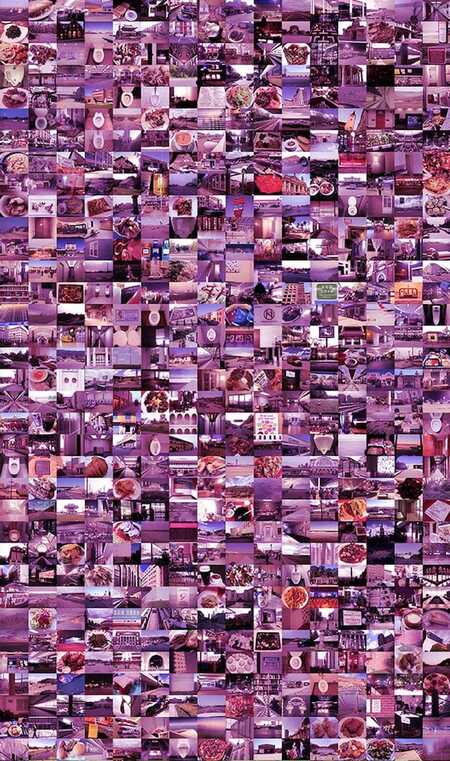
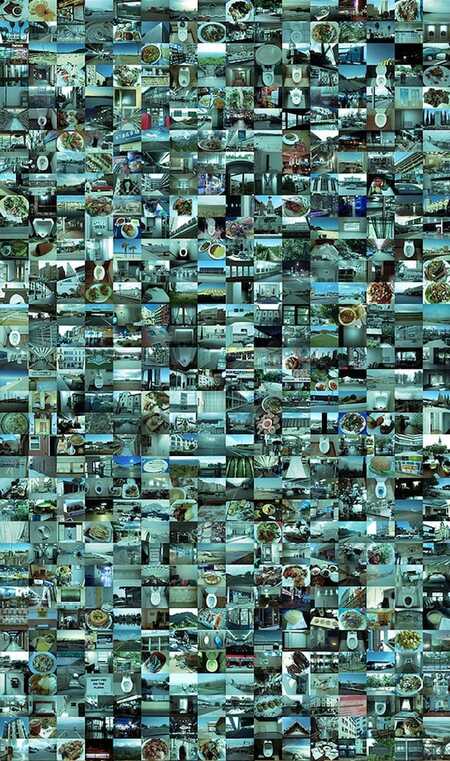
Hasan Elahi. Thousand Little Brothers, 2014. Work details.
In the small frames, similar angles repeat. Therefore, the viewer’s gaze first notices the row and color, then singles out individual objects and tries to relate them to one another. The archive engages the viewer in observation precisely at this moment. It behaves like a person who has gained access to a large volume of information and is now deciding which pieces are significant. Some photographs clarify the route, while others begin to repeat themselves. The more images that are open, the more noticeable the work of selecting them becomes.
Elakha’s openness functions as a means for her to dictate the form of her presence online. The artist chooses where to direct the camera, displaying the labor required to transform the mundane into a continuous record. This control over publication arose as a response to external pressure from authorities. Consequently, the project maintains a contradiction: the author manages her own archive, yet the impetus for its creation was the necessity of accounting for her movements to others.