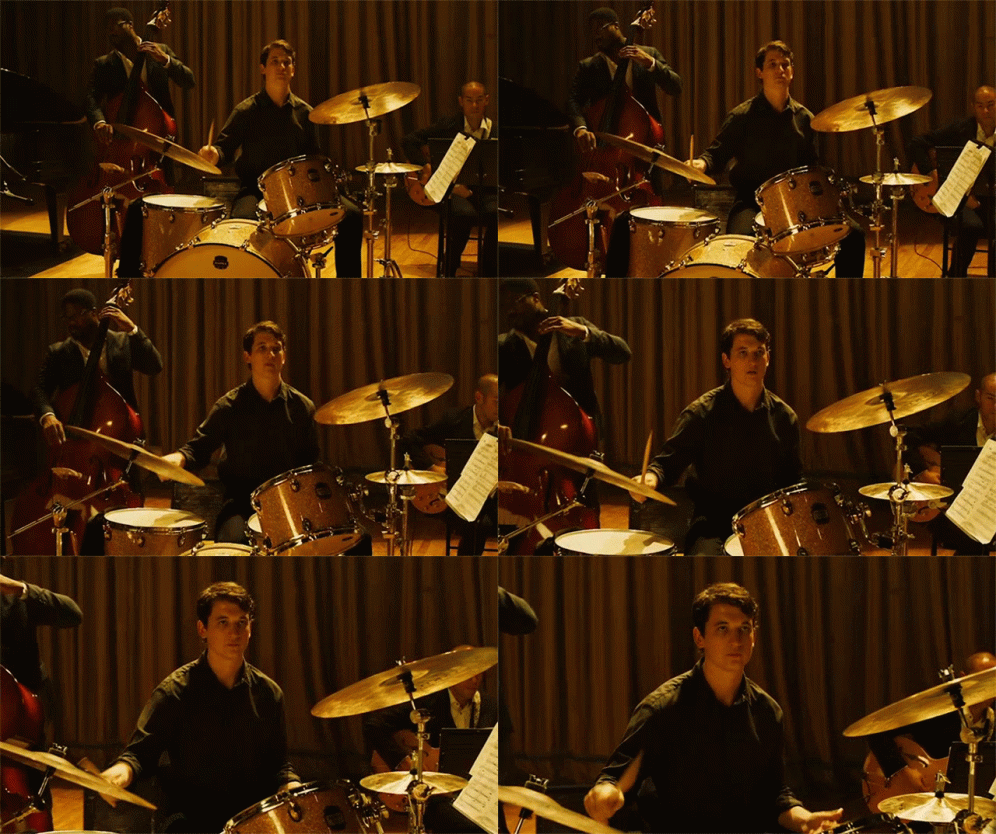
A clip from the film «Whiplash,» 2014.
Navigator
I. Concept II. Before the Drum III. Ancient Percussion Instruments IV. Rhythm as Language V. From Ritual to Orchestra VI. The Birth of the Modern Drum Kit VII. The Drum in the Digital Age VIII. Conclusion
Concept
Long before the advent of musical instruments, humans utilized surrounding objects and their own bodies to create sound—striking stone on stone, clapping their hands, stomping their feet. Gradually, these simple sonic actions began acquiring rhythmic structure and becoming part of collective, ritualistic, and other social practices.
This visual study examines the evolution of percussion instruments, from early sound-making methods to the formation of the modern drum kit. The relevance of this topic lies in the diversity of their construction and function: in different cultures, drums were used not only for making music but also for transmitting messages, conducting ceremonies, organizing collective actions, and signaling in warfare.
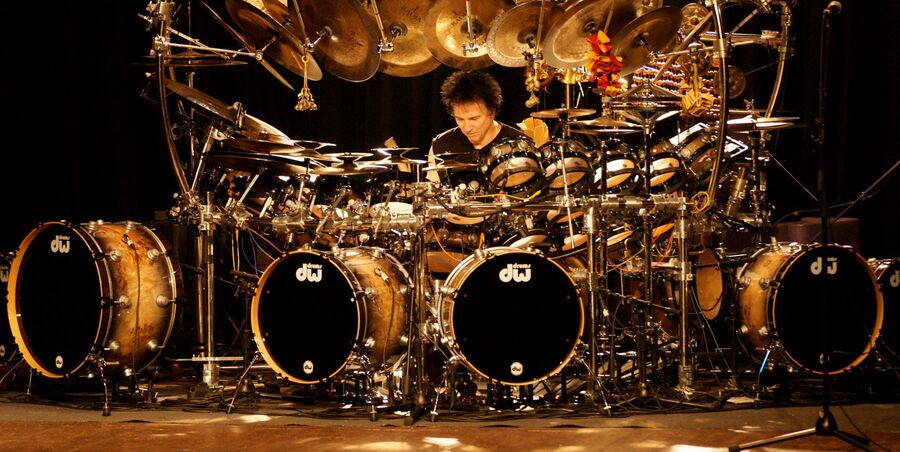
The goal of this research is to trace how the construction, materials, and function of percussion instruments have evolved under the influence of technological capabilities and the cultural needs of various societies.
Key Question: How and why did percussion instruments evolve from the simplest means of sound production into complex systems of musical, ritualistic, and communicative tools?
The selection of materials is based on a combination of chronological, geographical, technological, and functional approaches.
Hypothesis — the development of percussion instruments was determined not only by the human desire to create music but also by the need to interact with the surrounding world.
Before the drum
Sound accompanied humans long before the invention of musical instruments. The surrounding world was constantly generating sonic signals: the wind rustling through trees, water striking rocks, animals calling out to one another, and thunder breaking the silence. Humanity existed within this soundscape and gradually learned to utilize its potential.
To create sound, specialized equipment was not necessary. The voice, breath, and body movements were already capable of producing various auditory signals. Clapping hands, striking the body, the sound of footsteps, and contact with surrounding surfaces could form the basis of repeating rhythmic sequences. Such actions accompanied dances, collective work, and rituals. The exact timing of these practices is unknown—clapping and footfalls themselves leave virtually no archaeological trace. Therefore, we cannot reconstruct when humans first began consciously creating rhythm, but we can surmise that the body became one of the most accessible means of sound production.
Over time, sound sources were not limited to the body but extended to surrounding objects. People discovered that striking two stones created a resonant sound, hitting wood produced a dull echo, and hollow objects amplified certain sound vibrations. Natural materials possessed diverse acoustic properties, and using them unlocked new possibilities for creating rhythm.Stone proved to be a particularly interesting material. Certain types of stone can emit a sustained chime when struck. By selecting stones of a specific shape and size, one could generate sounds of varying pitches. Later, people learned to shape these objects into specialized instruments. Today, these are called lithophones—resonating stone plates or blocks that are placed on a stand and struck with specialized mallets or hammers.
Stone was not the only material humans could transform into a source of sound. Hollow shells, seeds, shells, bones, and wood were used to create rhythmic effects. One of the simplest instruments of this type was the rattle. Inside its body were small, hard objects that collided with each other and with the shell walls when shaken. Gourds, nut shells, shells, and other natural materials were used to make such instruments.
Archaeological collections allow us to see how diverse these constructions could be. For example, researcher Emily Brown studied about 1,300 musical objects from the archaeological sites of ancestors of modern Pueblo peoples in the southwestern United States. Among them, she found rattles, scrapers, bells, whistles, and other instruments. They were made from wood, bone, shells, gourds, seeds, and even small insect casings. These objects span various periods, starting from the first centuries CE, so they cannot be considered direct evidence of Paleolithic musical life. However, they do demonstrate how diverse the methods of creating sound with readily available materials could be.
Sound objects gradually became the result of deliberate craftsmanship. Humans no longer simply used a randomly found stone or hollow shell; they altered the material’s form to achieve a specific sound. One of the most compelling pieces of evidence for this approach was discovered at the archaeological site of Einan-Mallach in modern-day Israel.
In 2023, researchers published findings from their study of seven small instruments crafted from bird wing bones. The bones exhibited deliberately drilled holes and signs of use. Experimental replicas demonstrated that the tools could reproduce sounds resembling the cries of predatory birds. These artifacts date back to the final period of the Natufian culture and are approximately 12,000 years old. Researchers hypothesize that these sounds may have been used for interacting with birds, hunting, or musical practices. The precise function of these instruments remains a subject of scholarly interpretation. nps.gov+1
These finds are particularly important not because they are percussive instruments. On the contrary, they are wind instruments, where sound is created by moving air. They demonstrate that as early as the prehistoric period, humans were consciously altering natural materials to achieve a specific sound. Sound ceased to be merely a result of random interaction with the environment; it became a controllable instrument that could be shaped and utilized to meet specific goals.However, reconstructing a complete picture of early sonic practices is nearly impossible. Organic materials—such as hide, wood, and plant casings—deteriorate over time. Consequently, archaeologists most often find artifacts made of stone, bone, and ceramics. Even when an object recovered has an unusual shape or holes, its exact function is not always clear. To address this, researchers must take into account signs of craftsmanship, wear patterns, the deposition context, and the results of reconstructive experiments.The history of the first musical instruments, therefore, remains incomplete. We can study individual surviving objects, but we do not know what instruments existed before them or what sonic practices vanished without leaving material traces. Perhaps the simplest drums made from wood and hide appeared much earlier than the constructions archaeologists have managed to discover. But for now, this remains a hypothesis, not an established fact.Humans began interacting with sound long before the emergence of complex musical systems. Initially, their sources were their own bodies and surrounding objects; later, specially crafted structures appeared that allowed for control over the sound’s character. The next step was the creation of instruments where natural materials were integrated into a cohesive system: a hollow body, a tensioned surface, and a means of exciting that surface. Thus, the groundwork for the development of the drum gradually formed.
Birth of the Drum
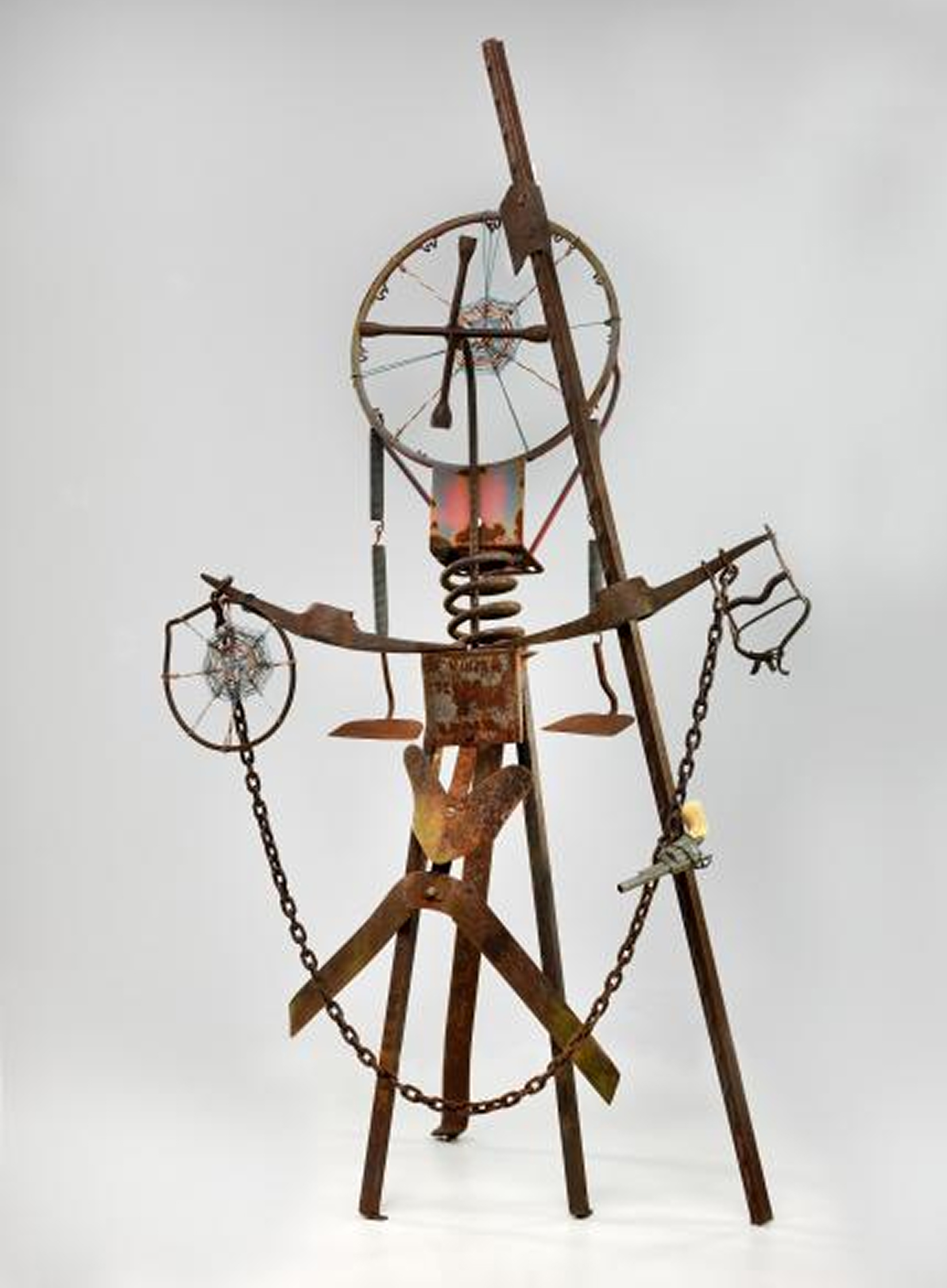
Traditional frame drum. Illustration of the construction principle.
Humans had already learned to extract sound from surrounding objects—by striking rocks, wood, hollow trunks, and vessels. But one day, a new principle of sound extraction emerged in this story. Instead of striking the object itself, humans stretched a skin over a hollow body and began striking the skin. This gave rise to a structure that became the basis of the drum.
In musical classification, such instruments are called membraneophones. Their main characteristic is that the sound is produced by the vibrations of the taut surface. Upon striking, the membrane begins to vibrate, while the body participates in shaping the sound. Depending on its shape, size, material, and the tension of the skin, the drum can sound dull, resonant, low, or sharp.
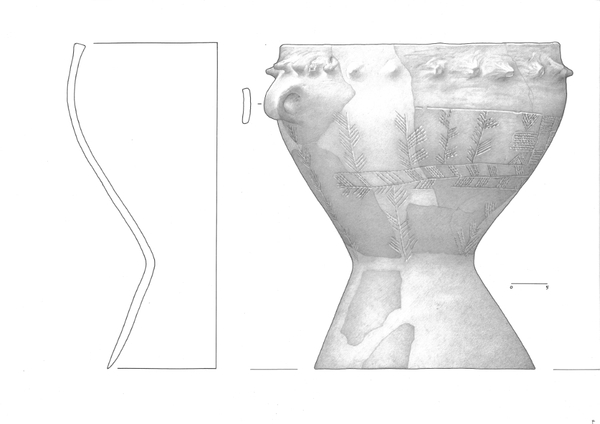
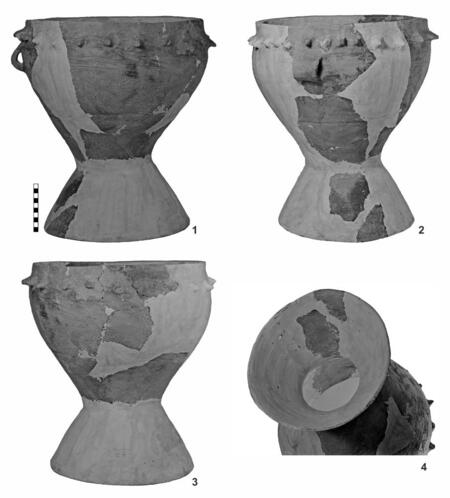
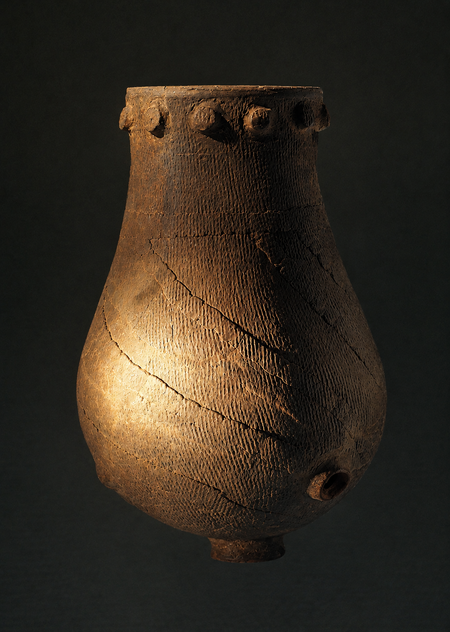
Burnburg Ceramic Drum from Derenburg, Germany. 4th–3rd millennia BCE.
To construct a drum, two different materials needed to be joined. The body created a cavity within which sound waves propagated, while the skin formed the surface driven by impact. The body could be crafted from hollowed-out tree trunks, wooden frames, ceramic vessels, or other hollow forms. The membrane was made from treated animal hide, which was secured using cords, holes, hoops, or specialized protrusions.Gradually, this design allowed for experimentation with sound. By altering the size of the body, the thickness of the skin, and the tension of its stretching, the artisan could achieve diverse sonic characteristics. In some instruments, the membrane covered only one side of the body; in others, it was stretched on both sides. Different playing methods emerged—using palms, fingers, or sticks. The drum evolved from a mere sound-producing object into an instrument capable of controlling rhythm.However, pinpointing the exact moment of its origin is practically impossible. Wood, leather, and plant fibers do not preserve well in archaeological settings. Therefore, the earliest drums may have existed long before the finds currently available to researchers. Archaeology more often reveals individual preserved elements, depictions of musicians, or objects whose function must be inferred through circumstantial evidence.One intriguing piece of evidence for the early existence of drums comes from Central Europe. During the Neolithic period, specialized ceramic items were made here, which archaeologists identify as clay drums. They are found in artifacts from several cultures linked to the tradition of funnel-shaped cups. To date, approximately 310 finds, fragments, and reconstructed examples are known from Central and Northern Germany, along with about 30 additional finds from neighboring regions. These are predominantly dated to the 4th and early 3rd millennia BCE. Researchers continue, however, to debate their precise function and potential connection to rituals. September 2024+1
The example from Derenburg, discovered in 1959, is particularly noteworthy. It measures about 48 centimeters in height. The body features an expanded upper section and a narrowed middle, and the surface is decorated with geometric and botanical motifs. A series of protrusions is located beneath the upper rim, which may have been used to secure a membrane. The object was found shattered into large fragments and subsequently reconstructed by museum specialists. Some missing sections and ornaments were filled in with plaster. Therefore, it is important to distinguish between the original parts of the find and the restoration elements. September 2024+1These finds suggest that people were creating specialized objects as early as the Neolithic period, the shape of which may have been related to extracting rhythmic sound. However, they do not allow us to assert that the first drum originated in Central Europe. Such constructions could have arisen independently in different regions, and the absence of preserved organic materials leaves the archaeological picture incomplete.The emergence of the drum represented a significant step in the development of human sound culture. Rhythm could be reproduced repeatedly, established for a group of people, and used to accompany movement, dance, or ritual. The next phase of this history is less about the instrument’s construction and more about the role it played in human societies.
Ancient percussion instruments
When the first civilizations began building cities, forming states, and shaping complex religious systems, music became integral to public life. It accompanied festivals, ceremonies, military events, burial rites, and daily recreation. Percussion instruments occupied a unique position within this system: their sound helped set the rhythm for collective actions, signify the solemnity of an event, and unite people in shared activities.However, ancient societies did not categorize instruments as modern music theory does. Drums, rattles, bells, cymbals, and clappers could exist together in one ensemble, fulfilling diverse functions. Some created sustained rhythmic patterns, others highlighted specific sonic moments, and a third group was used in religious ceremonies. Therefore, the history of percussion instruments cannot be reduced merely to the history of the drum.Mesopotamia was one of the first regions where musical culture developed in complexity. Within the territory between the Tigris and Euphrates rivers existed Sumerian, Akkadian, Babylonian, and Assyrian states. Music was connected to temple life, royal ceremonies, and celebrations. This is documented in cuneiform texts, images of musicians on seals and reliefs, as well as the archaeological remains of the instruments themselves.
Rhythm as Language
From Ritual to Orchestra
The Birth of the Modern Attack Platform