Research Concept
Where does the weight, movement, and drama in Pisanos' marble figures originate?
Niccolò Pisano and his son Giovanni worked in Pisa, Siena, and Pistoia during the second half of the 13th to the beginning of the 14th century, and their stone pulpits are often cited as the beginning of the sculptural revival in Italy. What interested me was something else: in these reliefs, figures suddenly become corporeal; they acquire weight, torsion, gesture, and emotion. I chose this topic because I wanted to understand where this «vitality» comes from and why it manifests differently in the father and the son. For me, it is also a way to learn how to look at a relief—to notice how movement is structured, not just what is depicted. I believe that such a question can be answered primarily through sight, by comparing the images themselves, rather than by recounting textbook assessments.
The core question of this project is: how did antique models and Gothic style make Pisano’s figures corporeal and dramatic? My hypothesis is that Niccolò’s physicality stems from Roman marble: weight, volume, and assured posture. While Giovanni’s drama arises from the Gothic style, which introduces a sense of suddenness. However, one does not negate the other: Niccolò already incorporates Gothic elements, and Giovanni does not disregard the Roman legacy. Vitality, it seems to me, emerges from the meeting of two sources, and this encounter is what I aim to demonstrate.
The work is divided into three sections and a conclusion. In the first, I compare Roman sarcophagi and the sculpture of Pisa with Niccolò’s pulpit in the baptistery (1260)—focusing on posture, bodies, and drapery folds. In the second, I compare Niccolò’s pulpit in Siena (1265–1268) with Giovanni’s pulpit in Pistoia (1297–1301) to observe what changes in movement, emotion, and the composition of crowds. In the third, alongside Giovanni’s works, I present examples of French Gothic art to try and understand the source of his expressiveness. In the conclusion, I test my hypothesis. The material was selected based on two principles. First, I chose pairs where the subject or figure type coincided—such as the Virgin Mary, the Beheading of the Infants, or the Crucifixion—because the differences in posture and gesture are best visible when the prompt is the same. Second, every pair has supporting documentation in literary sources: I am not inventing connections, but verifying relationships cited by researchers through the visual evidence.
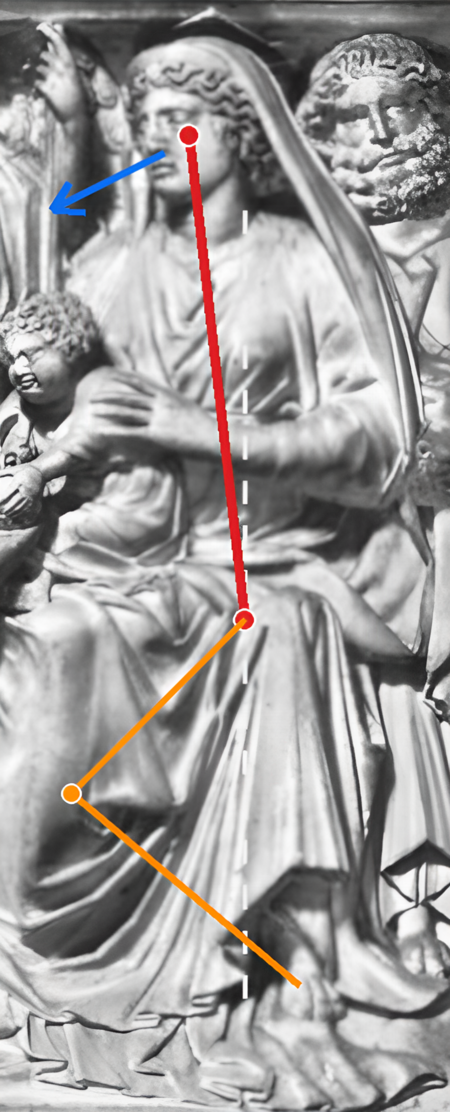
From textual sources, I utilize survey monographs on Italian art and sculpture, encyclopedia articles, and museum descriptions. Where opinions diverge—for example, regarding the involvement of assistants or which scene the image of Phaedra repeats—I state this plainly. The primary material of the work consists of images, and the text serves to verify my observations. My own element of research is motion schematics drawn over photographs. These demonstrate body axes, the direction of gestures, and the rhythm of folds—in other words, elements that are difficult to describe in words but easy to compare visually.
1. Antiquity -> Niccolo
Nikolo wasn’t reinventing the body: Roman marble lay in Pisa practically next to the baptistery.
Pisa considered itself the heir of Rome, and the cathedral square was surrounded by an unusually large number of ancient sarcophagi. For the sculptor, this was a ready-made workshop filled with models, and it was from there that Niccolo drew poses, heads, and folds of clothing for the Department in 1260.
— Fedra and Maria
Sarcophagus with the Myth of Phaedra and Hippolytus. Rome, c. 180 CE. Camposanto, Pisa
Niccolò Pisano. Adoration of the Magi. Baptistery, Pisa, 1260.
Literature converges on the notion that Nicola closely follows seated Fedra when sculpting the Virgin Mary. Vasari noted this already, and today this connection is considered widely accepted. From the Roman figure to the Christian relief, we see a transition in heavy posture, massive head, and large folds draping over the body. Mary ceases to be a flat icon and becomes a body that possesses weight.
— Dionysus and Simeon
Roman Dionysus with a satyr. [Example from Hall, pp. 231–232]
Niccolo Pisano. Bringing into the Temple. Baptistery Department, Pisa, 1260.
Saint Simeon in the scene of the Presentation in the Temple is modeled after the Roman Dionysus. In both cases, the figure is supported by a young attendant: a satyr in the ancient god’s depiction, and a servant in Niccolo’s. The Christian narrative receives classical plasticity, yet the pose remains unchanged—a fine example of how «vitality» is borrowed directly from the original model.
— Heracles and «Power»
Roman Hercules in contrapposto.
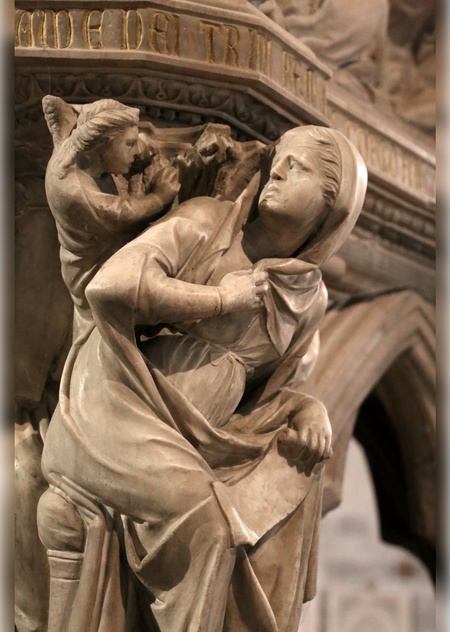
Niccolò Pisano. «Strength» (Heracles). Baptistery, Pisa, 1260.
The nude man in contrapposto is considered the first heroic nude in Italian art since antiquity. This is the most open Roman «quotation» image in the Department. However, Niccolò does not copy it precisely: the head seems too large, and the drapery on other figures remains broken, as in the medieval tradition. Thus, one object reveals where the Roman model has already prevailed, and where it has not yet done so.
— Author’s Diagram
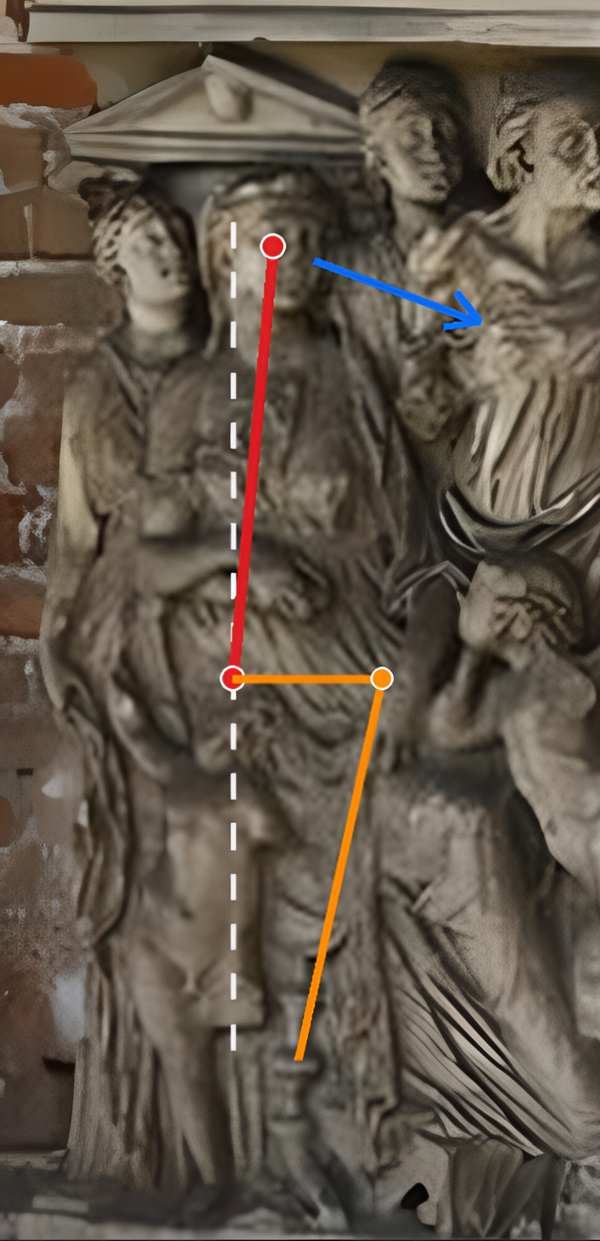
Sarcophagus with the myth of Phidias and Hippolytus. Rome, c. 180 AD. Camposanato, Pisa.
Niccolò Pisano. Adoration of the Magi. Baptistery Department, Pisa, 1260.
It is apparent that both figures share a similar, heavy lean and the same support on the hip. The difference is that Phaedra’s pose communicates her feeling, while Maria’s communicates her role within the scene.
The Roman mold provides Niccolo with form: weight, volume, posture. But the movement is still restrained.
2. Niccolo $\rightarrow$ Giovanni
The father builds the stage; the son makes it move.
The contract for the Sienese chapel (1265) stipulated seven reliefs instead of five in Pisa. Giovanni’s chapel in Pistoia (1297–1301) is built in the Sienese style, and the order of the reliefs is taken from there. Consequently, the differences in marble treatment are particularly noticeable.
— Infant Abuse
Niccolò Pisano with assistants. Beating of infants. Siena Cathedral Department, 1265–1268.
Giovanni Pisano. Beating of Infants. Department of St. Andrew’s Church, Pistoia, 1297–1301.
There was no narrative in Pisa, and in Siena, it became a novelty for the department: here there were nearly twenty-four nude children instead of the usual three or four, and the soldiers and mothers were not standing in formation, but fighting, throwing themselves, and hiding. In Pistoia, the scene is equally crowded and dramatic, but Giovanni’s surface is sharper and cut deeper, whereas the father’s forms are more massive and monumental. Where the plot demands drama, Giovanni does not restrain open emotion.