Concept
For my research, I selected two monuments of 12th-century French Romanesque sculpture: the tympanum of Saint-Foy Church in Conques and the tympanum of Saint-Lazare Cathedral in Autun. Both reliefs depict the Last Judgment. In Christian tradition, this is Christ’s judgment over humanity at the end of time, where their fate is determined. In sculpture, this subject matter can integrate several episodes into one composition, including the resurrection of the dead, the weighing of souls, the salvation of the righteous, and the punishment of the condemned.I was interested in how such a complex narrative transforms into a scene that can be grasped with a single glance. In both churches, the relief occupies the tympanum—the field between the doorway and the arch above it. The arch constrains the space for the figures, and the position above the entrance establishes a view from below. I am interested in comparing how two sculptors, under similar conditions, arranged the episodes and which parts of the scene made themselves noticeable from a distance.
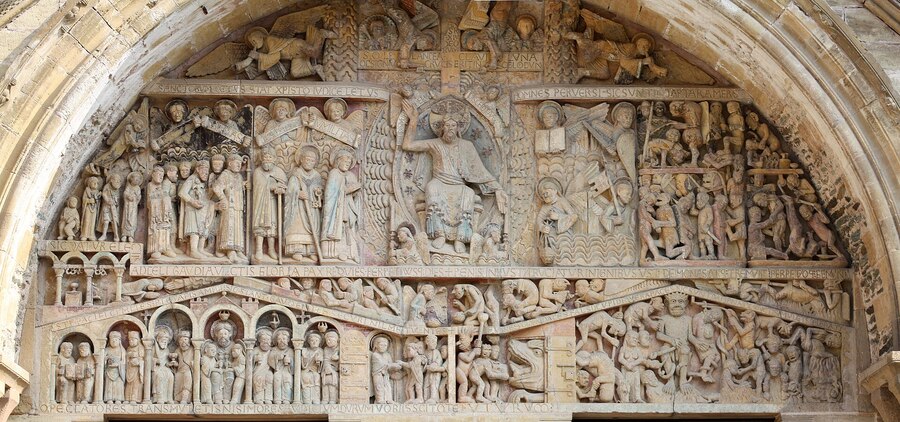
Unknown master. «The Last Judgment.» Tympanum of Saint-Foy Church, Conques. First half of the 12th century.
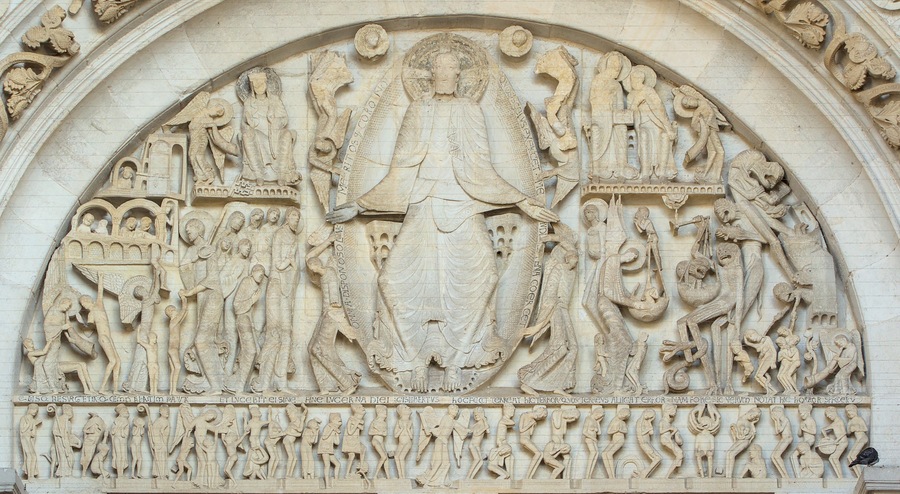
Ghislebert (presumed artist). «Last Judgment.» Tympan of Saint-Lazare Cathedral, Autun. Circa 1120–1135.
The central question of this research is how the composition of the tympana in Conca and Otione helps the viewer connect the separate episodes of the Last Judgment and understand the fate awaiting the saved and the condemned. My hypothesis is that the relief can be read on multiple scales. In the overall view, the size and placement of Christ define the center, while the tiers help distinguish groups of figures. In detail, gestures and inscriptions clarify the meaning of the events. The arrangement of the scenes relative to each other suggests how the depicted actions are connected. Therefore, the same episode can play a different role depending on the space assigned to it within the tympanum.
The chapters of this study are structured around elements of composition: the scale and placement of the central figure—Jesus Christ—as well as the division into tiers, gestures, and movement, the layout of heaven and hell, and the framing of the portal. In each chapter, the same element is examined in both Conca and Otione. This allows for a comparison of how the sculptors emphasize key figures, link the episodes, and depict the various outcomes of the judgment.
The main principle for selecting images is the ability to compare the same episode or compositional technique in both monuments. The general views of the portals show where the relief is situated in relation to the entrance, while photographs of the entire tympana allow for a comparison of figure proportions and scene placement. Close-up shots help examine the details that determine the reading of the episode: gestures, inscriptions, and objects held by the characters. For comparison, I chose photographs where these details are discernible and the fragment’s placement can be cross-referenced with the general view.
For this research, I utilized catalogs and art historical publications dedicated to these monuments. I used the catalogs to verify dating and authorship information. The descriptions of the reliefs helped identify the characters and understand the inscriptions. I compared this information with photographs of both tympana.
Two portals: Konk and Otyon
In Conke and Tone, the Judgment Day greets the viewer above the temple doors. From the general view of the entrance, the shape of the arch and the placement of the relief are visible. The small figures are harder to distinguish from this point, but the large forms establish the composition of the entire scene. Therefore, the comparison begins with what is visible right at the entrance—with the position and scale of the figure of Christ.
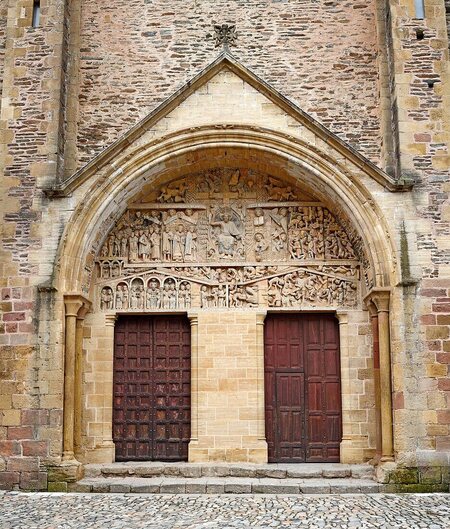
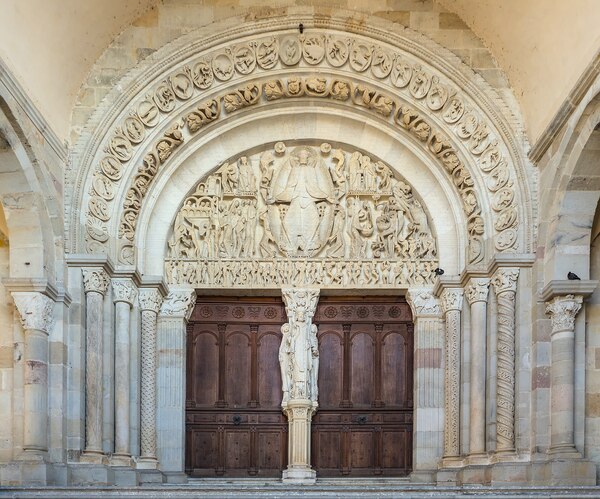
1. Western portal of the Church of Saint-Foy, Conques. 2. Main portal of Saint-Lazare Cathedral, Autun.
Center and Scope
In both reliefs, Christ occupies the highest position beneath the arch. His figure is larger than the surrounding figures, and the almond-shaped framing, the mandorla, allows it to be distinguished from the neighboring groups. The scale immediately indicates who is presiding over the judgment. To understand exactly how this decision is depicted, one must examine what is happening around Christ’s hands and how the inscriptions relate to his figure.
On both tympana, Christ divides people into the saved and the damned.
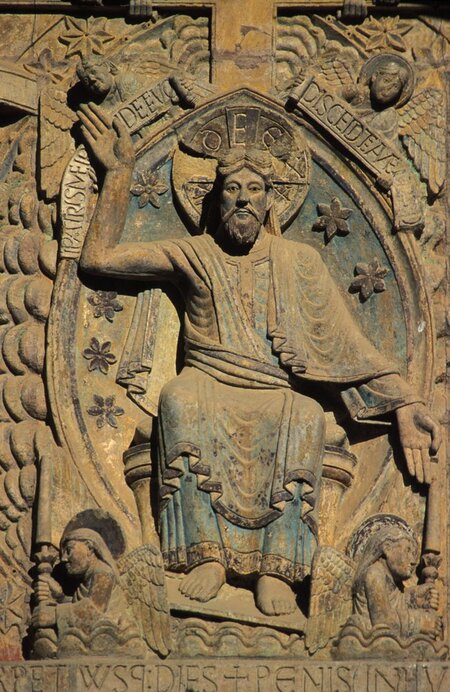
Unknown Master. «Last Judgment, ” fragment of „Christ in a Mandorla.“ Tympanum of Saint-Foy Church, Conques. First half of the 12th century.
In the Conque, this division is expressed in his posture. The raised right hand faces the saved, and the lowered left hand faces the condemned. The inscriptions near Christ clarify the meaning of the two gestures: with one, he invites them to the Kingdom of Heaven; with the other, he turns them away from himself. Thus, the two sides of the relief receive different directions starting from the central figure—up and down. The gesture itself suggests that different words are directed toward the two groups.
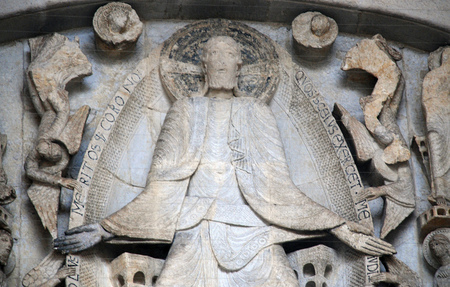
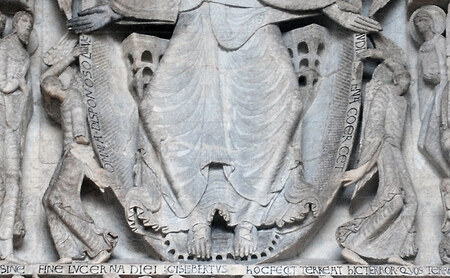
Jusibert (presumed author). «The Last Judgment.» Two fragments of the figure of Christ in a mandorla. Tympan of Saint-Lazare Cathedral, Autun. Circa 1120–1135.
In The Tones, Christ spreads his arms out to both sides at roughly the same height. The difference between the two outcomes of the judgment is more easily discerned by what surrounds the figure. On one side of the mandorla, an inscription speaks of reward; on the other, of punishment. Groups of the saved and the condemned are positioned on either side of Christ. The viewer understands who is destined for which fate by moving their gaze from the figure of Christ to the inscriptions and the neighboring scenes.
Stages and scene boundaries
Trumpet Call. The Beginning of the Trial
On both tympana, angels sound the trumpet, announcing the resurrection of the dead. The sculptors faced one challenge—to render sound in stone and convey the event that followed it. The horn held to the mouth signifies the trumpet call, and the arrangement of the angels connects it to the other scenes.
Unknown Master. «Last Judgment,» fragment from «Trumpeting Angels by the Cross.» Tympanum of Saint-Foye Church, Conques. Early 12th century.
At the top register, angels blow trumpets to the sides of the cross. The people being called from their tombs are depicted in another section of the relief, closer to the scales. The call surrounds the cross and is perceived as a sign of the beginning of the general judgment. The viewer sees its consequence in a separate resurrection scene.
Juslibert (presumed artist). «The Last Judgment, ” fragment of „The Trumpeting Angel Above the Arch of the Resurrected.“ Saint-Lazare Cathedral, Autun. Circa 1120–1135.
In the Tympanum, winged angels are situated near the bottom edge of the tympanum, beside the lintel where people emerge from tombs. Here, the source of sound and its consequence are closely intertwined. To understand the connection between them, one only needs to observe how the angel figure abuts the row of the resurrected.
The narrative in both reliefs is the same. In Konk, the trumpet call is connected to the cross and marks the beginning of an event that encompasses the entire composition. In Otyon, it is primarily associated with a group of the resurrected. The placement of the identical figure changes how the viewer reads the episode.
Day of the Dead
Unknown Master. «The Last Judgment,» fragment from «The Resurrection of the Dead.» Tympanum of Saint-Foy Church, Conques. Early 12th century.
In the Concilium, the resurrection is shown in a brief episode next to the weighing of souls. Angels open the tombs, and people rise from them. The proximity of the two scenes allows the viewer to see the connection between the actions: those who have just risen from the dead appear before judgment.
In Tonal Resurrection, a long band runs above the doorways—the portal lintel. Figures emerge from the tombs across its entire width. The angel beneath Christ’s feet divides the resurrected into two groups. Therefore, the repeating row of tombs shows that the resurrection concerns everyone, while the angel’s figure denotes the moment when human destinies diverge.
Gestures and Movement
What’s happening on the scales?