Navigator
- Research Concept
- Why Did They Shoot It? Germany in the 1960s
- The «Becher Protocol»: Why Are the Photos So Similar?
- Water Towers: How the Grid Works
- Gas Holders and Coal Mines: The Aesthetics of Industry
- How Bechers Revolutionized Photography: The Düsseldorf School
- Conclusion
- Bibliography
- Image Sources
Research Concept
This study attempts to decipher the true value of Bernd and Hilla Becher’s photographs. For decades, they documented old factories, water towers, and mines—structures that were eventually torn down as obsolete. The central question of my work is: how does this purely documentary depiction of these objects enable us to see conceptual art within them, and why have these series of images become so culturally significant? I hypothesize that the value of the Bechers’ work stems from documenting a fading industrial era. They managed to capture things that no longer physically exist today. Furthermore, they were not simply taking snapshots for posterity; they created a vast archive where, through the rigorous repetition of angles, the exclusion of superfluous details, and the grouping of frames, the viewer begins to perceive technical structures as independent art objects. The photographic book functions here as a space that preserves vanishing architectural realities, transforming them into pure concept.
I am drawing my research material from specific albums published by the studio from the late 1980s to the late 1990s. Each album was assembled around a singular principle, yet applied to different architectural subjects. The foundation is laid by the books Water Towers (1988) featuring water towers and Gas Tanks (1993) with gas reservoirs—these clearly illustrate the authors' fundamental methodology. For more complex structures and forms, we will examine the album Blast Furnaces (1990), which showcases massive blast furnaces. To see how this logic functioned outside of Europe, I included the book Pennsylvania Coal Mine Tipples (1991) on coal trestles in the United States. Finally, we will explore how Becher handled flat surfaces and mining structures through the publications Industrial Facades (1995) and Mine Heads (1997).
The long-form article structure moves from the historical context to specific photographs. First, we will examine the atmosphere of 1960s Germany: what was happening with its industry, and why Becher first conceived the idea of totally documenting vanishing factories. Next, we will look at their shooting conventions—why they photographed only in overcast weather and without people, making the images as similar to each other as possible. Using the example of towers, we will explore how the grid is structured on the pages of the books, and using the examples of gas holders and mines, we will examine exactly how the aesthetic of these photographs functions. Finally, we will assess their influence on the students who later formed the Düsseldorf School.
Why did they film this? Germany in the 1960s
In the late 1950s and early 1960s, West Germany experienced the so-called «economic miracle,» but for older industrial regions, such as the Ruhr Valley and the Zillertal, it signaled the beginning of the end. The coal mines and metallurgical plants built in the late 19th to early 20th centuries were rapidly becoming obsolete. The economy was shifting toward oil and gas, rendering the massive industrial complexes unprofitable. They weren’t converted into museums or placed under preservation—they were simply demolished and dismantled for scrap metal.
Bernard and Hilda Becher. «Industrial Landscapes.» Hainer Hütten Steelworks, Ziegen, 1961.
For Bernd Becher, who grew up in a family of miners in Siegerland, these landscapes were not exotic scenery, but a familiar habitat that was literally disappearing before his eyes.
Initially, Bernd Becher studied as a painter and graphic artist, attempting to sketch factory closures from life. But it soon became clear: a pencil and brush could not keep pace with the demolition crews. In 1959, he partnered with photographer Hills Bober. Together, they realized that the only way to preserve this architecture was to document it before the buildings turned into piles of bricks. Thus, a personal nostalgia for a vanishing childhood landscape blossomed into a large-scale rescue operation armed with a large-format camera.
Brand and Hilla Becher. «Fachwerk Houses of the Ziegen Industrial Area, ” 1959–1978
Bernhard and Hilla Becher. «Half-Timbered Houses of the Ziegen Industrial Area, ” 1959–1978
In post-war Germany, industrial architecture was regarded as purely utilitarian. Art historians considered cathedrals, palaces, or at least Bauhaus modern villas to be «true» architecture. No one perceived a water tower or a cooling tower as a cultural monument—they were simply functional mechanisms. Becher were the first to recognize an independent plastic form in these «unbeautiful» structures and termed them «anonymous sculptures.» Since these structures, made of concrete and metal, were not meant to be preserved, they needed to be preserved on paper—in the form of a photobook.
Bernard and Hilda Becher. Book: «Anonymous Sculptures: Typology of Technical Structures.» 1970
It is at this moment that the simple documentation of a passing quality begins to function as a conceptual gesture. By extracting the factory building from its familiar, grimy context and placing it on the clean page of an album, Becher shifted the viewer’s perspective. The photo book became a new, permanent space of existence for these buildings. What was slated for demolition in reality transformed into a museum exhibit on paper.
Bernhard and Hilda Becher. «Cooling Towers (Steel—Wood), Ruhr Region, ” 1963–1972
Bernhard and Hilla Becher. «Cooling Towers (Steel—Wood), Ruhr Region, ” 1963–1972
However, one desire to save a vanishing era was not enough. For the viewer to truly perceive art in the old mine, rather than just a local history postcard, Becher required a rigorous, almost scientific method of photography.
«Becher Protocol»: Why are the photos so similar?
If you look at any of Becher’s series, the absolute sterility of the frames immediately strikes the eye. There is no random weather, no passersby, no picturesque sunsets, and no dramatic low-angle shots. This is not artistic whim; it is a rigid, systematic protocol they developed in the early 1960s and never changed for the rest of their lives.
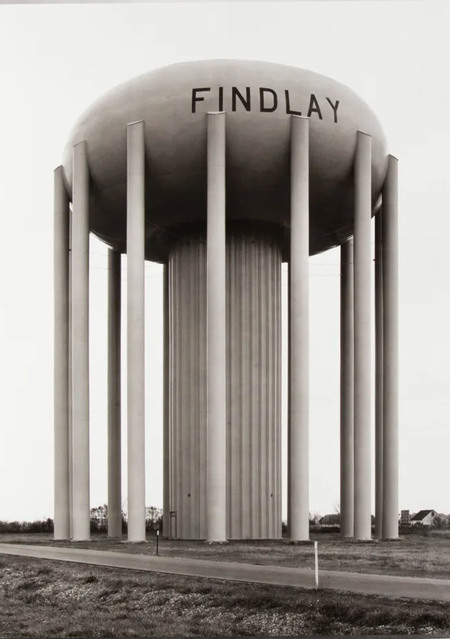
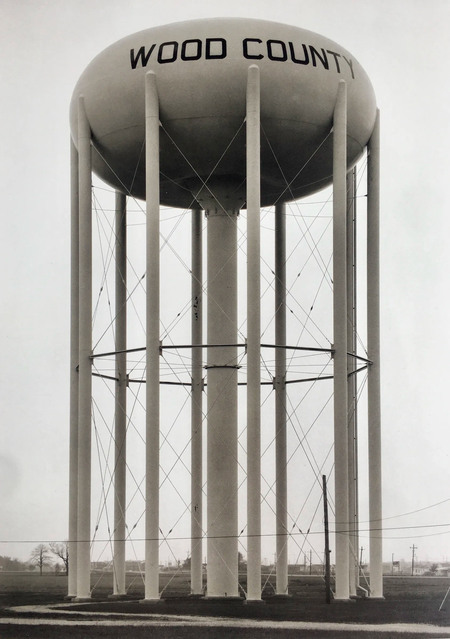
Brand and Hilda Becher. Two water towers (front view comparison). 1970s
The first rule of the method was to shoot exclusively on overcast days or early in the morning, before the sun reached its zenith. Bechers avoided direct sunlight and deep shadows. Their goal was to reveal the object’s pure structure, not to play with contrasts of light and shadow. Diffused light erased random highlights and transformed the photograph into a blueprint, where every rivet and sheet metal seam was visible.
Bernhard and Hilla Becher. Fragment of Industrial Construction. 1970s
The second rule is a strictly frontal perspective. They never photographed buildings from diagonal angles that would impart dynamism or the «heroic» appearance characteristic of Soviet or American industrial posters. For this, they used a heavy large-format camera mounted on a wooden tripod, positioning it at eye level or raising it on a special gantry so that the lens axis was strictly perpendicular to the building’s facade.
Bernd Becher at work with a large-format camera against the backdrop of an industrial complex. 1970s.
These frames fundamentally lacked human presence. The photographs show neither workers nor smoking smokestacks in operation, nor the roar of machinery. Behers deliberately stripped away the social and romantic pathos of labor. Their subjects appear as abandoned monuments of the industrial age—frozen in time, their function exhausted, yet their forms remaining.
Brand and Hilla Becher. Grain Elevator, Sheldon, Illinois, USA. 1986
Thanks to this methodology, Becher’s photographs resembled pages from botanical atlases or archaeological catalogs. They «cataloged» architecture as if it were rare species of insects or minerals. Yet, it was precisely this pseudoscientific dryness that transformed documentation into pure conceptual art: the form of the object began to speak louder than its utilitarian function.
When hundreds of such «impartial» photographs were brought together, Becher’s main tool was born—the typological book grid, which we will discuss using the example of his famous water towers.