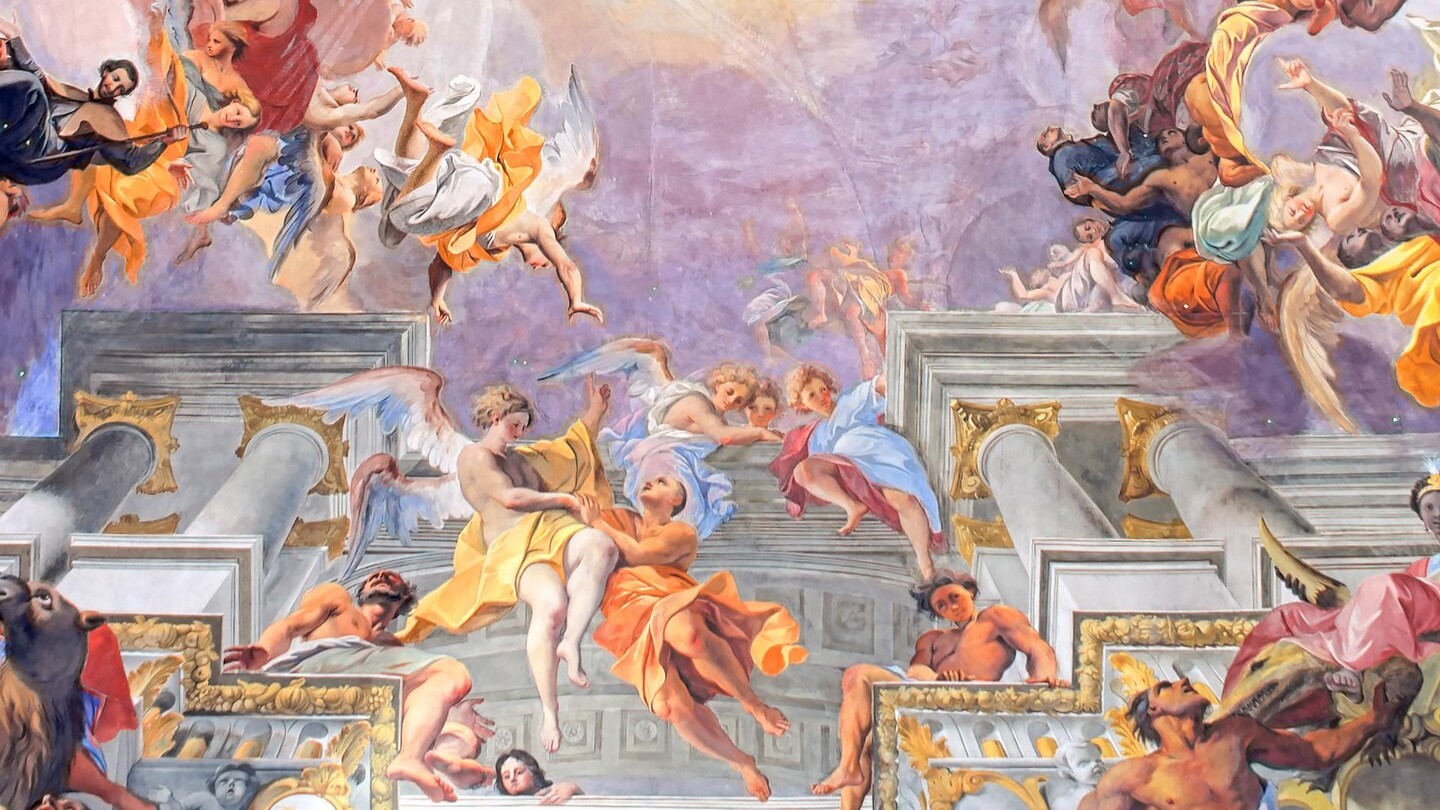
Как художники учились рисовать пространство (XIII–XVII века)
Как живопись обрела глубину: от плоской иконы до прямой перспективы и иллюзий барокко.
Categorization
- Concept
- Chronological Scale: Five Stages of Evolution
- Comparison of the 13th and 17th Centuries
- Chapter 1: The Flat World and Golden Background (13th Century)
- Chapter 2: The First «Boxes» and Intuitive Depth (14th Century)
- Chapter 3: The Invention of Linear Perspective (15th Century)
- Chapter 4: Aerial Perspective and Shift in Viewpoint (16th Century)
- Chapter 5: Breaking Boundaries and Baroque Illusions (17th Century)
- Conclusion
- Bibliography
- Image Sources
Concept
Any painting is an attempt to translate a voluminous, three-dimensional world onto the flat surface of a board, wall, or canvas. But throughout the centuries, artists have approached this challenge in different ways. What seems natural to the contemporary viewer—streets receding into the distance, figures diminishing on the horizon, and the depth of an interior—is actually the result of five centuries of searching, mathematical discoveries, and bold optical experiments. This visual exploration traces the evolution of artistic space in European painting from the 13th to the 17th century. Over five centuries, the painting evolved from a flat, precious icon, where no depth exists whatsoever, to dizzying Baroque frescoes capable of visually shattering the ceiling of a cathedral and revealing the infinite sky above the viewer.
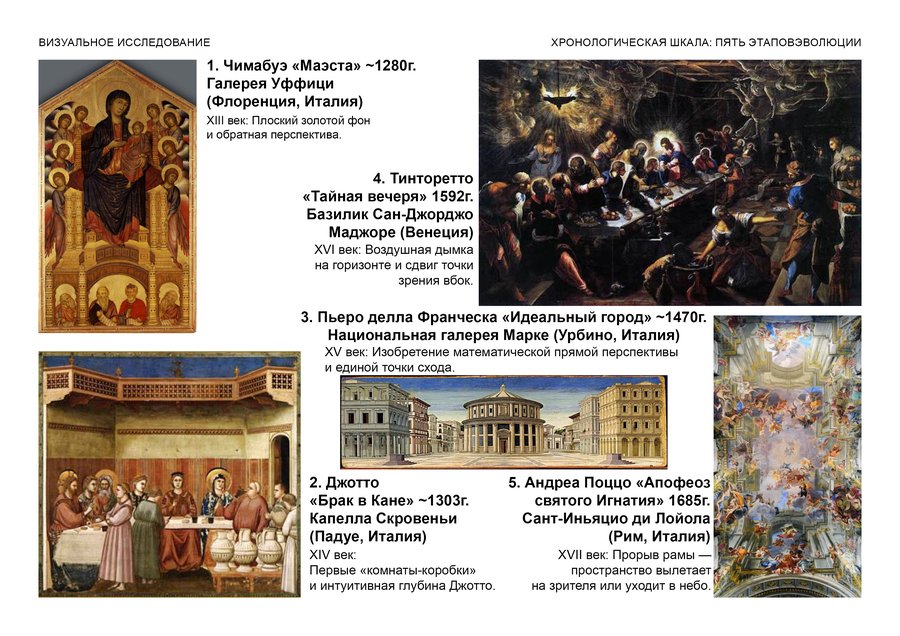
Visual Methods and Structure
The research is not constructed as a textbook summary, but as a tangible, visual analysis. The primary tool of the work is visual montage and close examination of detail. Each stage of evolution is revealed through carefully selected masterpieces of world painting and enlarged fragments of those works. By juxtaposing the overall composition of the paintings with close-up details of interiors, landscapes, and figures, the study demonstrates step by step how space within the frame became more complex.
The Artist Becomes a Scholar
At the turn of the 14th and 15th centuries, the role of the painter in society underwent a transformation: shifting from a craftsman applying decorative motifs according to old conventions, the painter evolved into an intellectual and a researcher. The new humanistic worldview placed humanity at the center of the universe, meaning that the world depicted in a painting now had to be constructed as perceived by a real human eye from a specific vantage point.