Navigator
1. Research Concept
2. Introduction
3. Material Selection Principle
4. Key Question and Hypothesis
5. Marlboro Before Repositioning: The Women’s Cigarette
6. Brand Crisis and the Emergence of Change Opportunities
7. 1954: Transition to a Male Audience
8. The Visual Language of Marlboro Man
9. Consumer Psychology and Selling Identity
10. Marlboro Country: Transforming Advertising into a Brand World
11. Brand Development After Repositioning
12. Contradictions and Boundaries of the Advertising Persona
13. Conclusion
14. Bibliography and Image Sources
Research Concept
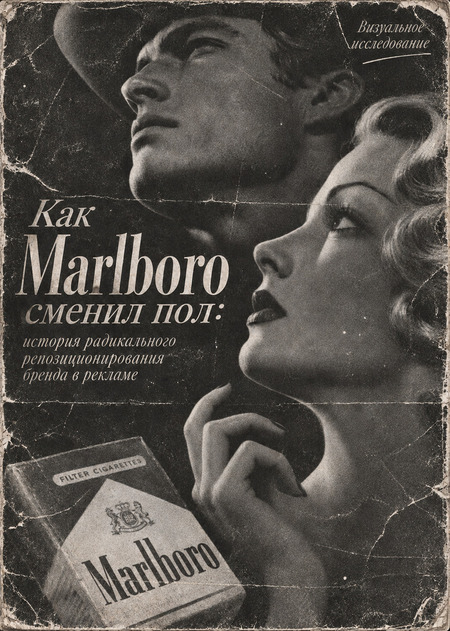
This visual study focuses on the history of Marlboro’s radical brand repositioning. Today, Marlboro is most frequently perceived as a symbol of masculinity, freedom, independence, and the American West. The solitary cowboy against an open landscape has become the brand’s central icon. However, Marlboro was originally created as a women’s cigarette and was marketed through ideas of softness, delicacy, and attractiveness. I am interested in exploring how the same product managed to alter its gender perception, transitioning from the category of feminine goods to the category of overtly masculine goods. To do this, it is crucial to analyze Marlboro not only from the perspective of advertising campaigns but also as a complete branding system, encompassing the packaging, name, color, visual symbols, characters, slogans, and consumer behavior. In this case, the advertising does more than just communicate product features—it constructs an image of the person the consumer can aspire to be. The cigarette becomes a signifier of a particular character, lifestyle, and social standing. Therefore, the Marlboro story offers a lens through which to examine the shift from product advertising to identity advertising.
Introduction
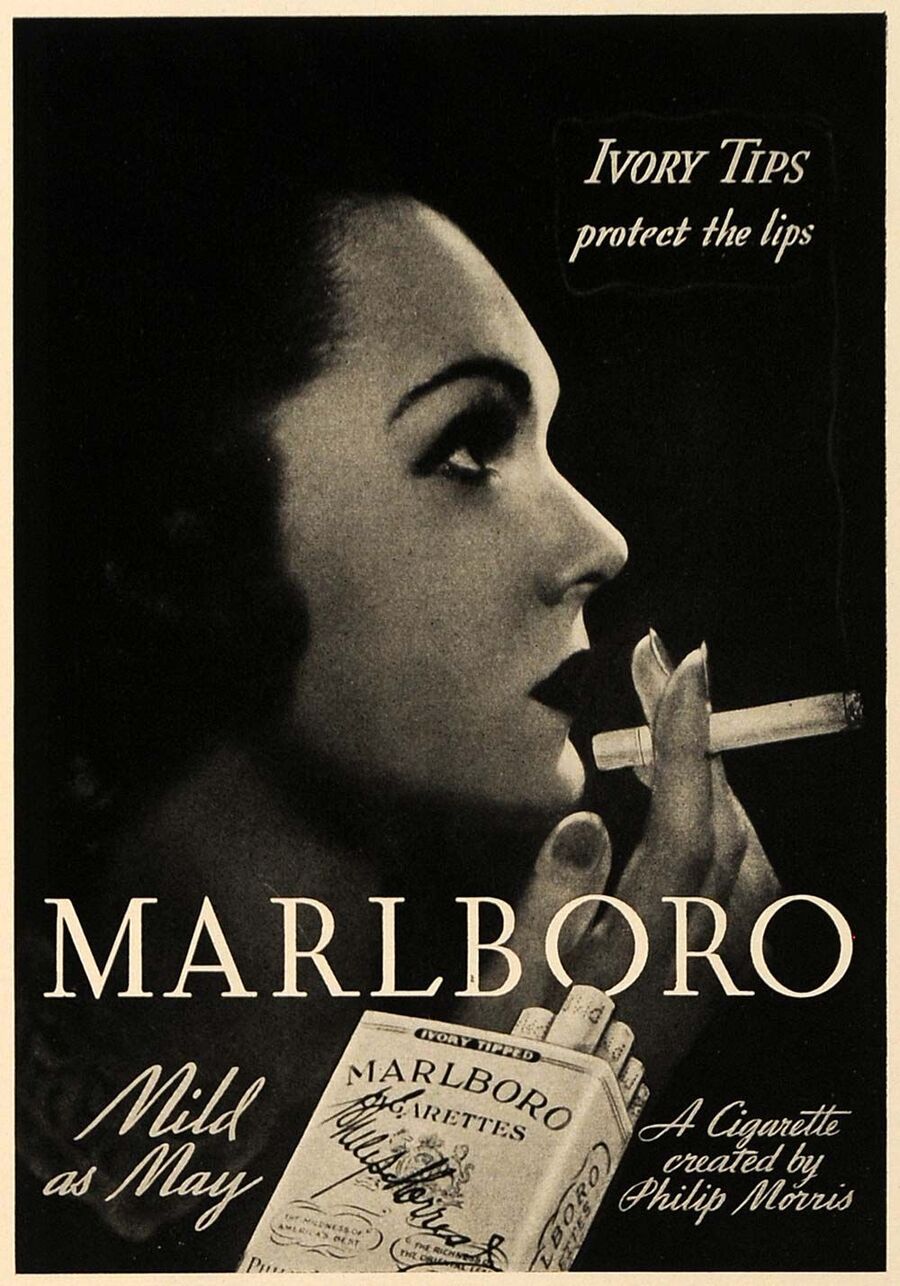
The history of Marlboro demonstrates that brand perception is not static. The same product can appeal to different audiences if its visual language, packaging, advertising narrative, and cultural associations change. Marlboro debuted in 1924 and was initially positioned as a women’s cigarette. Its advertising used the slogan «Mild as May,» and the filter was red or ivory-colored to conceal lipstick traces. In the first half of the 20th century, the filter was seen as a characteristic of women’s cigarettes, so Marlboro occupied a small niche and barely competed with popular unfiltered brands. By the early 1950s, the situation shifted. Public awareness regarding the link between smoking and lung diseases prompted manufacturers to actively promote filtered cigarettes. However, men feared that the filter would be perceived as a sign of weakness or femininity. This was Marlboro’s core challenge: the product already possessed a technical feature that could be in demand, but its existing image hindered its appeal to a male audience. In 1954, Philip Morris began changing the product, packaging, and advertising strategy. It was then that Marlboro transformed from an obscure women’s cigarette into a brand associated with masculinity and independence. This new campaign became one of the most famous examples of repositioning in advertising history.
Material Selection Principle
For this study, advertising materials and visual objects are selected that reflect different stages of brand development: • Early Marlboro advertising from the 1920s–1930s; • Packaging and advertisements prior to 1954; • Leo Burnett’s initial campaigns; • Images of the Marlboro Man; • Marlboro Country advertising posters; • Packaging featuring the red-and-white «roof-shaped» logo; • Advertising materials from the 1960s–1980s; • The brand’s sports and event projects; • Marlboro’s advertising imagery following tobacco advertising restrictions. The material is examined not only chronologically. The following changes are important for the analysis: • Gender and the social image of the target audience; • Visual symbols of masculinity; • The role of packaging; • The relationship between the product and its advertising image; • Consumer psychological motivations; • The brand’s transformation into an independent cultural sign.
Key Question
How did Marlboro manage to alter the gender perception of its brand, transforming the women’s cigarette into a symbol of masculinity, freedom, and independence?
Hypothesis
The success of Marlboro was not linked to a change in the product itself, but rather, primarily to a shift in its symbolic meaning. The brand stopped selling a cigarette as a technical object and began selling the image of the person who uses it. Several factors were combined to achieve this: a masculine visual model, the cowboy archetype, open landscapes, red and white packaging, minimal text, and the idea of independence. This radical repositioning worked because Marlboro offered the consumer not just a commodity, but a complete identity. The buyer gained the opportunity to feel strong, free, self-reliant, and independent of social constraints.
1. Marlboro pre-repositioning: women’s cigarette
The initial Marlboro advertising materials revolved around softness and delicacy. Visually, the brand appealed to a female audience through light colors, neat packaging, slender cigarettes, and imagery of women. The Marlboro name evoked an aristocratic English resonance and was perceived as a symbol of refinement. The advertisements emphasized a smooth taste and comfort. The cigarette was presented as an integral part of a woman’s aesthetic, rather than an element of rebellion or physical strength. The so-called beauty tips—the colored tips of the cigarettes meant to conceal lipstick stains—held particular significance. This illustrates that the advertising communication was constructed around specific, everyday female experiences. The product was not merely sold as tobacco; it was tailored to the rituals and appearance of the consumer. From a branding perspective, Marlboro in this period possessed a sufficiently clear but limited identity: it was soft, neat, and feminine. The problem was that this image prevented the brand from reaching beyond a small demographic. Another significant limitation was that the brand lacked a strong cultural myth. It had no protagonist, no setting, and no recognizable lifestyle. Marlboro spoke about the product, but it did not create a distinct world around it.
2. Brand Crisis and the Emergence of Opportunities for Change
In the early 1950s, the tobacco industry encountered a new situation. Scientific publications and journalistic investigations heightened public anxiety regarding the dangers of smoking. Manufacturers began promoting the filter as an additional safety feature, even though the filter did not make smoking safe. During this period, filtered cigarettes started to become more desirable. However, they faced a perception issue: the filter was associated with feminine products. A man might want to reduce the harshness of the smoke, but he did not want those around him to perceive his cigarette as a woman’s. Thus, the Marlboro problem was not merely commercial, but also psychological. The product needed to retain the filter while shedding its feminine image. Philip Morris decided not to create a new brand, but to modify an existing one. This approach was more economically viable: Marlboro already had a name, manufacturing infrastructure, and a certain level of recognition. The goal was not to change the product itself, but its meaning.
3. 1954: Shift to male enrollment
In 1954, Philip Morris began collaborating with the advertising agency Leo Burnett. The agency’s challenge was to make filtered cigarettes appealing to men. Instead of providing a technical explanation of how the filter worked, an emotional strategy was chosen. The advertisements needed to demonstrate that the filter did not make a man weak or timid. On the contrary, Marlboro was meant to become the cigarette of a strong, independent, and confident man. In the early stages, various male characters appeared in the ads: sailors, athletes, workers, soldiers, and tattooed men. They were united by physical strength, experience, masculinity, and independence. The first cowboy emerged as one of the potential archetypes for the male image. Eventually, he became the central character. Industry history of Marlboro notes that after launching the new campaign, sales grew from 18 million cigarettes in 1954 to 6 billion in 1955 and over 20 billion in 1957. These figures come from Philip Morris’s internal advertising materials, so they should be viewed as a corporate narrative of the campaign’s success rather than a completely independent study. The main shift was that the advertising no longer explained why the cigarette was convenient; it showed what kind of person chose it.
4. The Visual Language of the Marlboro Man
The Cowboy as a Symbol of Masculinity
The cowboy proved to be a fitting archetype for several reasons. He was connected to American history, open landscapes, physical labor, and independence. Unlike the urban hero, the cowboy existed outside a complex social system. He did not depend on an office, a boss, trends, or public opinion.
In Marlboro advertising, the cowboy rarely appeared as a specific person with a detailed biography. He evolved into a type. The viewer did not need to know his name. What mattered more was the silhouette, the hat, the horse, the leather, the hands, the clothing, and the posture.
Thus, the Marlboro Man functioned as a visual sign. He represented not a specific individual, but a set of qualities: • physical strength; • self-reliance; • tacit confidence; • endurance; • freedom from rules; • closeness to nature; • the ability to act alone.
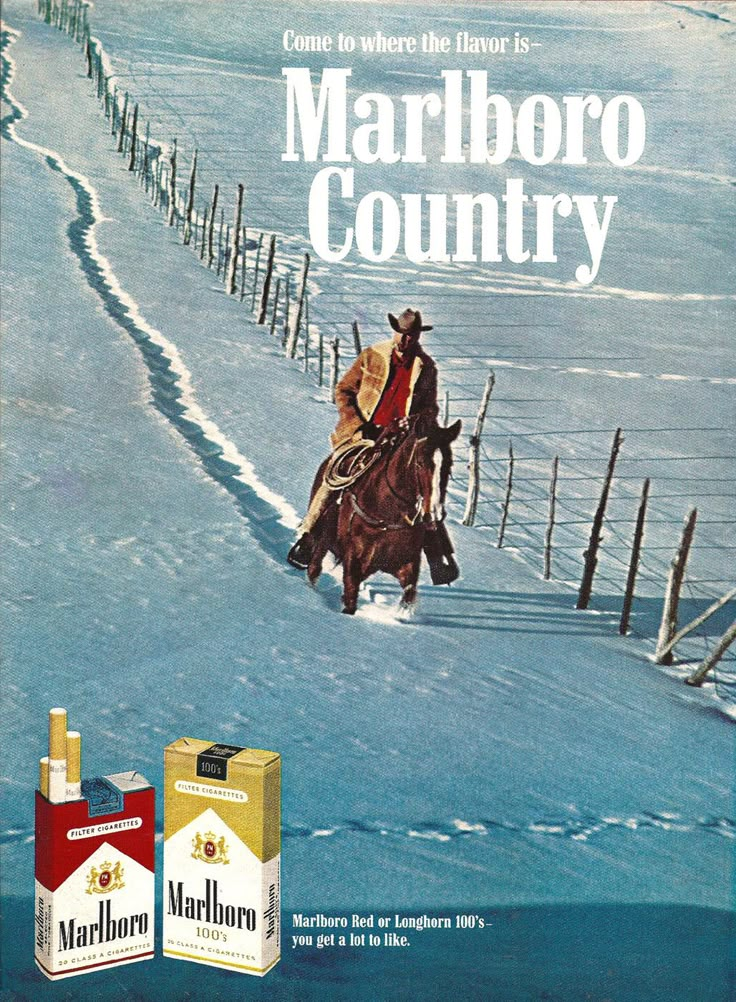
Open LandscapeThe composition of the advertisements played a vital role. The cowboy often occupied only a small portion of the frame, while the mountains, steppe, sky, and distant horizon filled the main space. This decision created a sense of scale. The human appeared small compared to nature, yet he did not look weak. On the contrary, he was perceived as someone capable of existing within that environment. The open landscape became a metaphor for freedom. The advertisements did not show smoking in a typical room or at a table. Instead, they transported the act into a space of adventure. The consumer was meant to associate the cigarette not with a mundane habit, but with the feeling of the open road, risk, and independence.
The Color Red and Packaging One of the most important elements was the red and white packaging. In 1954, Marlboro received a new pack with a flap lid and a bright red top. According to the brand’s internal history at Philip Morris, the packaging needed to look bold, striking, and masculine. tobacco-img.stanford.edu The color red served several functions: • distinguishing the pack from competitors; • creating a sense of energy; • enhancing the contrast with white; • aiding in brand recognition from a distance; • associating with danger, strength, and action. Later, the red «hooded» element became a distinct Marlboro symbol. Even if a cowboy wasn’t in the advertisement, the color scheme and packaging shape could already evoke the brand.
Tattoo as a MotifIn the early male campaigns, tattoos played a significant role. They were small but expressive details that conveyed the character’s biography. The tattoo signaled to the viewer that they were looking at a person with a past, experience, and a certain freedom of behavior. However, Marlboro did not explicitly explain the meaning of the tattoo. The viewer constructed the image independently. This heightened the psychological impact—the person didn’t receive a ready-made character profile, but rather interpreted the sign themselves.
5. Consumer Psychology and Identity Sales
Consumers Buy More Than Just a ProductIn traditional advertising, a product is explained through its attributes: taste, size, composition, convenience, or technology. In the case of Marlboro, these properties gradually took a backseat. The consumer was offered not just a cigarette, but the opportunity to get closer to a specific lifestyle. This principle can be described as symbolic consumption. A person acquires an item to express or feel their own identity. With Marlboro, the cigarette became a kind of passport into a world of masculinity.
The Mechanism of Self-IdentificationThe advertisement didn’t explicitly say, «Buy Marlboro to become a cowboy.» Instead, it created a visual scenario where the viewer could imagine themselves alongside this character. This is where the principle of desired similarity comes into play. The consumer compares themselves to the advertising image and sees the qualities they wish to possess in it. Even if a person doesn’t live on a ranch or has never ridden a horse, they can perceive the image of the cowboy as a symbol of freedom and control over their own life. Therefore, the Marlboro Man wasn’t a realistic portrait of the typical buyer. He was an idealized figure to strive for.
Gender CodingThe repositioning of Marlboro was built upon mid-20th-century cultural perceptions of masculinity. The man in the advertisement needed to be reserved, physically strong, independent, and devoid of doubt. This model of masculinity was cemented through visual details: • Direct gaze; • Broad posture; • Workwear; • Absence of a smile; • Close-up of hands; • Horses and weaponry attributes; • Absence of dependence on other people in domestic settings. In this sense, Marlboro didn’t just find a new audience—it participated in constructing a specific archetype of manhood.
The Sense of BelongingMarlboro fostered a sense of belonging to a specific community. Individuals could see themselves as part of a group of independent, masculine, and free people. Documents from the World Health Organization emphasize that tobacco marketing utilizes not just product information, but also brand imagery that appeals to the audience’s psychological and social needs. Lifestyle, prestige, belonging, and desired self-image become particularly important elements.
Psychological De-sensitization of FearMen might have been apprehensive about filtered cigarettes because they were perceived as milder. Marlboro shifted the focus from the filter to the consumer’s character. The filter ceased to be a sign of femininity and became part of the strong person’s cigarette. The advertisement essentially conveyed: if the cowboy chooses the product, the filter cannot be a weakness. This is an important branding mechanism: an undesirable characteristic does not disappear; rather, it acquires a new meaning.
6. Marlboro Country: Transforming Advertising into a Brand World