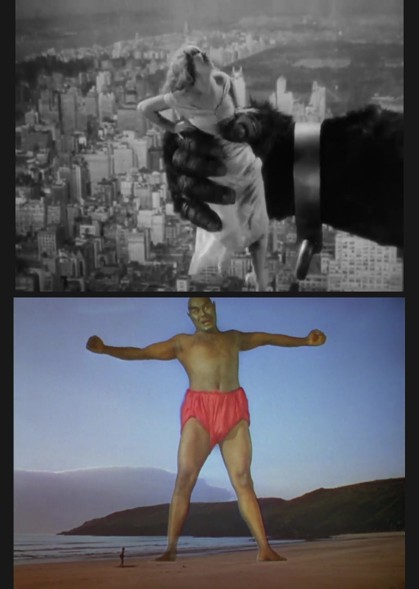
Research Concept
When King Kong lifts Ann, he must be large enough for the actress to fit in his hand. In a wide shot, this can be achieved using a puppet, but in a close-up, it is crucial to see the actress leaning on his fingers. I was interested in how early cinema created such scenes. The physical size of objects on set could change from frame to frame, yet the audience would still see the same giant throughout the scene.
For my research, I selected four films from 1902–1940: Georges Méliès’s «Gulliver’s Travels into Lilliput and the Land of Giants, ” Harry O. Hoyt’s „Lost World, ” Merian C. Cooper and Ernest B. Schoedsack’s „King Kong, ” and Ludwig Berger, Michael Powell, and Tim Уиlan’s „The Baghdad Thief.“ The focus is on the methods used in these films to create and maintain size differentials between characters across different shots. What visual details convince the viewer that two characters belong to the same space, even if their filming required separate sets, different scale props, or even distinct imaging techniques?
The selected works are united by a single technical challenge. Melies had to combine people filmed in different scales. In «Lost World» and «King Kong, ” a stop-motion animated model appears in the frame next to the actors. Since both films are connected to the work of Willis O’Brien, we can compare how he solved a similar problem in two of his projects. For „The Baghdad Thief, ” Lawrence Butler was responsible for the visual effects, where the differences in size are created between two actors, and for some shots, a huge prop appears next to the performer. The films represent French, American, and British cinema. The temporal scope is defined by the examples themselves, ranging from silent studio fantasies to color films with complex composite shots.
My hypothesis is that the best way to maintain a sense of scale is through points of reference that can be linked across adjacent shots. These points include the edge of the table in Méliès’ film, the branch near Ann in «King Kong,» or the giant foot next to Abu. The overall shot allows for a comparison of proportions, while the close-up lets me examine how the character interacts with or touches an object, and I also analyze where a person’s gaze is directed and at what moment a figure obscures part of the set design. These details can be observed in the finished film and then correlated with the filming documentation. Within the episode, shots proceed in screen order, and supplementary illustrations are labeled as set design documents or props photographs.
For technical details, I utilized materials where authors discuss specific scenes. The CinEd manual explains why Méliès had to precisely calculate the stage height for the Lilliputian. The George Eastman Museum describes the blending of frames with actors and stop-motion in «Lost World.» The Academy of Motion Picture Arts and Sciences and Ron Brinkman analyze the rear projection in the Kong fight scene, while the British Film Institute describes optical compositing and large props in the genie episode. This information helps illuminate the origins of the visible result. If a source describes a technique for the film as a whole, I reserve for a specific frame only what is visibly observable or separately verifiable.
The sections are organized by year. I begin by comparing two scenes from Gulliver’s Travels where the hero’s scale shifts relative to people and furniture, and then I examine how the model’s scale is perceived on the plateau and within the city in The Lost World. In the final two sections, the moment of contact is crucial. Kong’s hand and the genie’s foot allow for a comparison of how a physical object sustains the illusion between broad and intimate planes.
Gulliver and the Two Scales of a Single Scene
In the first episode, Georges Méliès shows Gulliver next to a model of a city. Next, the effect depends on superimposing separately shot figures. To make the tiny person appear to be standing on a large table, the height of his platform was pre-calculated relative to the image of the tabletop, and in the land of giants, the principle works in reverse. The table again sets the scale, and now Gulliver fits next to a cup.
A still from the film «Gulliver’s Travels into Lilliput and the Land of Giants» (1902).
Gulliver leans over the structures, barely reaching his knees. The city model sets the scale in the first episode. The roofs and stairs resemble ordinary architecture, and the familiar forms provide the viewer with an initial measure of the body while people are still hard to distinguish next to the hero.
A scene from the film «Gulliver’s Travels into Lilliput and the Land of Giants» (1902).
On the upper platform, a row of Lilliputians is visible, while Gulliver, tied up, lies below. Thanks to the horizontal positioning of the hero, both figures—a single tall silhouette and an entire group—fit within the frame.
A still from the film «Gulliver’s Travels into Lilliput and the Land of Giants» (1902).
In the next scene, Gulliver is seated on the left, while people walk across the square on the right. The edge of the table extends into the space of the square, linking the two parts of the frontal frame. The figure next to the glass allows for a direct comparison; the everyday object in the frame becomes a measure of the Lilliputian’s height.
Still from the film «Gulliver’s Travels into Lilliput and the Land of Giants» (1902).
The Lilliputians move up the stairs while Gulliver shifts his posture by the desk. The fixed position of the tabletop unifies both elements of the action.
A still from the film «Gulliver’s Travels into Lilliput and the Land of Giants» (1902).
A yellow palanquin appears on the table, its size readable both in relation to Gulliver’s figure and the small people in the square.
Gulliver remains on the left edge; the figures near the palanquin are visible at tabletop level. To connect the actions, the direction of the gesture and the height at which it terminates are important.
Still from the film «Gulliver’s Travels into Lilliput and the Land of Giants» (1902).
The table is framed frontally in the land of giants. Now, the card players take up almost the entire height of the frame, leaving a wide tabletop in the foreground.
A frame from the film «Gulliver’s Travels into Lilliput and the Land of Giants» (1902).
A tiny figure stands up on a table next to the dishes. The viewer already knows Gulliver’s height relative to the Lilliputians, and now the same measure applies to the giants' place setting.
A still from the film «Gulliver’s Travels into Lilliput and the Land of Giants» (1902).
Standing Gulliver can be compared to a cup. The ordinary object restores recognizable proportions to the human body, even when a row of actors is filmed larger.
A still from the film «Gulliver’s Travels into Lilliput and the Land of Giants» (1902).
In the next scene, the staircase puts the height difference into action, as the protagonist must climb it to get closer to the giantess’s face.
Dinosaur near people and the city
In «Lost World, ” Willis O’Brien handled the stop-motion animation while Marcel Delgado created the models. The American Institute of Cinema catalog provides details on the composite shots that allowed people and dinosaurs to appear together. In the camp, the boundary between them is defined by the terrain and vegetation, whereas in London, the model is juxtaposed with streets, facades, and crowds.