Research Concept
The Game of Life invites the player to live an entire life in a single game. However, the word «life» itself does not explain what constitutes success. The answer is provided by the grid, the names of the cells, the in-game objects, and the method of determining the winner. The study compares two games: The Checkered Game of Life, released by Milton Bradley in 1860, and The Game of Life, created by Reuben Klamer to celebrate the company’s centennial in 1960. These are different games, yet they share a common name and a common idea—to illustrate a person’s journey from the beginning of life to its end [1; 2].
Key Question
How do the design and rules of these games reflect what constitutes a successful life? Research Hypothesis: When transitioning from a grid field to a highway, the focus shifts from the individual’s qualities and actions to family, career, and wealth. Furthermore, the dichotomy of «19th-century morality versus 20th-century money» requires examination—wealth and other markers of prosperity were already significant in the early game [3].
The research object is board games that depict a person’s life journey. The subject is how the game portrays success through its visuals and design: the organization of space, the names and text on the spaces, the player character, the collection items, and the depiction of the ending. The comparison is structured around consistent criteria, rather than a sequential retelling of each game’s story. This approach allows us to discern which changes relate to aesthetics and which fundamentally alter the concept of a successful life.
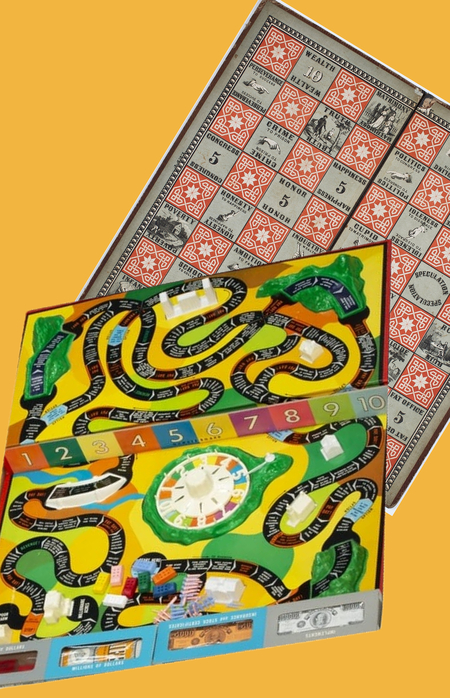
The visual foundation is drawn from the historical board game, The Checkered Game of Life from 1866, and museum photographs of a set from the early 1960s.
Methodology
Compare images and verify observations against museum descriptions, patents, and game rules. First, the field and path are examined, followed by words and images, then the player figure and game completion conditions.
How to Read Game Lives
For this analysis, we utilize the concepts of agon (contest) and alea (chance), as proposed by Roger Cailliau. These concepts help frame the question: why does the game evaluate a lived life based on an outcome that is partially dependent on chance? Cailliau’s categories do not automatically explain the significance of each cell; this requires an analysis of the objects themselves [7].
The relevance of this topic stems from the fact that gamified learning occurs through the familiarization of objects—the game field presents the participant with a pre-set array of life goals. The research objective is to compare the design details and demonstrate how the image of a successful life evolves. Since Thomas Burns has already compared these versions of the game, the comparison itself is not novel [8].
The long-form structure moves from the general overview to specific details: two life models; the geometry of the journey; the language of evaluation; the tangible image of the participant; the finale and scoring; and comparative conclusions. It is important to consider: you cannot judge all of American society based on two tabletop games. They allow for a discussion of the models presented to the players, but they themselves do not prove that everyone in that era shared these values.
Two games, two ways to live life
Milton Bradley. The Checkered Game of Life, 1866.
The dates 1860 and 1960 mark the introduction of two games. Preserved artifacts are used for visual comparison: an early board from 1866 and a set from around 1961.
In the early field, small images and short captions are distributed across the cells. In the later version, the viewer sees a winding road, topography, and buildings. The fields offer different ways to view life: the first board invites the viewer to read individual states, while the second prompts them to follow the scenario’s progression.
Milton Bradley Company. The Game of Life. Game board, circa 1961.
In this work, a «successful life» does not refer to our assessment of a biography, but rather the outcome recognized by the game itself. To understand this, we must compare three things: what the image promises, what the captions suggest, and what the rules validate. If the images, captions, and rules align, the concept of success appears more compelling. If they diverge, it becomes clear how much the game simplifies life.
Cell and Road
Milton Bradley. The Checkered Game of Life, 1866. Field excerpt: Happy Old Age, Gambling, and Intemperance.
The top of the early field features «Happy Old Age"—meaning a «happy old age.» However, nearby are Gambling and Intemperance. The proximity of success and danger transforms the top of the board from a mere aesthetic finish into something where a desirable outcome resides alongside the potential for loss.
Milton Bradley. The Checkered Game of Life, 1866. Field segment: Infancy, School, and College.
At the bottom of the board, infancy, school, ambition, and social decline are arrayed. They do not form a continuous illustrated path. The reader encounters a collection of potential states; the inscriptions and rules help establish the connection between them.
On the Bradley field, patterned squares alternate with squares containing text. The repetition of the ornament creates regularity, while the words mark semantic pauses. On a single plane, qualities, institutions, family events, and final states coexist. Because of this, life is depicted as a collection of states. The game evaluates each of these states, and the token moves between the squares.
Milton Bradley Company. The Game of Life, circa 1961.
Late Game is structured differently. A black path connects sections of the field, and its turns guide the viewer’s eye along the route. Thanks to the buildings, the field resembles a small inhabited world. Even before reading the rules, the board invites the player to visualize life as a sequence of events.
Branching paths do not make the route arbitrary. The player chooses from pre-prepared options, and the field dictates the stages. Therefore, the presence of choice must be distinguished from the freedom to independently define what constitutes a successful life.
Words That Define a Person
Milton Bradley. The Checkered Game of Life, 1866. Field Fragment: Wealth and Matrimony.
Wealth and marriage are already integrated into the early model of life. Therefore, it cannot be described as exclusively a spiritual alternative to the later game. Here, wealth and marriage are valued alongside truth, honor, and happiness.