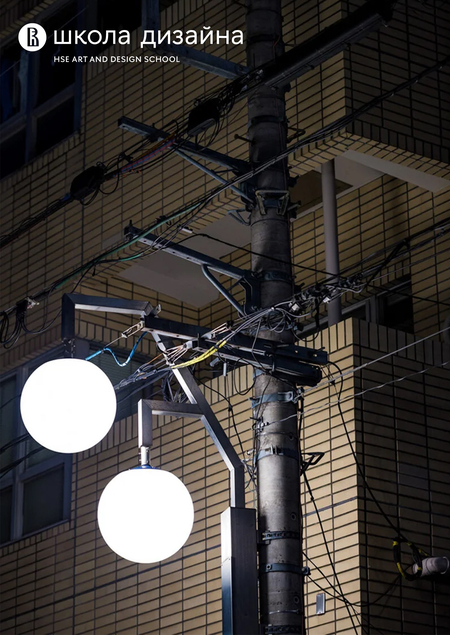
Concept
Urban identity is not solely formed by architectural monuments, historic buildings, and cultural symbols. Sometimes, the most recognizable elements are those that were never intended to shape the city’s image. Electrical poles, wires, and technical structures—everything that exists to support daily life—gradually becomes an integral part of the city landscape.
Dense tangles of wires crisscrossing facades, streets, and open skies frequently appear in photographs of East and Southeast Asian cities. While overhead wires are found around the world, their placement is primarily dictated by technical, historical, and economic factors. The interesting aspect is this contradiction: a utilitarian object, unattached to any specific cultural tradition, begins to evoke associations with a particular urban environment.
Why do wires, which should only connect points, become distinctive visual elements themselves? And at what point does technical necessity transform into a recognizable image of a place?
The study is premised on the assumption that visual identity arises not so much from individual objects as from recurring relationships between them. The tangles of cables reveal formal similarities to other features of the urban landscape: intersecting streams of traffic, the graphics of signage, dense compositions of shop fronts, and the architectural layers of different eras. This similarity, however, does not imply a shared origin or equivalence.The age-old tradition of calligraphy and the technical system of electrical supply exist within fundamentally different cultural and functional contexts. The common subject of analysis becomes only their visual characteristics—line, rhythm, density, intersection, and the relationship between filled and empty space.
The objective of this research is to investigate how infrastructure, which was not designed for artistic expression, can acquire its own visual significance and participate in shaping a recognizable urban identity. The focus is not on finding beauty in technical disarray, but rather on identifying patterns within the apparent chaos—understanding its origins and its role in the perception of the urban environment.
To achieve this goal, the research sets out the following objectives:
- To examine the historical and technical prerequisites for the formation of aerial cable networks, comparing their spatial organization with the system of urban routes and connections.
- To investigate the graphic properties of wires—line, rhythm, curve, intersection, and the ratio of empty to filled space—by correlating them with writing, calligraphy, and abstract graphics.
- To consider the interaction of cable networks with signage, typography, and other elements of the city’s visual communication, identifying their role in forming the effect of visual saturation.
- To trace how historical changes in urban infrastructure are reflected in the material form of the wires and supports, and how the modernization and disappearance of aerial communications transform the familiar urban landscape.
- To generalize the identified visual patterns and determine the conditions under which recurring combinations of wires with the surrounding environment can become part of the visual code of urban identity.
The research methodology is built upon the intersection of historical and comparative visual analysis. Engaging with written sources is necessary to understand the real reasons for the formation of the infrastructure, whereas photography allows it to be viewed as a collection of graphic and spatial relationships. The choice of this method is dictated by the very nature of the research question: visual similarity cannot be established solely through historical facts, just as the origin of a technical system cannot be explained exclusively through image analysis. Therefore, scientific studies, archival and contemporary photographs, works of art, and graphic design objects are examined in comparison to one another.
This visual exploration attempts to examine the city through what typically remains on the periphery of attention. It seeks to see in the wires not just a trace of technological development, but a complex structure of relationships between time, space, and the human. Perhaps the character of a place emerges precisely where a multitude of independent decisions coalesce into a single image, and the random intertwining of lines begins to be perceived as an essential part of the city.
Visual oversaturation can arise from the interaction of multiple independent systems, each possessing its own logic. Wires form an engineering network, signage adheres to the demands of visual communication, writing exists within historically established graphic rules, and architecture preserves traces of successive transformations. Their formal similarity does not negate their differences, but it allows us to observe recurring principles in the organization of the urban environment.
When cable networks form unintentional graphic compositions at the urban level, their placement in product design can become the result of conscious choice. The wire ceases to be perceived solely as a technical element that must be hidden or organized. Its form and interaction with the surrounding space open possibilities for the artistic reinterpretation of a familiar utilitarian object.
This approach forms the basis for the graduation project—developing the brand identity for modular extension cords. Observing urban infrastructure allows for an investigation into the expressive qualities of line, which can then be utilized in shaping the brand’s visual language. This is not about literally transplanting the aesthetics of Asian cities into interiors; rather, the principle is paramount—the technical function of the cord should not constrain its visual expressiveness but instead serve as the starting point for the design solution. Observations gathered during this research permit the cord to be viewed not merely as an element that needs to be hidden or organized, but as an expressive line capable of interacting with form, material, and the surrounding space. This perspective becomes fundamental to developing the brand’s visual language and the subsequent expansion of the product line.
Chapter 1. A City Entangled in Connections
In 1895, an unusual tale about the origin of electric light appeared in a Hanoi newspaper. According to this story, Europeans managed to capture stars, string them onto iron cables, and affix them to metal poles. Thus, the celestial bodies appeared above the city streets and began to illuminate them as night fell. Of course, this was not a genuine Vietnamese legend, but rather a literary fantasy by the French author Victor Lê Lan, published in the colonial press. However, it is interesting that even in this fictional story, electricity could not be conceived without wires strung across the city.
Today, such structures seem commonplace, although just a century and a half ago they barely existed. To understand how streets gradually became filled with cables, one must look at the history of the technologies for which they were created. After all, wires did not appear all at once, and they were not always intended for transmitting electrical energy.
One of the first technologies to require extensive lines of communication was the telegraph. In 1869, the construction of a telegraph line began in Japan between Tokyo and Yokohama, and telephone service was operational in these cities by 1890. Information could now be transmitted almost instantly, but this required physically connecting distant points. New technical structures began appearing along the streets—structures whose purpose had nothing to do with lighting or urban transportation.Simultaneously, the other side of daily life was changing: the urban night. At the end of the 19th century, the streets of Hanoi were illuminated primarily by oil lanterns. By 1891, there were about 900 of them, and specialized workers were responsible for daily ignition and maintenance. Within a year, city authorities announced two separate competitions for installing new lanterns: 54 metal poles with copper fixtures were designated for the European Quarter, and 500 wooden poles with zinc lanterns were slated for the districts predominantly inhabited by the Vietnamese population.
Even before the advent of electric wiring, the infrastructure across different parts of the city was noticeably varied. These differences were apparent not only in the amount of lighting but also in the materials used for the structures themselves. It appears that the technical design of the streets was initially dependent on who they were intended for. Electrification did not eliminate this unevenness; rather, it largely continued a practice that already existed.
At first glance, the introduction of electric streetlights should have made the city more convenient. However, Kirsten Andres’s research, «City of Lights, City of Pylons, ” reveals that the adoption of this new technology was accompanied by numerous contradictions. Electrical grids expanded predominantly in the most affluent neighborhoods, and the growing demand constantly outpaced the capacity of power plants. Even after the First World War, power outages remained a common occurrence. The majority of Vietnamese residents never gained access to electricity in their own homes during the colonial period.Here lies an unexpected feature of electrification: the presence of technical infrastructure did not automatically mean that all residents could utilize its capabilities. The wires became a noticeable part of the streets much faster than electricity became an accessible part of everyone’s daily life.
It is interesting that the drive to eliminate visible wiring emerged almost simultaneously with its proliferation. In the early 20th century, underground cable installation was already being considered as an alternative to overhead lines. Etsuro Suzuki, who studied the development of Tokyo’s electrical grid during the Taishō period (1912–1926), noted that underground utilities were laid in 11 out of the 15 municipal wards at the time. However, this did not lead to the complete disappearance of wires above the streets.
Over time, new types of communications have been added to electrical and telephone lines. This has become particularly evident with the development of the internet and digital communication. Where voice messages were once transmitted via cable, today the growing volume of information requires fiber optic networks. Their proliferation has once again changed the quantity and composition of technical lines above the streets.The example of modern Bangkok illustrates just how far this process has advanced. The Thai telecommunications operator True Corporation notes that the same utility poles can host old telephone cables, new fiber optic lines, and communications from government services, including video surveillance systems. Some former connections are no longer in use but remain in place. According to the company, such poles can serve more than ten different operators and organizations.
A paradox emerges: communication technologies are becoming increasingly sophisticated, but their advancement does not necessarily make urban infrastructure visually simpler. New capabilities require additional connections, and older lines aren’t always removed immediately after a replacement appears. Hidden within modern cable tangles is not a single technology, but an entire history of successive methods for transmitting power and information.
Nevertheless, it would be inaccurate to attribute the appearance of all cities in East and Southeast Asia to the same causes. Hanoi, Tokyo, Shanghai, and Bangkok developed under different political and economic conditions. In some places, the spread of electricity was determined by colonial policies; in others, it was driven by industrial development, state regulation, or the needs of private enterprises. These differences prevent us from positing a singular model for the formation of aerial networks.
Yet, it is precisely this diversity of histories that helps us understand the nature of the modern urban landscape. Wires did not appear over the streets as a result of a single project. Their placement reflects decades of technical decisions, each responding to the needs of its time. We see the cable network as a whole, even though it emerged gradually, from countless individual connections.
It remains to be understood why such a complex, yet functionally organized system is perceived as a haphazard tangle. Perhaps to see its internal logic, one should pay less attention to the quantity of wires and more attention to how they connect various points across the city.
Chapter 2. Intertwining Paths
Peter Bialobrzeski — Bangkok Diary, 2018. Bangkok Diary Series.
The city has routes that no one uses. They stretch between buildings, cross streets, and branch out from poles in various directions. The wires, like the roads, connect discrete points in the city, forming a complex system of connections. People and transport travel along some of these routes, while electricity and information are transmitted along others.
At first glance, this is merely a visual resemblance. However, Bangkok’s history demonstrates that the development of the two systems was far more intimately connected. In 1894, city trams began converting to electric traction, and subsequently, the transport and energy businesses merged. Electricity powered the trams, and the transport network became one of the primary consumers of the new urban infrastructure.It turns out that the roads and the wires did not just intersect in space—at a certain point, they became integral parts of a single technical and economic system. Furthermore, their subsequent development was not necessarily governed by a unified master plan. Each new road and communication line was integrated into the existing urban structure, gradually transforming it.







