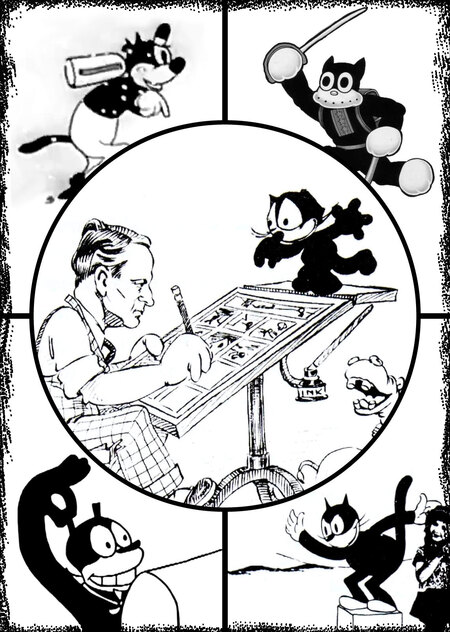
Concept
Felix the Cat is an iconic animation character from the first half of the 20th century. Viewers first encountered the black-and-white cat in the short film «Feline Follies» in 1919. It is worth noting that the character was originally named Master Tom, and he acquired his familiar name—the one that brought him worldwide fame—a little later.
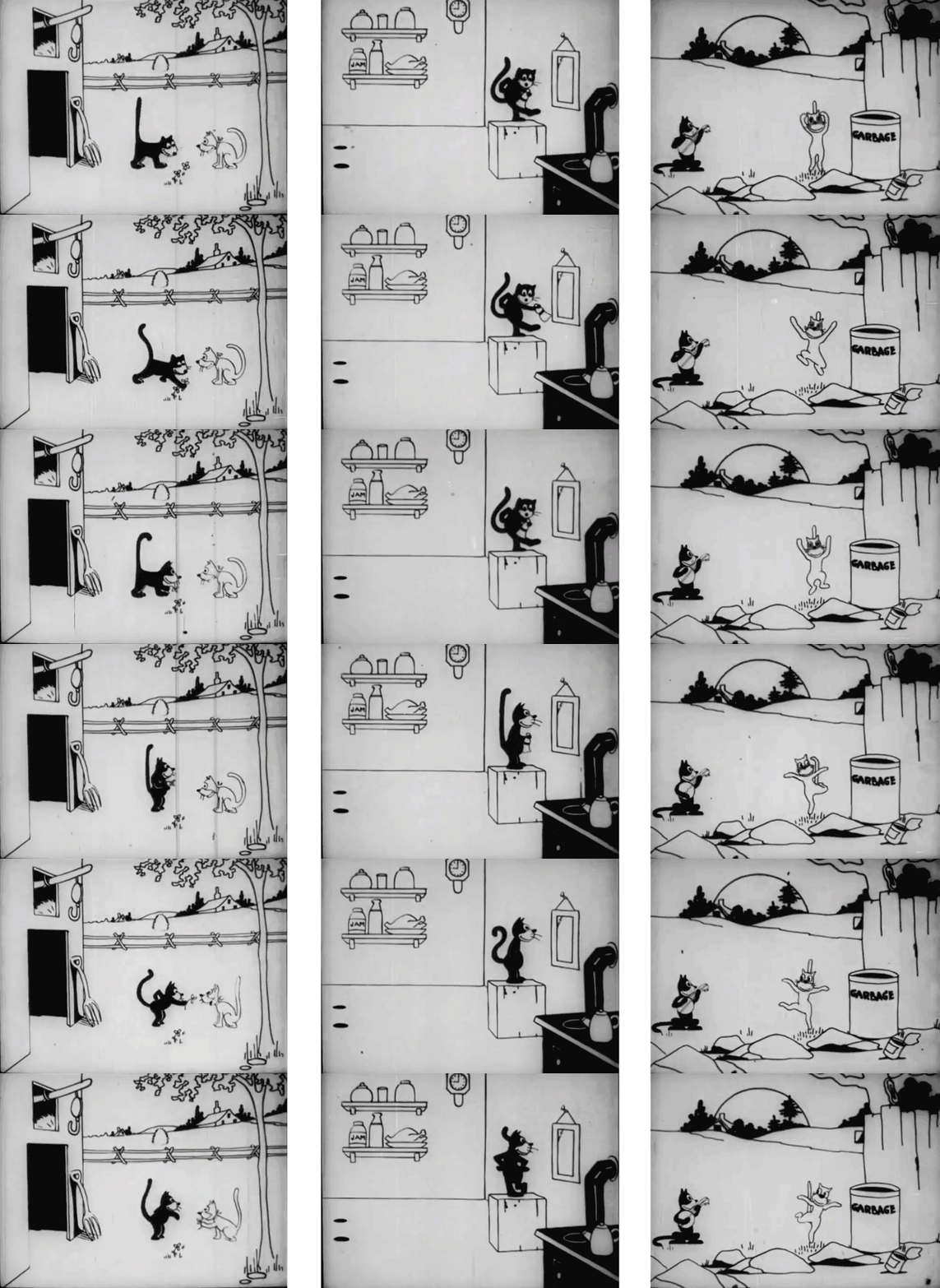
Felix The Cat — Feline Follies (1919) Creator: Pat Sullivan
«He is the cat that makes the whole world laugh! You can laugh with him and at him every week in MODERN BOY!» — description of Felix the Cat’s character from the comics
[2, author’s note]
It remains unknown who created Felix; this has been the subject of extensive debate. However, the majority believes that Otto Messmer was the actual creator and artist of the character, while Pat Sullivan owned the studio where the cartoons were produced.
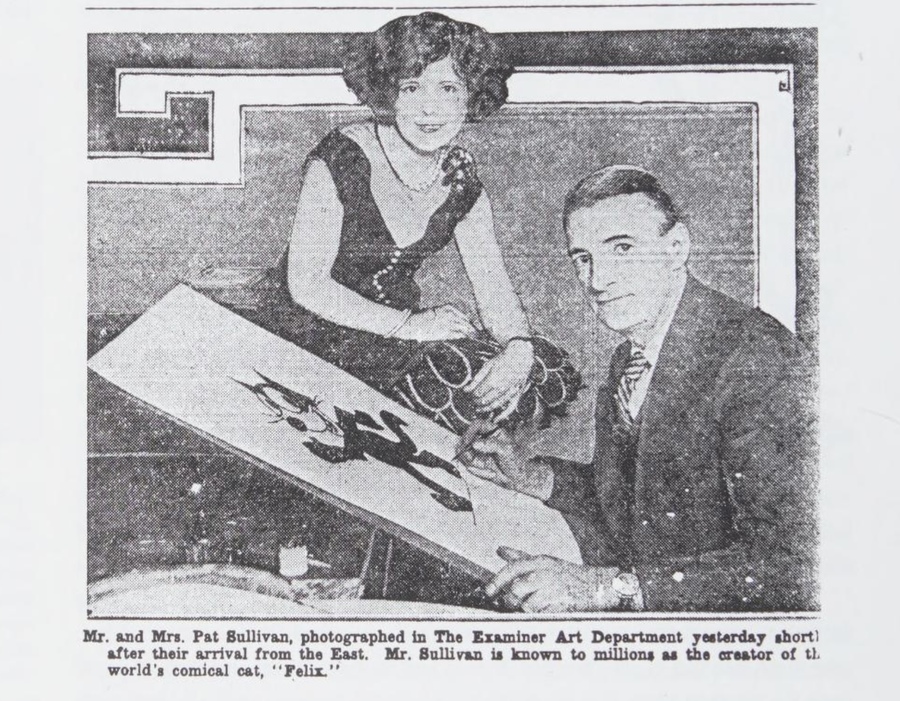
«Mr. and Mrs. Pat Sullivan, photographed yesterday in the art section of The Examiner shortly after arriving from the East. Mr. Sullivan is known to millions as the creator of the world’s funniest cat—‘Felix.’» [Photographer]
Felix’s visual identity emerged from several primary sources: the aesthetics of silent black-and-white cinema, which demanded maximum contrast for silhouette legibility; the tradition of newspaper comics; and the eccentric physicality of Charlie Chaplin. His black body, contrasting white face with huge eyes, and his ability to detach his tail—transforming it into tools or punctuation marks—forged the universal graphic language of the 1920s.
«After almost a decade, this cat’s spirited screen persona, his expressive pantomime and facial expressions, individual mannerisms (such as the habit of pacing while thinking, with his paws clasped behind his back), and his ability to solve problems in fantastical ways—often inventively using his own body parts—were enthusiastically received by audiences» [2, p.3, author’s words]
Objective of the visual study
The goal of this visual study is to trace how the recognizable design of Felix the Cat evolved into a ready-made industry template, sparking a wave of direct imitations in world animation before 1950. The tremendous success of the hero’s visual identity prompted numerous studios to create similar characters in order to replicate his popularity among audiences.
In this work, I would like to focus on the recurring details of these doppelgängers' appearance, their characteristic plasticity, and their similar plot devices. Furthermore, it is interesting to trace exactly how this imitation evolved: animators frequently moved from one studio to another, taking their accustomed drawing style with them, and the very image changed with the advent of sound in cinema and under the influence of different cultures.
Topics
The research is structured on the principle of comparative visual analysis and is divided into five sections: the first examines the key features of the original piece itself, while the remaining sections focus on specific instances of imitation.
- Felix the Cat: Key Features of the Original Visual Identity
- Julius the Cat: A Direct Commercial Clone from Walt Disney Studios
- Crazy Cat: A Redesign by Former Felix Animators
- Waffles the Cat: Borrowing a Ready-Made Archetype
- Norakuro: An Example of Cross-Cultural Borrowing
Cat Felix: Key Features of the Original Visual Identity
Felix’s animation sketches from 1924.
Felix the Cat’s appearance is built upon the typical black-and-white contrast of its era: an entirely black body with pointed ears and a light-colored face. The main focus of his expression is his huge eyes and wide smile; this detail is what allows him to convey the primary spectrum of the character’s emotions, which viewers read without words.
Three stages of Felix’s image evolution from 1922 to 1960.
The anthropomorphic cat’s signature gesture was its famous gait—a habit of thoughtfully pacing across the screen with its paws held behind its back. This is largely inspired by Charlie Chaplin’s comedic walk.
1. Felix in Hollywood (1923) Creator: Pat Sullivan 2. Newspaper clipping in which Felix parodies Charlie Chaplin (note 1923)
Furthermore, Felix knows how to detach his tail and easily transform it into desired objects or punctuation marks.
1. Felix in Hollywood (1923) 2. Felix out of luck (1924) 3. Felix in Hollywood (1923)
Later, it was these details—the contrasting coloration, the vivid facial expressions, and the unusual tail tricks—that became the memorable template for all of his cartoon iterations.
Cat Julius: a commercial copy created at Walt Disney Studios
«Julius Disney caused particular irritation because he openly engaged in design and action plagiarism of Sullivan’s cat, while utilizing the same distributor» [2, p. 90, author’s transcription]
The cat Julius debuted in Walt Disney’s «Alice Comedies» cartoon series in 1922 as a direct commercial clone of Felix. This act of copying young Disney was prompted by distributor Margaret Winkler, who had previously worked with the original Felix and was seeking an urgent replacement after a conflict with his producer.
Advertisement for Disney’s «Alice Comedies» featuring a cat resembling Felix (note: 1924)
«Upon his return to the States, Sullivan instructed Harry Cope to demand that Pathé Frères cease collecting British royalties… A conflict arose between Pathé, Sullivan, and Margaret Winkler, which concluded with a tripartite agreement.»
[2, p. 89, author’s translation]
Julius Sketch, Walt Disney (c. 1920)
Externally, Julius is virtually indistinguishable from his prototype: he has the same solid black body, pointed ears, bright white muzzle, and large, expressive eyes. Although some original detail—the presence of white pants on the cat—can be seen in the earliest sketches, they do not appear in the animation itself.