Main Idea
The hidden image of a prohibited ruler always consists of two parts: the image itself and the key to it. The more dangerous the regime is to the viewer, the further the key is kept from the image. Therefore, the form of the crypto-portrait is determined not by the era or the artistic style, but by where the political situation allows the solution to be hidden: under the image, in the margins, in memory, in a separate object, or beneath the lid of the owner’s own body.
In other words, a crypto-portrait depicts two entities: the one being hidden, and the one from whom they are hidden. The location of the key allows one to reconstruct who the owner of the image feared.
Key Question
What determined the manner in which the image of a deposed or executed monarch was concealed in British and French visual culture between 1649 and 1830, and why did the same technique serve as a secret password in some years and an openly marketed puzzle in others?
Hypothesis
The key variable in a crypto-portrait is presumably the key distance—the space between the image and the information required to decode it. This distance does not decrease or increase linearly over time; rather, it fluctuates with the political regime: it increases when the image becomes evidence, and it shrinks to zero when the hidden image becomes legal. If this hypothesis is correct, three verifiable conditions must be met: 1. Different concealment mechanisms, chosen based on the degree of danger rather than fashion, must coexist in the same era. 2. The same technique (anamorphosis, double imagery) must appear with varying key distances depending on the situation. 3. Simultaneous sheets employing the same technique, created within the victors' camp and the vanquished camp, must primarily differ in the placement of the key.
Key Distance Scale
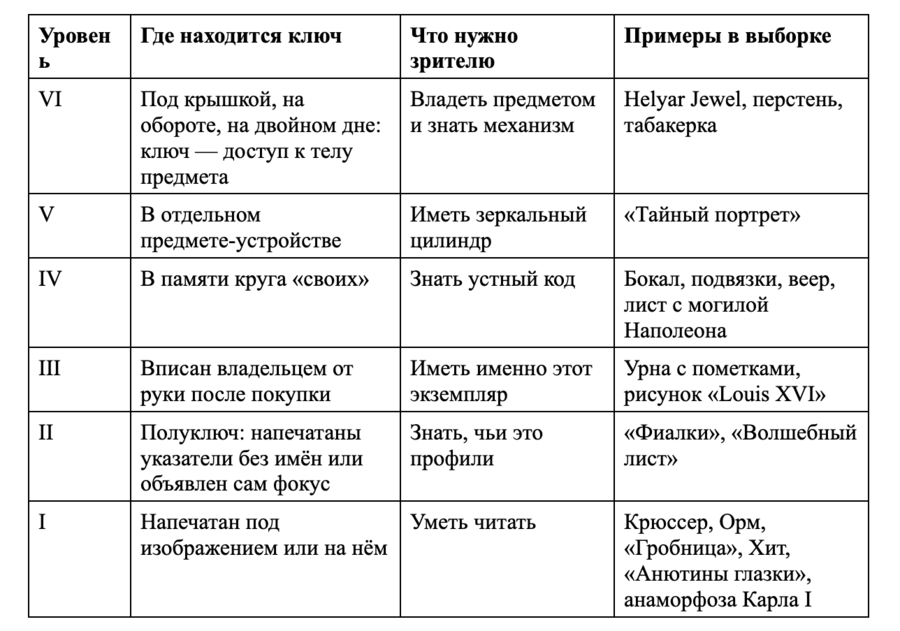
The central research instrument is a six-level scale. It functions both as a classification system and the structure for the work: blocks are arranged from maximum distance to zero. The zero level is an open portrait with no mystery. Control object No. 1 represents this level.
Block No. 1. Key to the Body (Level VI)
The first block unites subjects separated by a century but structured identically: the portrait itself is not encrypted; access to it is encrypted. This represents the maximum distance of the key—without physical possession of the object, nothing is visible at all. This method is chosen where the image itself becomes evidence in case of an inspection, such as in England after the execution of Charles I in 1649 and in Scotland after Culloden in 1746.
Embroidered miniature portrait of Charles I
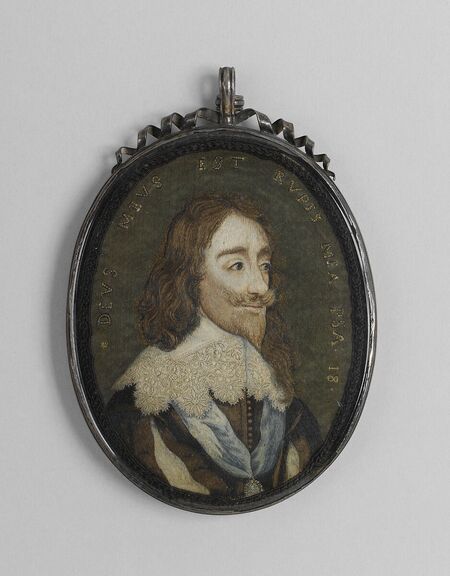
Embroidered miniature portrait of Charles I (control sample)Artifact: miniature in an oval frame with a suspension loop, silk and metallic threads on silk, 15,2 × 11.4 cm. England, 1650–1670. Based on a 1641 engraving by V. Hallor after a portrait by A. van Dyck.Storage location: The Metropolitan Museum of Art, New York (inv. 39.13.7)Key location: No key; the portrait is open (zero level)Visual analysis: The purpose of a control sample. This item is not a crypto-portrait, which is why it is placed first. It shows the image of the executed king without concealment. All subsequent objects are measured relative to this reference point. Composition and technique. The King is depicted bust-length, three-quarter profile to the right, gazing past the viewer. The head occupies the upper half of the oval, while the lower half features a white lace collar, a blue ribbon, and the Order of the Garter medallion. The background is dark green, and around the head, an inscription is embroidered with light thread in an arc: «Deus meus est Rupis mea Psa: 18”—a reference to Psalm 18. The arc of the inscription functions as a halo, transforming the formal portrait into an image of a martyr [11]. Openness as a dating indicator. The loop and bow indicate that the miniature was worn on the chest, facing outward. On the scale, this represents zero distance. I hypothesize that such openness is more probable for the period after the 1660 Restoration, when the cult of the martyred king became official. The catalog date (1650–1670) does not contradict this.
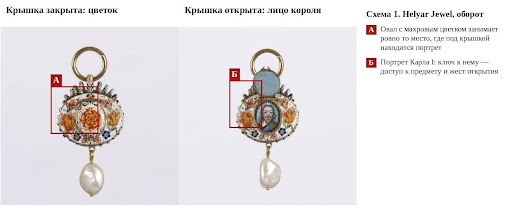
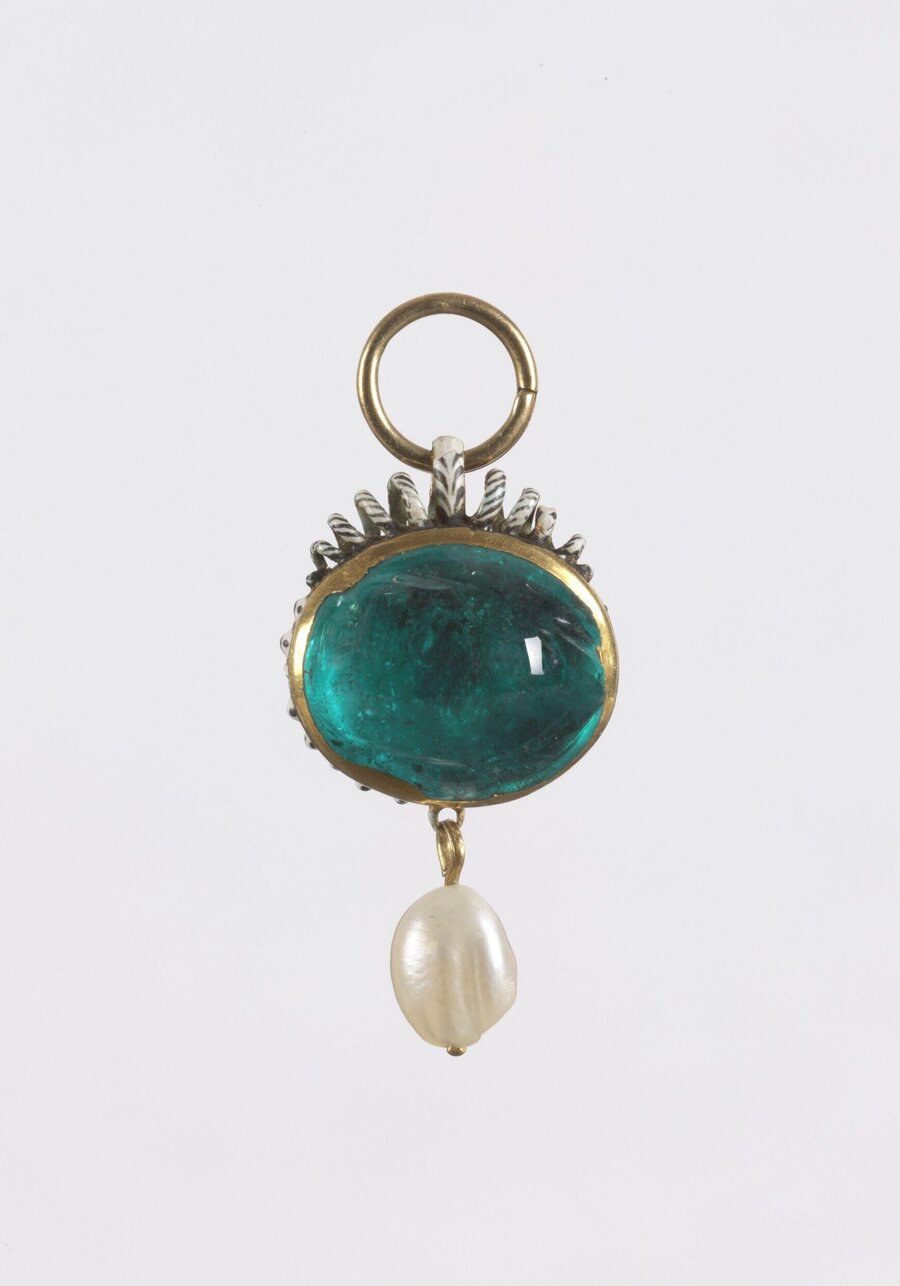
Helyar Jewel Pendant