Research Concept
At first glance, the maps of 15th-century Milanese decks, associated with the Visconti and Sforza families, depict a familiar social order: kings, queens, knights, and servants occupy different hierarchical levels. However, the rules of the game create a different power dynamic. Even the lowest trump card can defeat the king of the suit with a permissible move. The depicted social standing and the playing advantage turn out to be distinct characteristics of the card. This discrepancy becomes the starting point for the research.
Central Research Question: How do the images of earthly power, allegorical forces, and game hierarchy relate within 15th-century Italian Tarot? The study examines the cards simultaneously as artistic representations and objects embedded within a system of rules. A character’s significance is determined not only by their clothing, pose, and attributes but also by the actions the card permits during a game.
The Hypothesis is that the superiority of the trump suits over the other suits can be read as the subjugation of the individual person to broader «rules of life.» The Emperor and the Pope embody social order, Fortuna illustrates the variability of one’s status, Time signifies aging, and Death represents the finitude of human existence. Under this reading, the game’s inherent advantage gains conceptual grounding in these images: the earthly ruler remains subject to the forces that limit his power.
The Joker holds a special place. Its function of «excusing» allows one to evade a mandatory suit response or the trump card play under specific conditions. This enables a comparison between the card image and the cultural figure of the fool—someone capable of questioning established norms. After examining the hierarchies, the Joker introduces a different principle of action: the card’s value may lie in the possibility of exclusion rather than in superiority over an opponent.
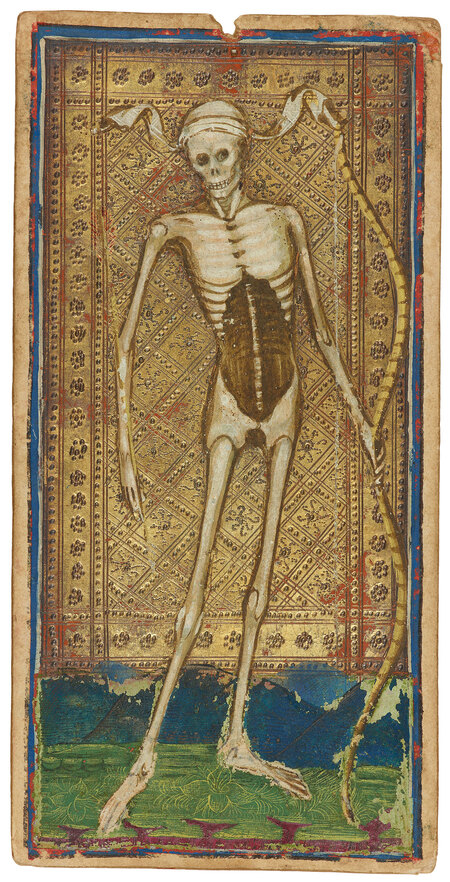
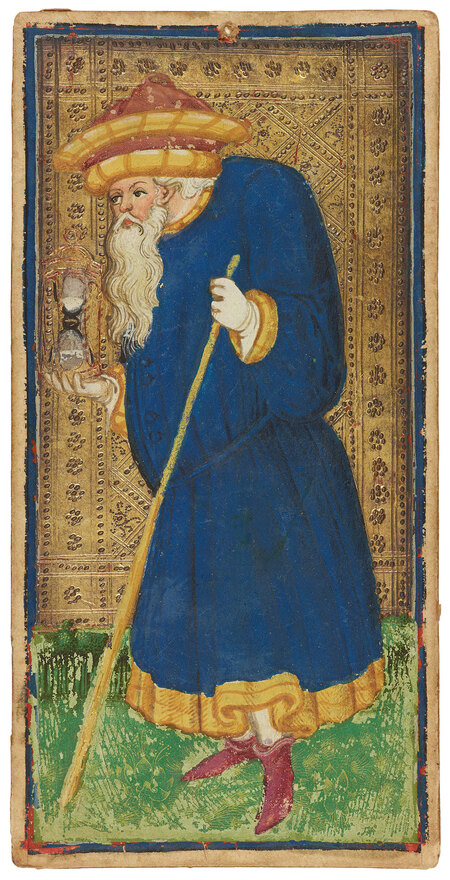
«Death» and «The Hermit» cards from the reproduction deck—from The Morgan Library & Museum, New York
The primary material for this research consists of maps from several 15th-century Milanese decks associated with the courtly circles of the Visconti and Sforza. Central to the analysis is the Pierpont Morgan–Bergamo deck, commonly known as the Visconti–Sforza, while the Brera–Brambilla deck is used for comparison.[2] [9] The significance of this topic lies in the ability to trace the interaction between imagery and rules using specific historical artifacts. The deck functions simultaneously as a system of artistic motifs and a set of objects for executing gameplay. Comparing these aspects reveals how cultural concepts acquire new functions within the game.
The main boundaries of this research are the 15th-century Milanese maps. Later works and written sources are included for comparison, noting their time and origin. Dating and attribution are derived from museum catalogs.
The work separates the observable features of the maps, information from historical sources, and the author’s interpretation. The proposed reading does not prove the existence of a single philosophical program underlying the deck. Instead, it allows an investigation into how the interplay between imagery and gameplay rules constructs a model of power—its limitations and potential exceptions.
The Rule Creates Its Own Order
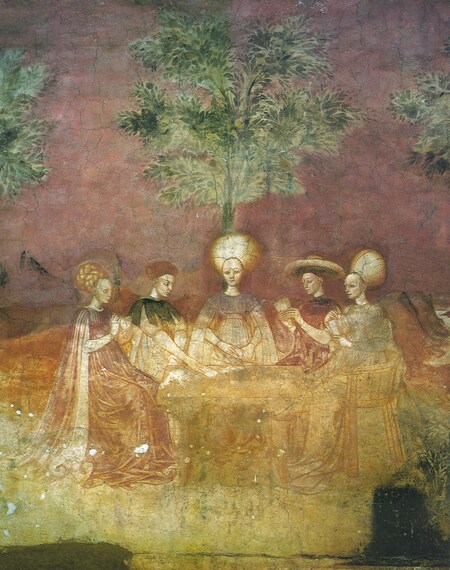
Tarot is best viewed primarily as a card game. In its complete structure, narrative cards coexist with four standard suits: cups, coins, swords, and wands. The deck includes 56 suited cards, 21 trump cards, and a Fool [2]. The Visconti–Sforza complex is associated with the Northern Italian court environment of the 15th century. For our discussion, the principle of trick-taking is essential. Participants lay down cards in turn, and the winner of the round takes them. In traditional tarots, one must follow suit; if the required suit is unavailable, one must play a trump, provided one is held. A trump card is capable of beating even a higher-ranking card of a standard suit [3] [4] Illustration: Board Game Master Bormeo. «Card Game, ” traditionally „Tarot Players.“ 1440s, circa 1445–1450. Wall painting. Palazzo Bormeo, Milan.
The King is higher than the other cards in its suit.
But the lowest trump card can beat the King.
This reveals a distinction between depicted rank and actual playing strength. Heisinga views the game as an activity that creates its own order, mandatory for its participants [1]. In Tarot, this principle manifests in the difference between the social status of the depicted figure and the card’s power. The King represents a high social standing, yet belongs to a standard suit. The Emperor and the Pope, despite the thematic closeness to power, fall into a different category—the trumps.
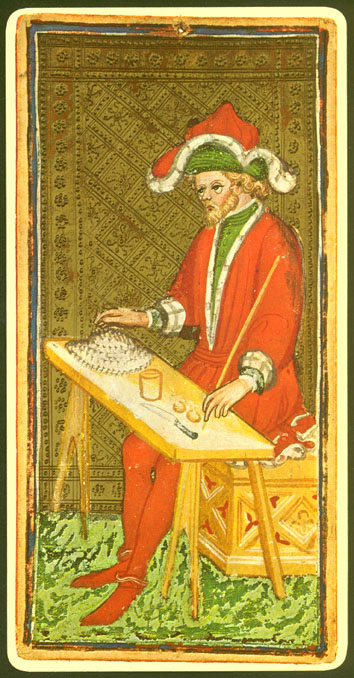
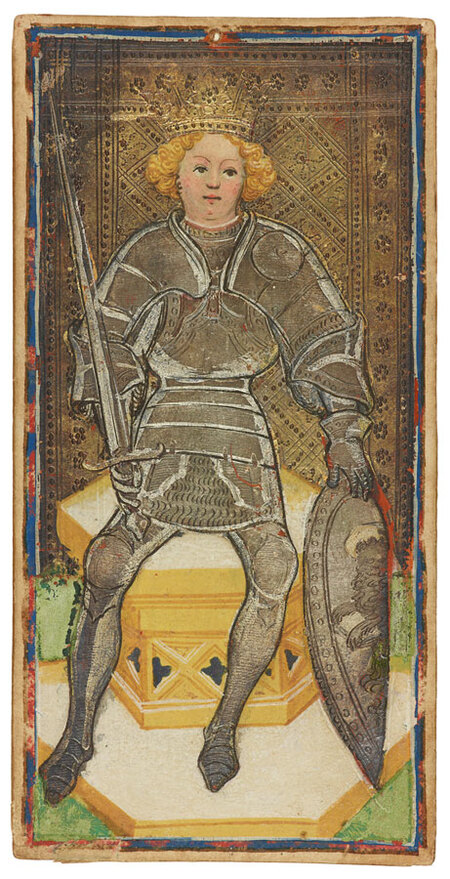
Bonifacio Bembo, by museum attribution. «Baggatto (Magician)» on the left, «King of Swords» on the right. Visconti–Sforza deck. Milan, circa 1450–1480. The Morgan Library & Museum, New York.
How Images Assert Power
The King of Swords is seated frontally, with his legs spread wide. The crown, armor, sword, and shield denote dignity and military power. The geometry of the seat and the central positioning of the body create a stable composition. The capacity for action is conveyed through the objects and the character’s stance: before us is a sovereign armed, yet not engaged in combat.
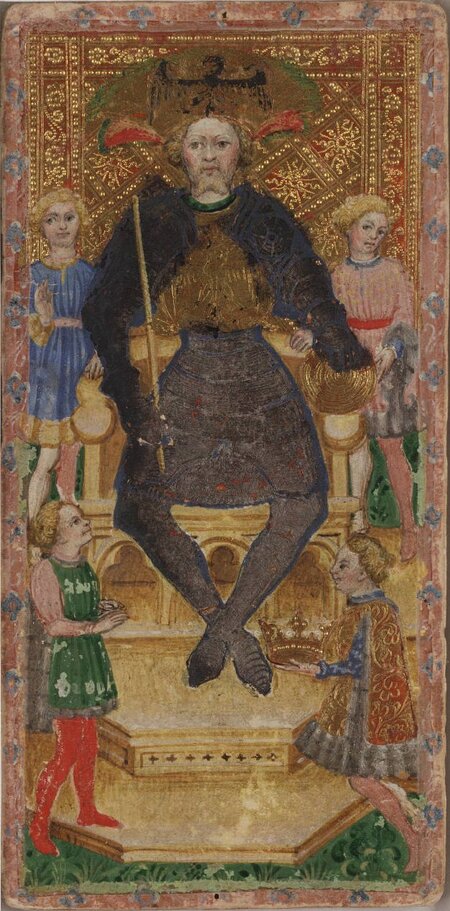
In the Emperor, authority is represented differently. His body is almost obscured by long robes. A gray beard, tall headdress, scepter, and orb create an image of dignity tied to age and status. The hand holding the orb is raised, but the entire silhouette remains composed. The attributes surround the figure, making its status recognizable.
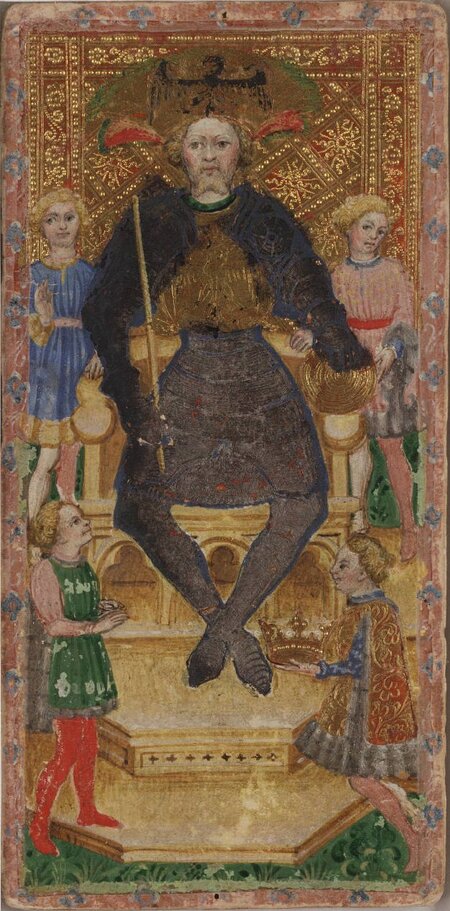
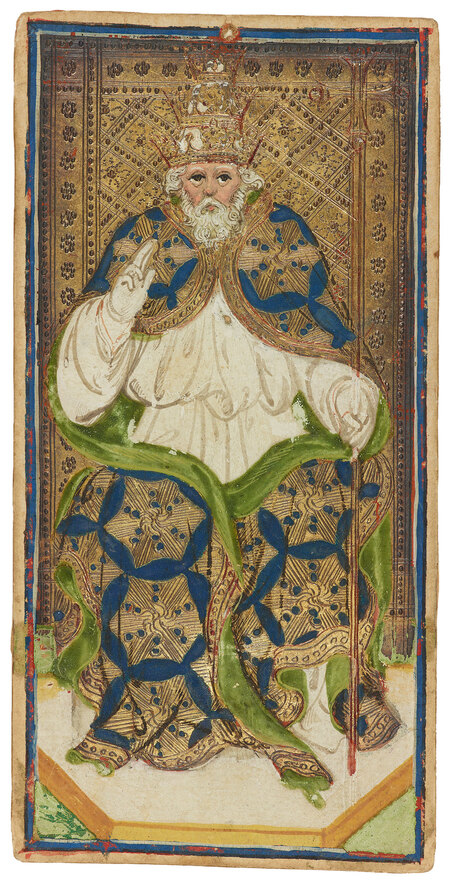
Bonifacio Bembo, according to museum catalog attributions. «The Emperor» on the left, «The Pope» on the right. Visconti–Sforza deck, Milan, mid-to-late 15th century. Accademia Carrara, Bergamo, Inv. 06AC00889/01; The Morgan Library & Museum, New York.
In Papa’s map, stillness is combined with a frontal posture, a multi-tiered tiara, and an raised arm. The large figure almost fills the frame. Ceremonial clothing conceals the body’s contours, and its ornamentation complements the decorative density of the background. The hand gesture becomes especially noticeable because of the stillness of the rest of the composition.
The King, Emperor, and Pope belong to different gaming categories. The King leads his own suit; the Emperor and Pope belong to the ranks of trumps. This comparison allows one to move from an individual holder of high status to broader forms of societal organization—secular and spiritual power.
Fortune: The Rule of Change
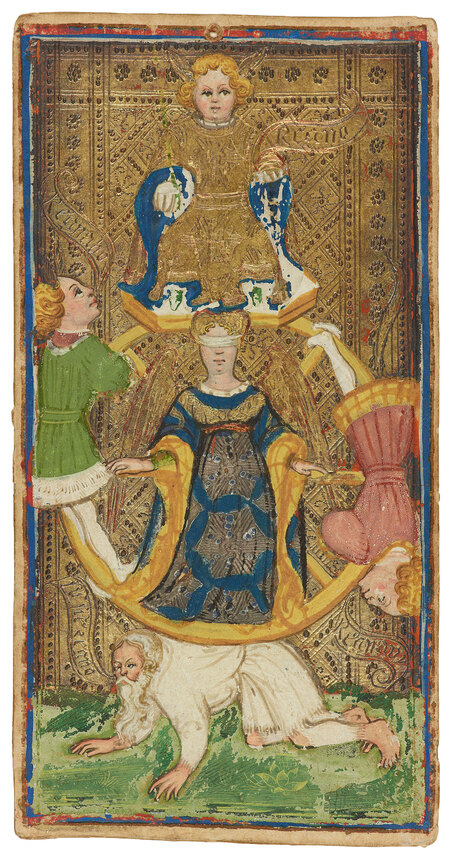
On the «Wheel of Fortune» map, the characters' positions are determined by their relationship to the rotating wheel. One rises, another is at the top, the third descends, and the fourth rests at the bottom. In the center, there is an image of a woman with a blindfold.
Illumination by Bonifacio Bembo, from the catalog. «Wheel of Fortune, ” Visconti–Sforza deck. Milan, c. 1450–1480. 173 × 87 mm. The Morgan Library & Museum, New York. Fragment.
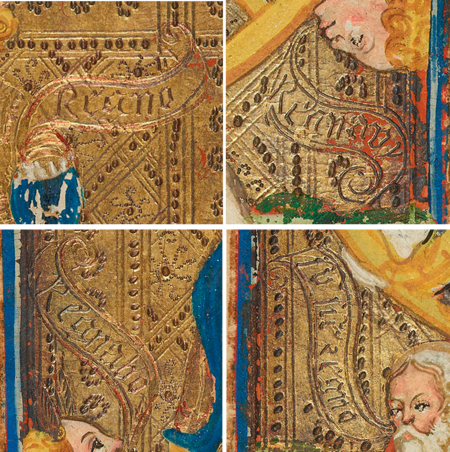
The museum description includes inscriptions accompanying the characters. The text connects these concepts to the possession of power: «I shall reign, ” „I reign, ” „I reigned, ” „I have no kingdom”[2]. Before us are four states that can be read as sequential stages of a single destiny. The highest position proves to be temporary.
The comparison with the Emperor reveals the difference between the two compositions. On his map, attributes are focused around a single, stable form. On the Wheel, an individual figure is subordinated to the overall structure. Power, represented as a ruler’s quality, becomes a position that can be gained and lost. The scale of change is particularly significant. In the Emperor’s map, objects uphold the dignity of the character. On the Wheel, the body’s posture itself becomes an indicator of elevation or decline: the seated figure at the top is contrasted with the inverted figure on the side and the figure crouching at the bottom.
Fortuna and the Emperor
Emperor embodies power within the world, while Fortune represents the rule to which even that power is subject. In our interpretation, this signifies a transition from being a participant in the social hierarchy to being the force that determines its fluidity. In the later Marseilles order, Fortune stands above the Emperor and defeats him in the gamble.[5] This dynamic relationship supports the proposed reading: possessing power does not liberate an individual from the conditions of its loss.
Images of Global Order Beyond the Game
Images of Fortuna, Time, and Death existed in culture beyond the context of playing cards. Comparing them with 15th-century artworks helps us understand the beliefs that were familiar to the contemporaries of the deck.
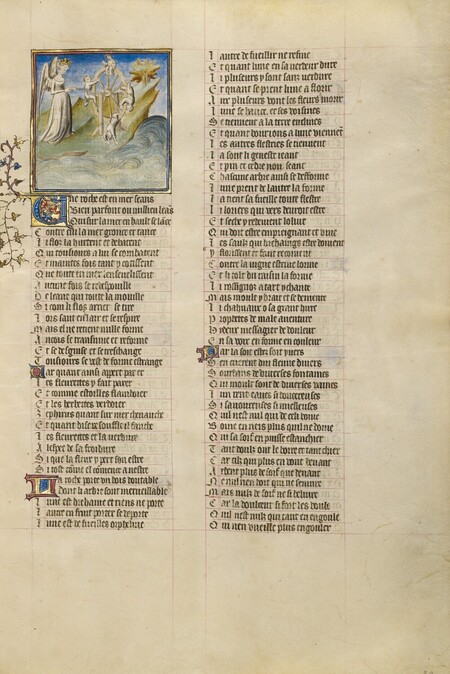
Fig. Unknown French Master. «Wheel of Fortune,» from the «Romance of the Rose.» c. 1405. Tempera, gold leaf, and ink on parchment. Leaf 36, 7 × 26 cm. J. Paul Getty Museum, Los Angeles. Ms. Ludwig XV 7, fol. 39; 83.MR.177.39.
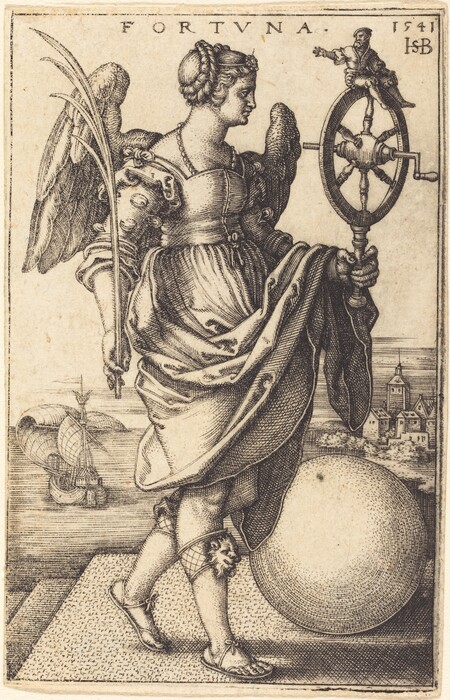
In the miniature, Boecius Fortune spins a wheel upon which ascent neighbors descent. This image also connects the human condition to the impermanence of luck. The map employs a recognizable visual motif, and the game gives it a specific function.Ill. Hans Sebald Beham. «Fortuna.» 1541. Engraving. Sheet 8, 1,1×0.5 cm. National Gallery of Art, Washington. Rosenwald Collection. Inv. 1943.3.1073.