Navigation Menu
- Introduction. Research Concept
- Space and Principles of Its Construction
- The Loss of Human Scale
- The Sensation of Infinite Continuation
- Space That Is Difficult to Coalesce into a Whole
- Hidden Boundaries: Frame, Shadow, and Depth
- Conclusion
- Bibliography
- Image Sources
Concept
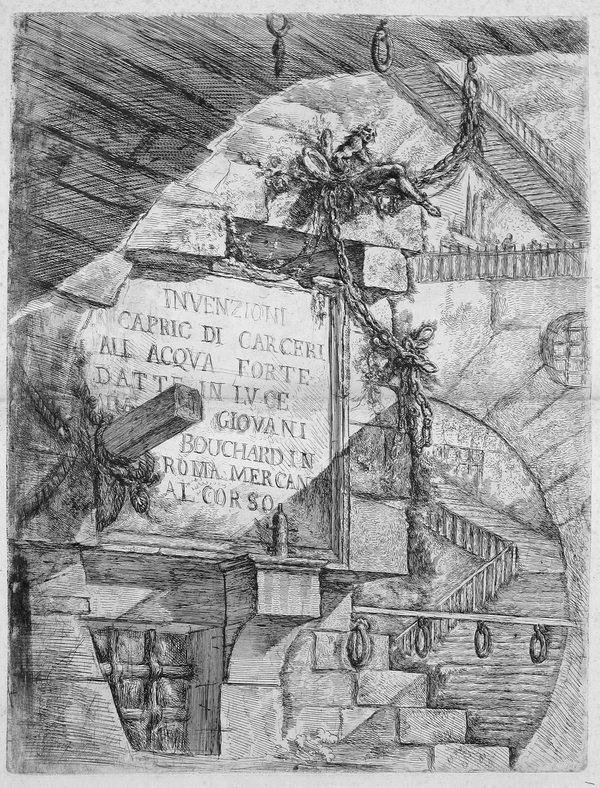
Giovanni Battista Piranesi was an Italian architect, graphic artist, and master etcher whose work combined the study of ancient architecture with the creation of fantastic spaces.One of his most famous works was the series of etchings, «Imaginary Prisons.» These plates depict monumental interiors filled with staircases, bridges, arches, and massive supports. The first edition of the series, published around 1749–1750, included fourteen sheets. In 1761, Piranesi revised and expanded it with two new compositions.
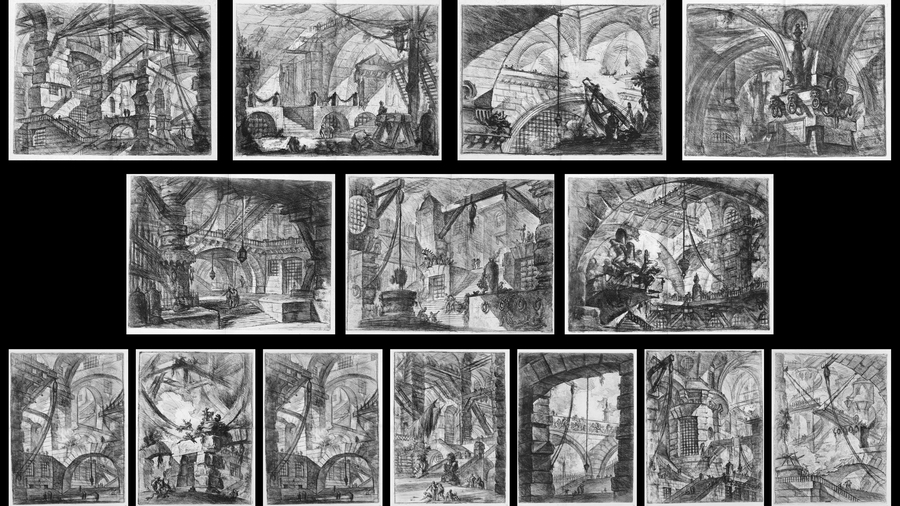
«Imaginary Prisons» / First Edition 1750 / Giovanni Battista Piranesi
The choice of research topic stems from the unique ways space is perceived in this series. When viewing the engravings, there is a feeling that the depicted interior cannot be grasped in its entirety. The eye follows the staircases, moves between platforms, and travels into the depth of arched passages, yet the structure’s composition remains ambiguous.
The primary material for this study will be engravings from the 1750 edition. The series will be examined without including the later changes from 1761.
«Spatial anomalies and ambiguities abound in all images of the series.»
The theoretical foundation of this work is the concept of the mathematically sublime, which Immanuel Kant discussed in the «Critique of Judgment.» For this study, it is important to trace how architectural forms guide the imagination toward an idea of the whole that cannot be directly grasped in contemplation. In this context, the concept of the sublime is used as a tool to interpret the visual experience presented in the engravings.
Mathematically Sublime. Space Beyond Comprehension In the «Critique of Judgment,» Kant links the mathematically sublime to the concept of the absolutely great. This perception reveals the limit of the imagination: while individual parts can be considered sequentially, it proves impossible to unite them into a whole.
«Sublime—that which makes everything else seem small in comparison.»
The sublime emerges from the tension between the limitations of sensory perception and the mind’s demand to conceive of absolute totality. Imagination cannot provide a commensurate image for it, yet the very possibility of conceiving the infinite reveals the supremacy of reason over sensory measure. Therefore, the sublime pertains to a state experienced by the subject during contemplation.
In the first edition of Piranesi’s «Carceri,» the basis for such an interpretation lies in the organization of the architectural space. Massive supports and high vaults dwarf the scale of human figures. The repetition of arches, staircases, and platforms guides the eye from one area to the next, yet it prevents the viewer from establishing the overall dimensions of the structure. The architecture extends beyond the plate, concealed behind ceilings and lost in the depth.
Individual structures remain recognizable, while their connection obscures the notion of a whole. The gaze continues to explore the space without reaching a discernible conclusion. It is this discrepancy—between the accessibility of details and the elusiveness of the overall structure—that allows the series to be viewed through the lens of the mathematically sublime.
The effect of spatial immeasurability arises from the combination of scale contrasts, repeating structures, and ambiguous boundaries. Individual architectural elements are accessible to perception, but their relative placement makes it difficult to form a coherent image of the structure.
1. Space and the Principles of Its Construction
In the first edition of «Imaginary Prisons,» the viewer is placed inside the architectural space. The interior is shown from a specific vantage point, which determines the relationship between planes, the direction of the gaze, and the portion of the structure visible.
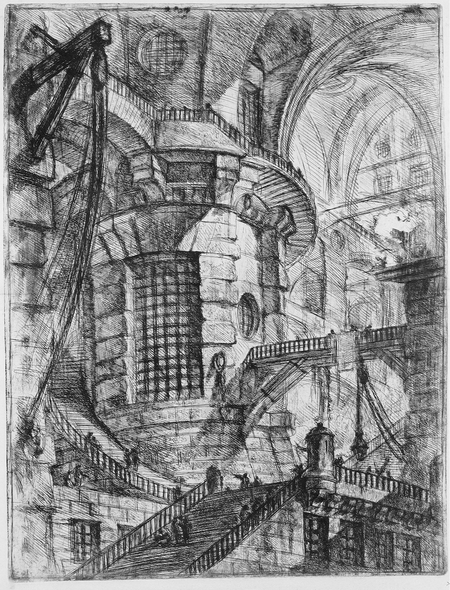
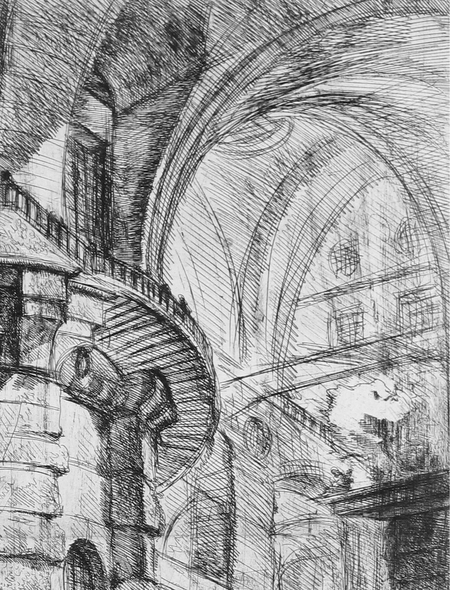
Round Tower First Edition (1750)
In the «Round Tower, ” the perspective is directed from bottom to top. The undersides of arches and passages are visible, while the upper structures are positioned high above the observation point. There is no open space before the viewer that allows them to step back and examine the structure from a distance. The architecture envelops the viewer, occupying almost the entire field of vision.
The tower establishes the compositional center of the page. Its curved surface contrasts with the straight lines of the stairs and landings. Passages approach it from various sides and at different heights, connecting the central volume to the surrounding architecture. Consequently, the space develops both around and behind the tower.Depth is created through the overlapping of architectural planes. A large arch in the upper portion of the page frames the tower, behind which more distant supports and walkways are visible. The nearer structures are drawn more densely, while the farther ones are rendered more transparently, with a light hatching. The successive reduction of detail allows distances to be discerned, yet each subsequent plane is only partially visible. The space unfolds and becomes clearer through the gaps between the structures.
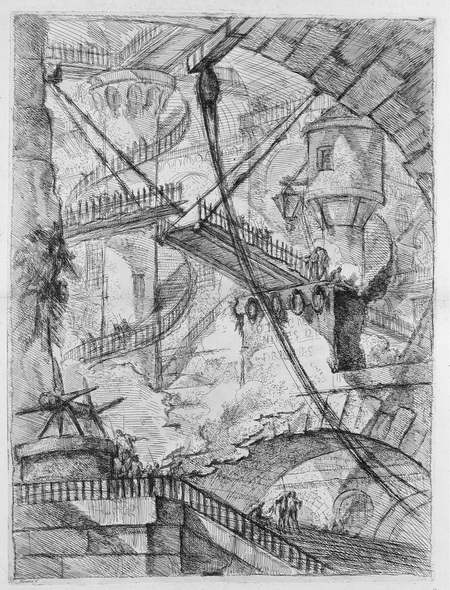
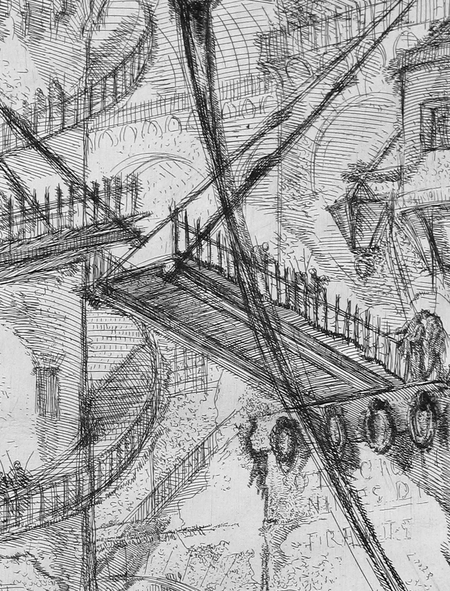
Lift Bridge First Edition (1750)
The composition in the engraving «Drawbridge» is based on the intersection of vertical support beams, horizontal walkways, and diagonal staircases. The verticals define the height of the interior, the horizontals divide it into levels, and the diagonals connect these levels. The viewer’s gaze continuously shifts direction as it moves between different areas of the image.
A sense of depth arises from the overlapping of structures. The nearer arches and supports partially obscure the platforms located behind them, beyond which subsequent architectural elements appear. Denser hatching in the foreground and lighter rendering in the distant areas intensify the distinction between them. The space is perceived as a sequence of planes receding beyond the immediate structures.
Similar to «Round Tower, ” denser hatching in the foreground and lighter rendering in the distant areas enhance the separation between the levels. The space is perceived as a sequence of planes receding beyond the immediate structures.
Gothic Arch First Edition (1750)
In the «Gothic Arch, ” massive supports, a tall pointed arch, and staircases form a space that unfolds both in depth and vertically. The arch opens onto distant spans, and the landings divide the interior into several levels. Each structural element allows one to perceive the immediate vicinity, but it does not define the measure of the entire structure. There is a significant distinction between the scale of an individual, comparable element and the overall expanse of the space, which the image leaves undefined.
The viewer’s position within the interior dictates the sequence of their perception. The gaze passes through the arch into the depth, then rises up the staircases, and lingers at the intersections of the landings. This movement can be correlated with Kant’s distinction between the sequential apprehension of parts and their unification in a single contemplation. However, the contemplation continues, yet each new section requires the viewer to retain what has already been seen in their imagination and connect it to what opens up further.
The levels, supports, and edges of the transitions are discernible, but their joints are partially concealed. Therefore, the accumulation of visual details does not result in a complete impression of the interior. This creates a sense of «structural purposelessness.»
2. Repetition and the Sense of Infinity