Concept
This paper examines the evolution of dress-up games—from their pre-digital material predecessors and early computer simulations of the 1990s–2000s to contemporary major releases.
The foundation of dress-up game genres lies in a simple yet fundamental interactive mechanic: assembling, combining, and transforming the character’s visual appearance using a set of interchangeable elements—from hairstyles and dresses to small accessories. From a cultural philosophy perspective, this process directly relies on the category of «mimesis,» which the French sociologist Roger Caillois identified in his work Games and People [1] as one of the four basic principles of any game.
Theoretical Framework
The philosophical foundation of this research draws upon the concepts of Dutch cultural theorist Johan Huizinga and French sociologist Roger Caillois. The work employs the concept of the «magic circle» (from Huizinga)—a special space separated from everyday reality, governed by its own rules, where costume allows a person to step beyond an ordinary role. Furthermore, the category of «mimicry» from Roger Caillois’s game classification is applied, which describes games based on disguise, imitation, and adopting a fictitious persona for the sake of aesthetic and psychological pleasure.
Relevance and Novelty
Game attire in modern video games is typically analyzed either through the lens of monetization (skins) or purely as an element of visual style. The novelty of this research lies in its construction of a cohesive chronological history of dress-up games, uniting pre-digital practices and contemporary video games into a single line of development. The work systematically traces the evolution of the genre—from French salon dolls and paper dolls with cut-out outfits to the Barbie phenomenon, early 2D fashion simulators, and modern game design in Infinity Nikki.
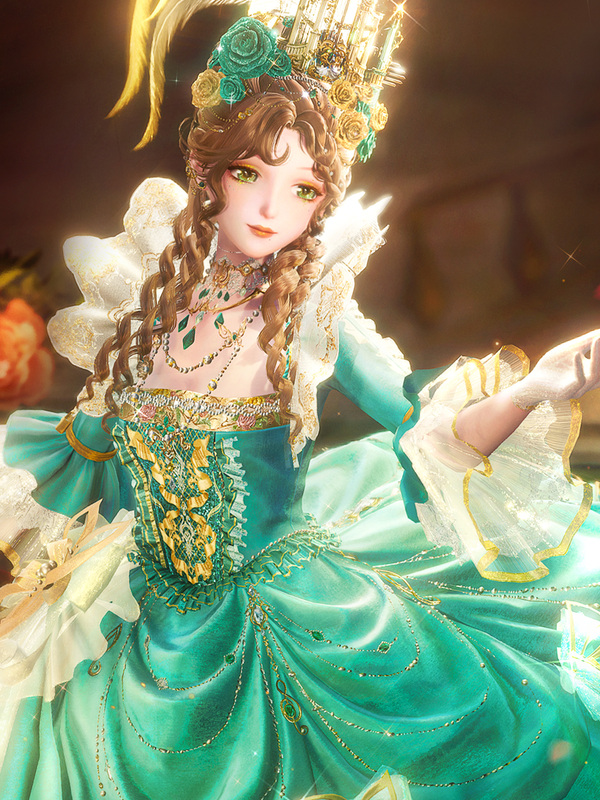
In recent years, the gaming industry has seen a rapid rise in the popularity of «cozy games» and projects that place aesthetics, customization, and character appearance at the center. A prime example of this trend is Infinity Nikki (2024), which merges the classic «dress-up» genre with a full-scale adventure set in an open 3D world. In Infinity Nikki, clothing ceases to be mere decoration; it transforms into a primary tool for interacting with the game world. Infinity Nikki has truly become the largest and most high-budget project in the history of the dress-up genre.
Research Question and Hypothesis
The central question of this work is: how has the visual logic of the wardrobe and the role of the costume itself transformed when moving from older dressing games to Infinity Nikki? It is hypothesized that while maintaining the compositional structure of classic paper and early digital dress-up games, Infinity Nikki qualitatively changes the function of the outfit, transforming it from a passive object of admiration into an active tool for interacting with the game world.
Navigation
- French Doll Dolls
- Paper Dolls
- Barbie Dolls
- Early Digital Simulators
- Costume as Gameplay Mechanic in «Infinity Nikki»
- Conclusion
- Bibliography
- Image Sources
French Parlor Dolls: Ample Wardrobes and the Simulation of High Society Life (1850s–1880s)
In the mid-19th century, the dress-up game acquired its first truly luxurious and detailed material form—the French fashion doll (poupées de mode or poupées de salon). While in previous centuries similar figures served as a practical tool for tailors to demonstrate Parisian tailoring, during the Second Empire, thanks to renowned Parisian workshops (such as Jumeau, Bru, Rohmer, and Gaultier), they definitively transitioned into the realm of children’s play.
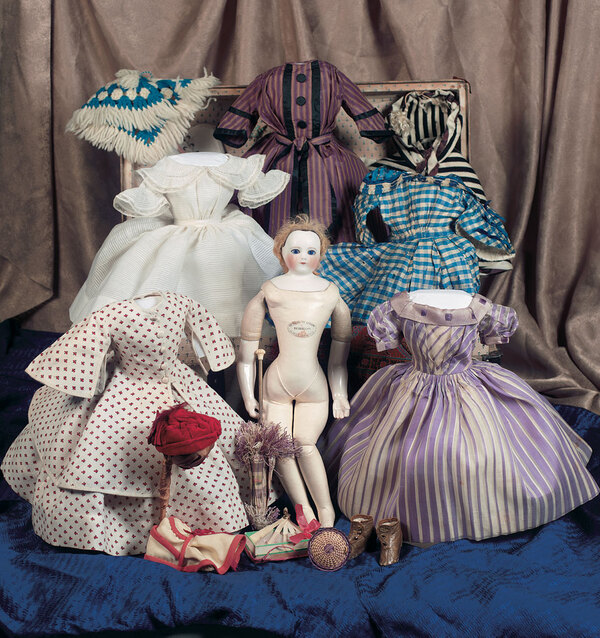
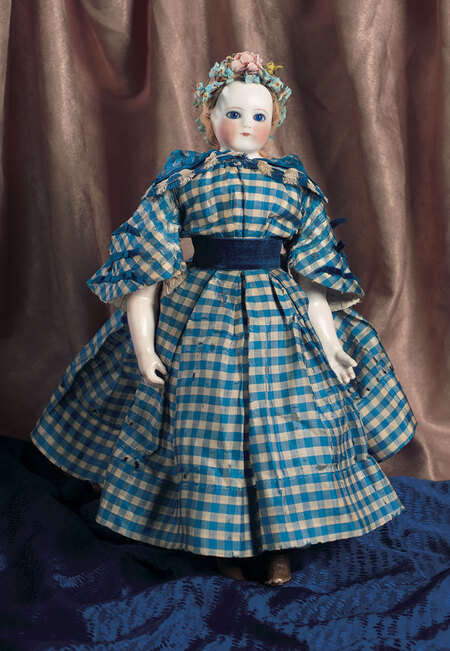
French fashion doll (poupée de mode) with a traveling wardrobe (trousseau). Workshop of Claude Joseph Blampue for the Herbillon department store («Au Calife de Bagdad, ” Paris), c. 1860. Glazed porcelain, kidskin, silk, wool, cotton. Height 35 cm.
The gameplay revolved around an enormous doll wardrobe, which was packed into miniature travel trunks complete with drawers and hangers. For the game to remain «correct, ” the doll’s owner had to dress her strictly according to the time of day and the occasion.
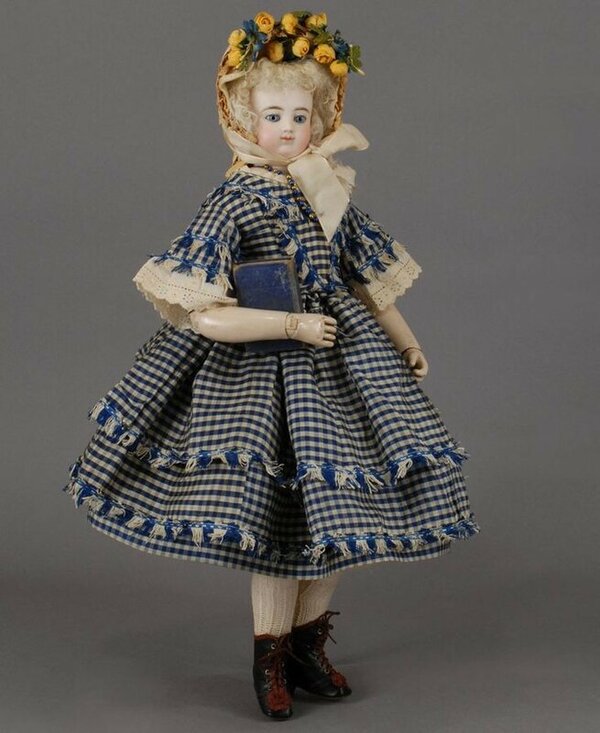
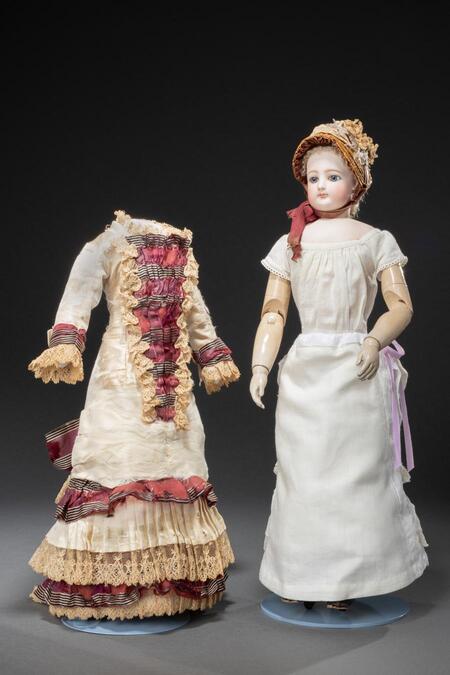
1. French fashion doll (poupée de mode) in a daytime walking ensemble. Workshop of Claude Joseph Blampua for the Parisian department store Herbillon («Au Calife de Bagdad»), c. 1860. Glazed porcelain, kid leather, textile. 2. French fashion doll (poupée de mode) in a morning white dress with a cap and a removable formal dress. Workshop of François Gaultier, Paris, c. 1875.
Morning and home excursions required a light cap and bonnet.
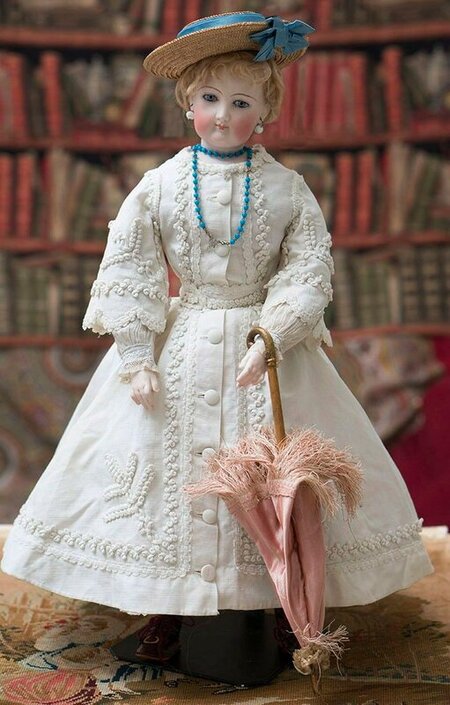
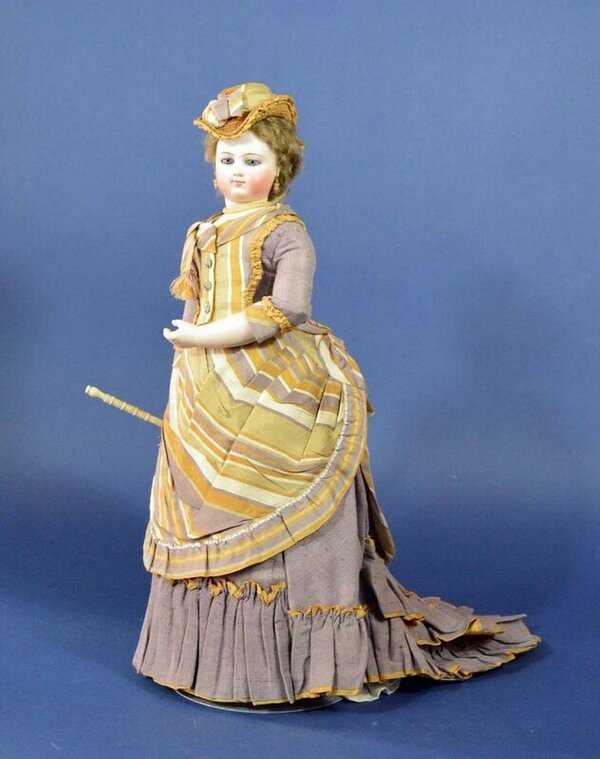
1. French fashion doll (poupée de mode) in a summer promenade ensemble with a straw hat and a lace parasol. France, c. 1875–1880. Bisque porcelain, cotton, lace, silk. 2. French fashion doll (poupée de mode) in a day dress with a bustle for visits and strolls. France, 1870s. Bisque porcelain, silk, wool.
Daytime outings and walks involved a complex, multi-layered ensemble featuring a crinoline, a hat, and a lace parasol.
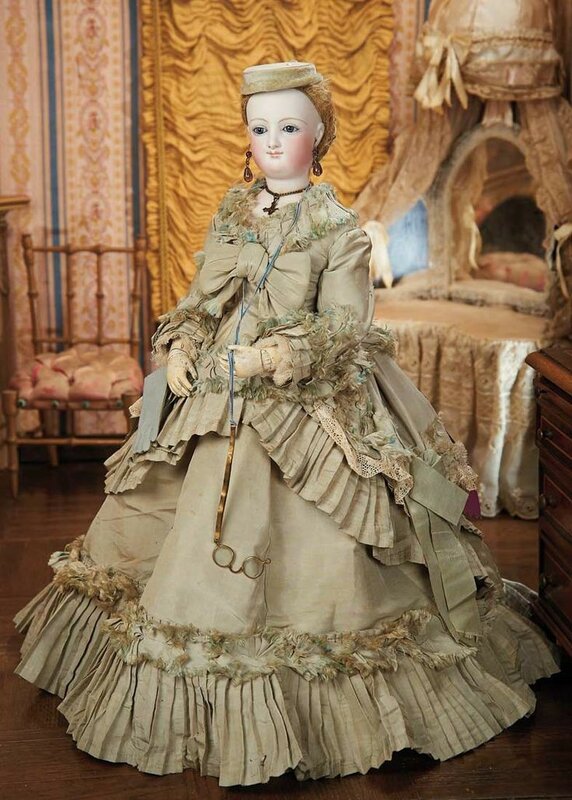
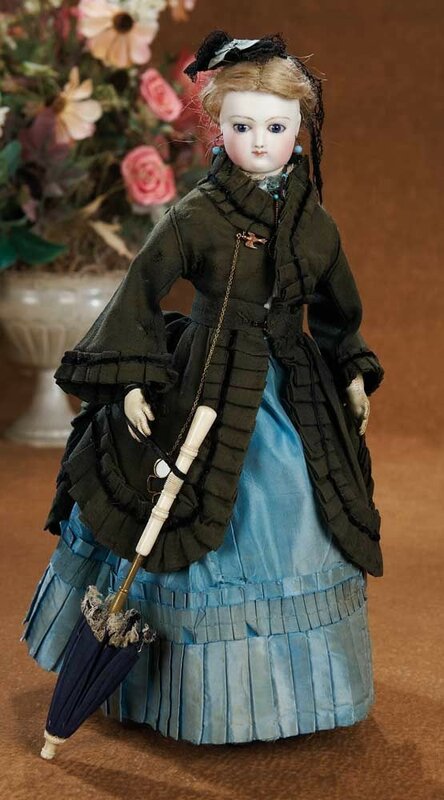
1. French fashion doll (poupée de mode) in an elegant silk dress suitable for visits and receptions. France, 1870s. Biscuit porcelain, silk, trim; the doll’s details include a miniature lorgnette on a chain. 2. French fashion doll (poupée de mode) in an outing ensemble featuring a Cossack jacket, a pleated silk skirt, and an umbrella. France, c. 1875–1880. Biscuit porcelain, silk, wool, lace.
The evening ball or opera required attendees to switch into a magnificent gown, complemented by jewelry and a miniature theatrical binoculars.
Paper dolls with cutout outfits (1810s–1850s)
Parallel to expensive porcelain dolls in the 19th century, a democratic and accessible counterpart for the middle class developed—paper dolls with cutout costumes. The first mass-market commercial game publication in this format was the English picture book «The History of Little Fanny, ” released by the London publisher S. & J. Fuller in 1810: in this publication, the cardboard figure of the heroine required her costumes and headwear to be swapped according to the plot’s progression. By the mid-19th century, the development of color lithography transformed paper doll production into a mass industry across Europe and the United States (led by publishers such as Raphael Tuck & Sons and McLoughlin Brothers), and the cutout sheets began appearing regularly in popular women’s and children’s magazines, such as Godey’s Lady’s Book.
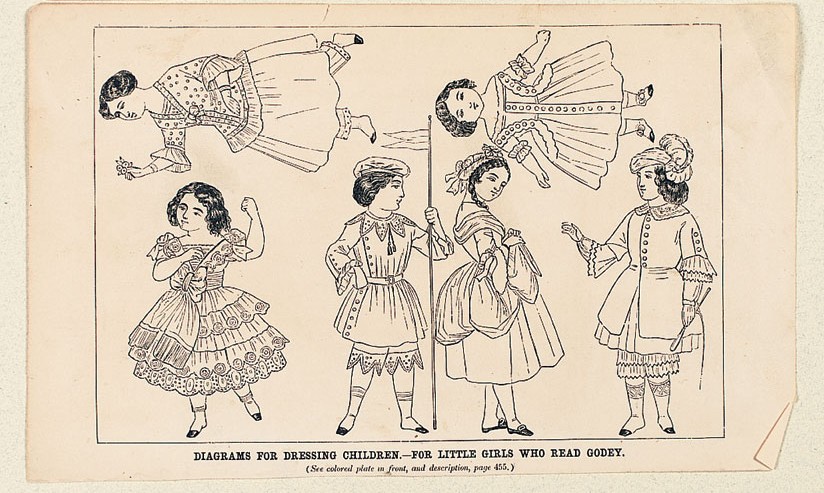
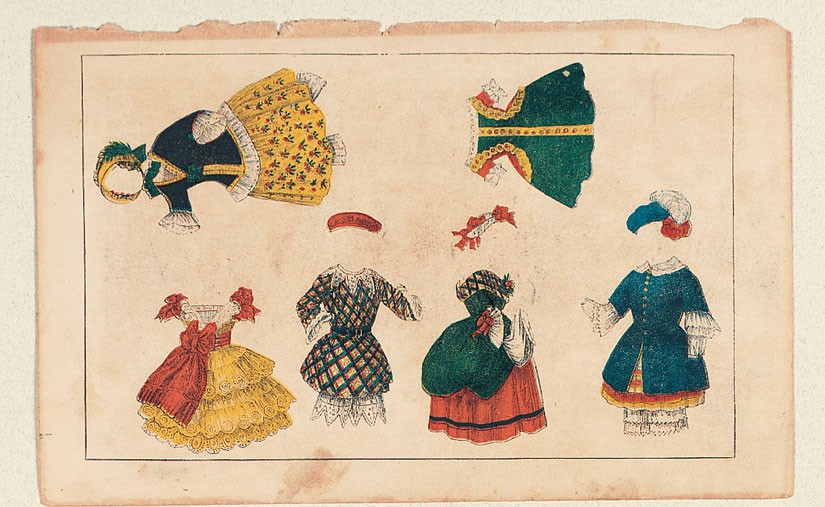
The invention of chromolithography (multi-color printing) drastically lowered production costs, making paper dolls accessible to the middle class. Paper tabs emerged during this time. Specifically, edges of outfits began featuring white paper tabs—fixators that allowed dresses and hats to be put on a flat figure without needing cutouts or glue. The popular American women’s magazine, Godey’s Lady’s Book, began regularly printing sheets featuring paper dolls and contemporary outfits directly within its pages, transforming them into the primary format for domestic leisure.
Mass Material Revolution: The Barbie Doll Phenomenon and «Career Outfits» (1959–1980s)
The Digital Transition and Early Simulators (1990s–2000s)
Costume as Gameplay Mechanic: Infinity Nikki (2024)