Navigation Menu
- Concept
- From Painting to Digital Imagery: Shaping the Artistic Language of Disco Elysium
- Pictorial Texture: Color, Brushstroke, and Image Distortion
- Space as a Canvas: Isometric Perspective and Game World Composition
- Portrait as Visual Characterization: Character Imagery and Internal Skills
- Interface as an Extension of the Art World: Typography, Graphics, and Visual Navigation
- Conclusion
Concept
Video games today are not just spaces for interactive action, but also autonomous visual environments that integrate techniques from various art forms. One example is Disco Elysium, an RPG by ZA/UM released in 2019. Its aesthetic diverges from the common tropes of video game design: rather than striving for photorealism, the developers employ painterly textures, loose brushwork, complex color palettes, form deformation, and expressive composition.
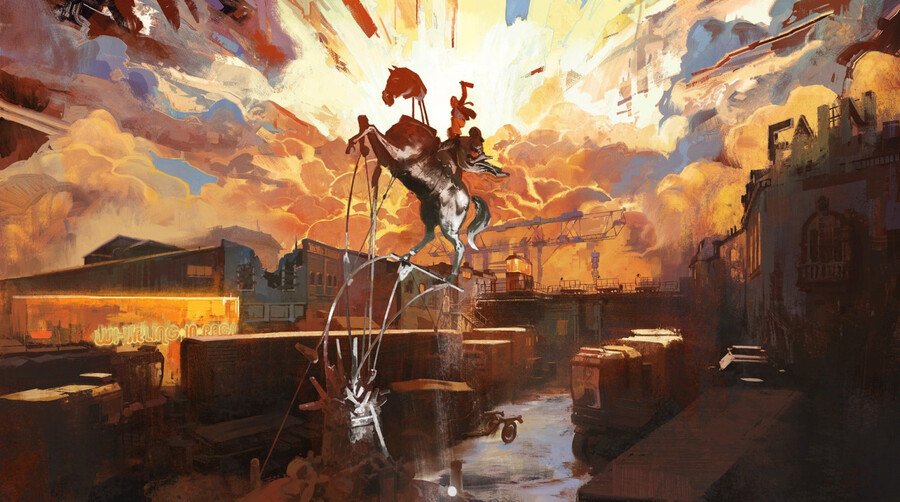
ZA/UM. Disco Elysium. Concept art of the city of Martinaise. 2019.
The visual style of the game is not just a surface feature.
The depiction of cityscapes, architecture, objects, and characters shapes the viewer’s perception of the world and becomes an integral part of the narrative. Locations appear not as neutral reproductions of reality, but as artistically curated spaces where color, light, texture, and composition convey the mood of the events. These painterly techniques function within an interactive environment: the visuals must retain expressiveness while simultaneously assisting the player in navigation.
ZA/UM. Disco Elysium. In-game scene in Martinez. 2019.
Relevance of the Study lies in the opportunity to examine how traditional fine art techniques are reinterpreted within modern video games. Using Disco Elysium as an example, one can trace the transition of painterly principles from static images into digital space and determine the functions they assume. This allows for the study of the game as a form of visual culture that creates its own aesthetic through artistic methods.Research Problem consists of determining how painterly techniques are transformed into a coherent system of visual narrative. It is crucial not only to note the similarities between in-game imagery and painting, but also to understand the role played by brushwork, color, texture, deformation, and composition—how they interact and influence the perception of the game world.
Research Object — the visual system of Disco Elysium.
Research Subject — the artistic and compositional techniques that shape its visual language: color and texture work, spatial organization, character portraits, and interface design.
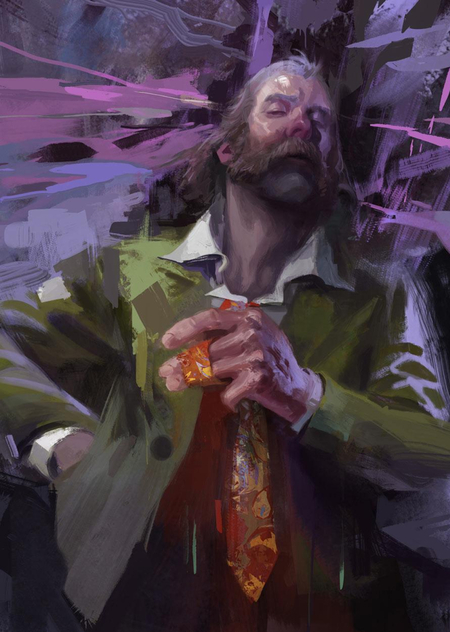
ZA/UM. Disco Elysium. Concept art by Kim Kitsuragi and Harry Du Bois. 2019.
Research Goal — to identify the distinctive visual language of Disco Elysium and determine how the principles of traditional painting are adapted to an interactive digital environment. The research aims to trace the development of the game’s artistic style, examine the painting references utilized by its creators, and analyze the core means of visual expression. Particular attention will be paid to the use of color, brushwork, and texture, the organization of the game space through isometric perspective, the specifics of character portraits and internal skills, as well as the interaction between typography and the interface with the game’s overall artistic system. Research Hypothesis posits that the expressiveness of Disco Elysium stems not from the direct replication of painted works, but from the reinterpretation of painting principles within the context of a video game. Brushwork, texture, color contrasts, form deformation, and composition become not merely stylistic features but also tools for visual storytelling: they shape the atmosphere, direct the viewer’s attention, and aid in revealing character and space.
ZA/UM. Disco Elysium. Hotel room interior design for Harry Dubois. 2019.
The research will be grounded in a visual and comparative analysis, along with an examination of composition, color, texture, and typography. The core material will consist of gameplay scenes, character and skill portraits, interface elements, concept art, and other assets related to the creation of Disco Elysium. Furthermore, works by artists who influenced the game’s visual style—specifically Jenny Saville, Alex Kanevsky, Sangram Majumdar, Ilya Repin, and Mikhail Vrubel—will be reviewed. Their work will allow us to trace the project’s artistic references and identify the distinctive ways painting techniques have been reinterpreted in a digital environment.
From Painting to Digital Imagery: Forming the Artistic Language of Disco Elysium
When developing Disco Elysium, the creators aimed to find a visual style that diverged from the conventional aesthetic of computer role-playing games. Instead of striving for photorealism, the team turned to the traditions of painting, focusing on the expressiveness of brushwork, color palettes, texture, and the plasticity of forms. This resulted in the game world possessing a unique artistic expressiveness, where recognizable elements of reality are combined with deliberately stylized and sometimes distorted imagery.
ZA/UM. Disco Elysium. Concept art panoramic view of Revachol. 2019.
Alexander Rostov, the game’s art director, played a crucial role in shaping this approach. Among the artists who influenced his artistic orientation, he named Jenny Saville, Alex Kanevsky, Sangram Majumdar, Ilya Repin, and Mikhail Vrubel. Despite their differing artistic styles, many of these creators share a distinct focus on the plasticity of form, the expressiveness of color, and the materiality of the painted surface. These qualities became vital components of the visual language of Disco Elysium.
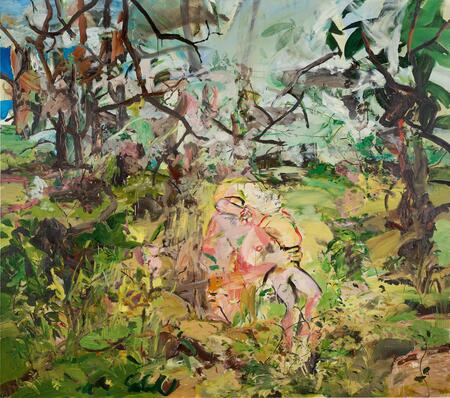
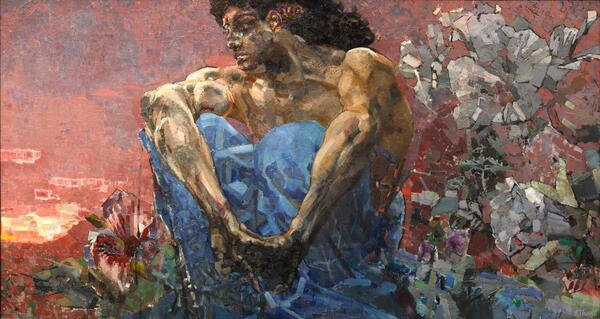
Jenny Saville. Propped. 1992. Vrubel M. A. Demon Sitting. 1890.
The game does not seek to literally replicate the style of any single artist. Its aesthetic emerges from the combination of various artistic principles. Some images feature a free engagement with color and texture, while others show deliberate distortion of proportions or blurring of the boundaries between objects. This blend allows the characters and their surrounding environment to remain recognizable while simultaneously lending them an unusual, almost painterly quality.
ZA/UM. Disco Elysium. Gameplay scene in the square with the monument in Martinhes. 2019.
One of the key elements of the visual style became the expressive brushstroke. Unlike the smooth, detailed graphics characteristic of many modern games, the images in Disco Elysium retain a sense of uneven, heterogeneous surface. Color patches do not always form crisp object boundaries, and individual details seem to dissolve into the surrounding environment. Because of this, the imagery is perceived not as an exact copy of reality, but as an independent artistic interpretation.
ZA/UM. Disco Elysium. In-game scene in Martindale. 2019.
Translating pictorial principles into a digital environment required adapting traditional artistic techniques to the specific characteristics of game graphics. The visual system was created using digital tools, three-dimensional assets, and complex texture work. Moreover, the technological foundation did not attempt to conceal its artificiality; rather, it allowed the feeling of a painted image to remain intact. The painterly texture became a part of not only the environment but also of the characters, objects, and other elements of the game world.
ZA/UM. Disco Elysium. Interior of the «Whirling-in-Rags» Hotel. 2019.
The interplay between painting and digital technology is particularly evident in the design of game environments. The city of Martinez is presented as a space with its own distinct color and compositional structure. Architecture, streets, objects, and lighting merge into cohesive visual scenes reminiscent of classical canvases. In this way, the surrounding environment does not merely serve as a backdrop for character action; it becomes an essential component of the game’s emotional experience.
Pictorial Texture: Color, Brushwork, and Image Distortion
One of the defining characteristics of the visual language in Disco Elysium is its rejection of smooth, homogenous imagery. The game world appears constructed from numerous painterly layers: splashes of color, rough brushstrokes, blurred transitions, and contrasting fragments. Surfaces do not appear perfectly rendered, and object boundaries often remain ambiguous. This lends the imagery a sense of materiality reminiscent of traditional painting.
ZA/UM. Disco Elysium. Interior of a book club in Capside apartments. 2019.
Color plays a special role in shaping the visual atmosphere. The palette of Disco Elysium is built upon complex combinations of muted and saturated hues. In some locations, cool blue, gray, and greenish tones predominate, while in others, bright red, orange, and yellow accents appear. Color does not merely designate objects and separate them from one another; it helps convey the emotional state of the space. Even familiar urban landscapes acquire a sense of anxiety, melancholy, or unreality due to unusual combinations of shades.