Concept
The purpose of this study is to attempt to define the stylistic and conceptual nature of Amedeo Modigliani’s painting—one of the most enigmatic and poetic artists of the first half of the 20th century. The question of which artistic movement his work can be ascribed to remains open and provokes manifold interpretations. Some consider him a representative of Expressionism, others a Post-Impressionist, and a third group includes him in the so-called «Paris School.»
However, all these attempts at classification only partially capture the essence of his style. This study aims to demonstrate that Modigliani’s painting is not an «intermediate link» between movements, but a phenomenon sui generis—meaning unique in its own right—with its own internal law of artistic construction and worldview.
The relevance of this topic lies in the need to re-examine conventional schemes and approaches to analyzing the painting of an artist whose work is still perceived more as a poetic myth than as an object for systematic art-historical analysis. This research plans to examine not only the biographical and cultural context in which Modigliani developed, but also specific works through which the logic of his artistic development, the choice of formal means, and symbolic accents can be traced.
Amedeo Modigliani’s creativity cannot be attributed to any single major artistic movement of the early 20th century. Despite clear intersections with modernist currents—such as Expressionism, Post-Impressionism, Symbolism, and formal Archaism—his artistic system possesses an inherent unity and a stable logic that transcends group aesthetics. Modigliani creates a unique visual language that merges formal simplification, elongated and stylized figuration, and a deep emotional and psychological resonance in his images. This allows us to speak not just of an individual artist’s style, but of a self-sufficient aesthetic paradigm in which elements of tradition (such as ancient and Renaissance plasticity, iconographic representation) and modernist innovation (volume deconstruction, flatness, symbolic content) are organically combined.
Modigliani’s painting is considered an autonomous artistic movement, yet it is fundamentally as significant as the trends of its time. His art constitutes a uniquely constructed system of expressive means, centered on a metaphysical concept of the human figure: for him, the person is not a social type or a carrier of his era, but an atemporal, lyrical, and plastic essence. The artist does not seek to express movement, protest, or ideology—rather, he strives for a quiet, almost meditative depiction of humanity, one in which presence and sheer being are expressed more than fleeting emotion.
Thus, the hypothesis posits that Modigliani’s style constitutes an aesthetically distinct system, formed at the intersection of classical tradition, avant-garde influence, and personal artistic intuition. This positions his painting as an exception within the movements of the 20th century and necessitates consideration beyond conventional categories.
Portrait of Jeanne Ebsworth in a large hat, 1918, Amedeo Modigliani
History
«Portrait of Jeanne Ebûtern» is one of Amedeo Modigliani’s last paintings, completed in 1918. Jeanne was his muse, lover, and wife, playing a pivotal role in the artist’s life. Their connection was profound and moving, despite the hardships of life in Paris at that time—poverty, illness, and social struggles.
The painting was created during a period when Modigliani’s health was rapidly deteriorating due to tuberculosis and alcohol abuse, lending the work a profound emotional weight and a sense of farewell. Shortly after completing the portrait, in January 1920, Modigliani passed away, and Jeanne, unable to bear the loss, died by suicide just two days later.
This portrait is a kind of visual farewell—a dedication, an embodiment of love and tragedy. It preserves the intimacy and timelessness of the relationship, becoming a symbol not only of the artist’s personal destiny but also of the eternal themes of love and beauty in art.
Composition
«Portrait of Jeanne Ebuerne» is one of Modigliani’s most poignant works—painted shortly before the artist’s death and dedicated to his wife and inspiration. The composition of the painting is distinguished by classical rigor: the woman’s figure occupies the central position, remaining static and compact. Moreover, the vertical orientation of the format accentuates the model’s elongated silhouette, highlighting her elegance and grace.
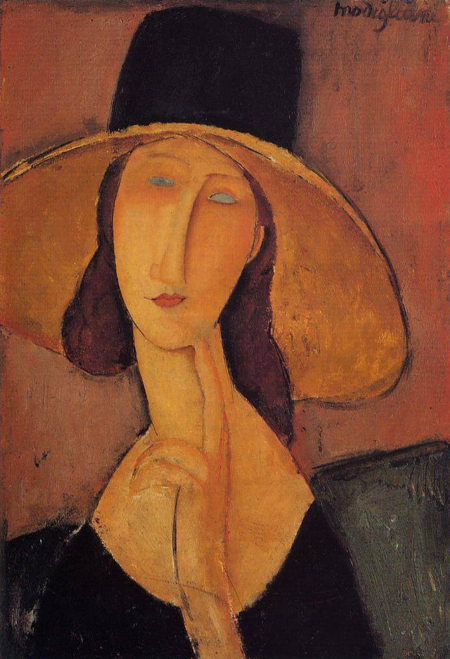
Compositional Simplicity: There are no distracting details or complex backgrounds—only a muted, neutral backdrop that pushes the figure to the forefront, creating the effect of an isolated space where the individual and their inner world are paramount. Balance and Symmetry: Jeanne’s head, neck, and shoulders form a thoughtful geometry dominated by verticality, yet soft lines create a contrast with the rigid structure, lending the composition fluidity and rhythm.
Program
«Portrait of Jeanne Ebuerne» is a prime example of why Modigliani’s work defies easy categorization into a single artistic movement. At first glance, his language incorporates elements from several styles, yet, overall, it forms a unique visual philosophy.
A reference to primitivism and archaic styles. Elongated forms, stylized facial and neck features, and conventionalized lines are clear borrowings from African masks and ancient sculptures. This connects Modigliani to modernist primitivism, which was part of the avant-garde explorations of the early 20th century. However, unlike the radical deconstruction of form by Cubists, for Modigliani, conventionalism serves more toward idealization than deconstruction.
The Influence of Symbolism. The painting emphasizes not physical reality, but the model’s inner world and spiritual essence. This brings the painting closer to the Symbolist tradition, where form is subordinated to the expression of emotions and states of the soul.
Classical Traditions. The portrait conveys a sense of harmony and proportion reminiscent of Renaissance portraits. Elongation and simplification are not a rejection of canons, but rather a reinterpretation of them through a contemporary lens.
A lack of clear affiliation with any particular avant-garde movement. Unlike Cubism, Fauvism, or Expressionism, Modigliani does not shatter space or experiment with color in a radical manner. His painting is more contemplative and plasticly «smoothed, ” rendering it simultaneously modernist and traditional.
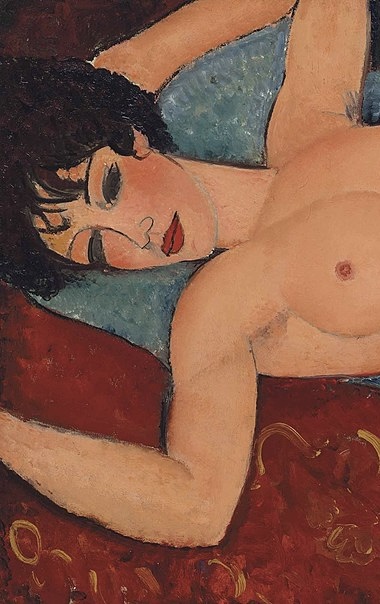
Nude Reclining, 1917, Amedeo Modigliani
Composition
The painting depicts a nude woman reclining in a relaxed pose on a bed or chaise lounge. Her body occupies almost the entire width of the canvas, seeming to merge with the plane of the painting. Her head rests on a white pillow, her left arm is draped behind her head, and her right arm lies alongside her torso. The woman is shown facing forward, with an open, almost defiant gaze directed straight at the viewer.
The composition is horizontal—a rarity for Modigliani, who usually painted portraits vertically. Here, the horizontality emphasizes sensuality, corporeality, and the fluidity of the lines. The figure isn’t «fitted» into an interior; it is merely suggested—a reddish-brown background with a slight hint of sheets or fabric. The focus is solely on the body.
Color and Painting
The color palette is warm and sensual. The skin is rendered in delicate peach and ochre tones that glow against a subdued red and deep brown background. The absence of sharp chiaroscuro modeling enhances the flatness of the image—the body does not project into space, but rather lies, like an icon, on the canvas plane. This gives the figure a more abstract and symbolic quality—it is less about sensuality and more akin to ritual.
Specialization
Not academic realism. While the nude figure is a traditional subject in academic art, Modigliani breaks from the conventional approach. He does not aim to render precise corporeality; rather, he stylizes the body, transforming it into a sign. This distances his work from 19th-century academicism and realism.
Not Cubism, and not Expressionism. The painting diverges from the Cubists' geometric deconstruction or the Expressionists' distortions. Unlike his contemporaries, Modigliani does not shatter form—he harmonizes and refines it, creating a sensual image without aggression.