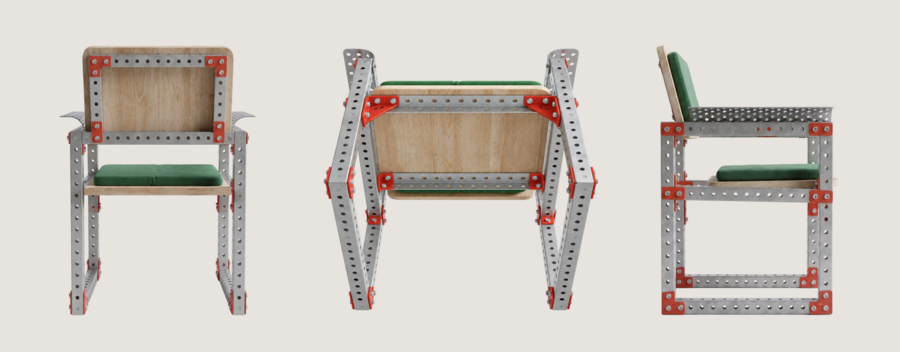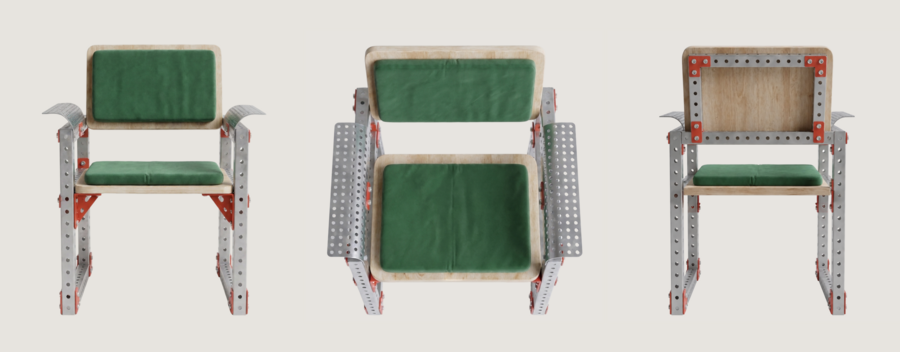
Product concept
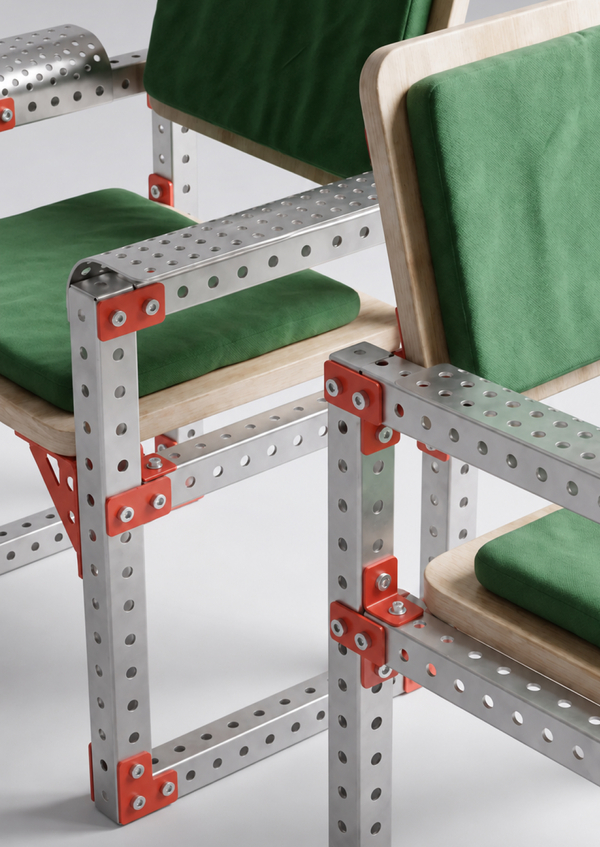
The first piece in the brand’s collection is a chair made of wood and perforated metal. The brand is founded on the reuse of wood, metal, and other materials that can find a new purpose instead of being discarded.
In this piece, wood and perforated metal—materials differing in texture and character—are combined. The construction is built from individual components and designed for simple assembly.
The chair is intended for everyday use in homes, studios, cafes, workshops, and other public spaces.
materials
— birch plywood; — perforated sheet; — perforated metal pipes and/or profiles for the frame; — expanded polystyrene (EPS) for filling cushions; — velvet for upholstery; — bolts and nuts; — corner brackets, wall brackets, connecting plates; — wood lacquer; — metal paint; — circular adhesive Velcro.
technology
For the armrests, two options are considered: a ready-made perforated sheet requiring subsequent cutting, rolling, and edge finishing, or a standard sheet metal that is perforated based on the mounting points to the frame. Given the need for the perforation to align with the frame attachment points, spacing is a critical consideration.The frame can be constructed from perforated tubes, a combination of tubes and profile, or entirely from profile. The final design is selected in collaboration with the workshop, taking into account the structure’s weight and strength.Wooden components are cut, routed, sanded, and coated with a protective lacquer. Soft elements are fabricated by cutting PVC foam and fabric, sewing covers, and subsequently assembling the cushions.
Construction & Assembly
The chair’s construction is a modular system made of wooden and metal components. The foundation is formed by a frame made of perforated profiles/tubes, to which the wooden seat and backrest, as well as the metal armrests, are attached. The main connections are secured with bolts, allowing individual parts to be taken apart and reassembled. The assembly process is sequential: first the frame, then the connecting elements, and finally the seat, backrest, and armrests.
prototype
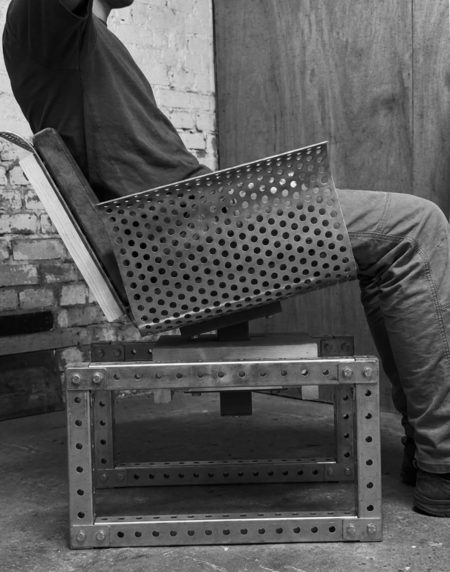
During the summer, the first version of the chair was developed, but issues emerged during manufacturing, transportation, and structural stability. Afterward, the design was revised to favor simpler assembly, greater manufacturability, and improved stability.