Concept
In 18th–19th century historical painting, a stable visual canon for the heroic figure emerged, which later transferred into cinema and poster graphics. Artists of Classicism, Romanticism, and Academicism tackled a complex sculptural challenge: they needed to transform a real military commander or historical participant into a figure of mythical scale. However, behind the external pathos of these canvases lies a rigorous system of visual devices. How exactly do composition, light, and perspective direct the viewer’s gaze? Why does a real historical fact on canvas become a legend? This theme was chosen because it allows for an analysis of Modern painting as a tool for myth-making. Several key works of European and Russian painting, created from the late 18th to the end of the 19th century, were selected for this study.
Material selection is determined by several factors:
- The selection includes paintings by European and Russian masters, ranging from Jacques-Louis David, Antoine-Jean Gros, and Eugène Delacroix to Francisco Goya, Vasily Surikov, and Vasily Vereshchagin—artists who either established or reinterpreted the visual standard of heroic composition.
- Comparing works from various artistic movements (from Classicism to Critical Realism) allows one to trace the evolution and gradual deconstruction of the heroic myth.
- Analyzing formal techniques through specific examples reveals that pathos is created not so much by the subject matter as by the geometry of the frame and chiaroscuro.
Key Question:
What specific plastic and compositional techniques did painters of the 18th and 19th centuries use to achieve the effect of mythologizing a real historical figure?
Hypothesis:
The sense of superhuman heroism arises from a stable set of visual constants, not solely from dramatic narrative. Artists intentionally eschew documentary accuracy in favor of theatrical expressiveness. It is suggested that the heroic and mythical status of a character is established through a low-angle perspective, framing the figure within a rigid pyramidal or diagonal composition, the contrast between a static hero and a chaotic crowd, and a sharp spotlight effect. As realism developed toward the end of the 19th century, these techniques began to be used to deconstruct the battle myth.
Equestrian Portrait and the Canon of the Raised Horse
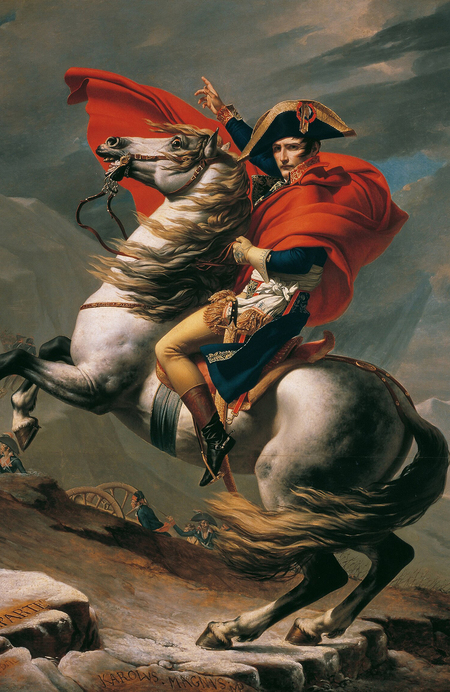
The equestrian portrait inherits the ancient triumphal tradition, transforming the military leader into an untouchable, monumental figure. In 18th–19th century painting, the rearing horse becomes the primary plastic symbol of unstoppable will and control over the elements. The sharp diagonal of motion, dictated by the animal’s body, visually elevates the rider above the surrounding landscape and the viewers.
Work Example:
Jacques-Louis David. «Napoleon Crossing the Great St Bernard Pass, ” 1801
In this work, the artist completely discards historical accuracy, replacing the real mule with a powerful, rearing horse. The general’s figure is incorporated into a harsh upward diagonal that mirrors the line of the mountain slope in the background. The billowing red cloak enhances the dynamic movement, and Napoleon’s utterly calm face contrasts with the strained posture of the animal. Due to the low horizon line, the viewer looks up at the hero from below, lending the image monumentality.
Work Example:
Theodor Gericke. «Officer of the Imperial Guard Cavalry, Advancing in Attack,» 1812
Gerico complicates the classical canon by infusing the composition with romantic expression and anxiety. The cavalryman is posed in a complex angle; his body faces forward along with the horse, yet his head is sharply turned backward toward an unseen army. The diagonal line of movement intersects with clouds of gunpowder smoke and flares of fire in the background. The highlight on the uniform and sword pulls the officer’s figure out of the dark chaos of battle, transforming the nameless soldier into a symbol of heroic impulse.
Example Work:
Franz Kruger. «Portrait of Emperor Nicholas I on Horseback, ” 1852
In this canvas, the artist employs the strict academic canon of the grand equestrian portrait. The rider’s figure and the raised horse are structured in a clear vertical-diagonal composition against the backdrop of a conditionally suggested military parade and a low horizon. The static, upright posture of the sovereign contrasts with the expressive movement of the animal, forging an image of unwavering state will and monumental serenity.
Hero on a High: Low Viewpoint and Monumentality
A low-angle shot compels the viewer to look up at the main character, literally elevating them onto a pedestal. This technique transforms a real person into a monumental statue, towering over the surrounding environment and landscape. The composition is often structured using a pyramidal scheme, where the figure of the commander or leader occupies the highest point, unattainable amid the chaos of battle or the elements.
Example work:
Antoine-Jean Gros. «Napoleon on the Arcole Bridge, ” 1796
Gro depicts a commanding figure at a sharp turn of a general’s body, who is lunging forward but turning back, dragging soldiers with him. The low viewpoint allows Napoleon’s figure to occupy nearly the entire height of the canvas, establishing him as the compositional centerpiece. In one hand, he holds a banner; in the other, a saber, setting up two intersecting diagonals of movement. His flowing hair and the dark, smoky background amplify the drama of the moment.
Example Work:
Vasily Surikov. «Suvorov’s Crossing of the Alps, ” 1899
Surikov employs a non-standard vertical canvas format to emphasize the breathtaking height of the mountain cliff. A squad of soldiers moves along a steep diagonal from top to bottom, yet the viewer’s gaze is immediately fixed on the figure of Suvorov at the summit. The commander is depicted as utterly calm and smiling at the edge of the abyss. The contrast between his static pose on the horse and the tense faces of the descending soldiers creates the mythical image of a fearless leader.
Example work:
Emmanuel Luce. «Washington Crosses Delaware, ” 1851
The painting’s composition is structured in the form of a rigid pyramid, its apex occupied by the standing figure of George Washington. While the other soldiers strain to paddle and push the ice floes in half-bent postures, the general stands fully upright, maintaining absolute balance in the unsteady boat. A bright break in the clouds directly behind him functions as a natural halo, highlighting the hero’s profile against the icy river.