Navigation
- Introduction
- Concept
- Principles for Selecting Visual Material
- Introduction of the Key Question and Hypothesis
- The Ancient Eidolon and Shadows in Hades
- Samuel and the Aender Sorceress in Biblical Iconography
- The Medieval Purgatory and the Burial Shroud
- Hamlet’s Father’s Shadow and Caesar’s Ghost in Graphic and Painting Art
- The European Shroud and the Japanese Burial Kimono
- Conclusion
- Bibliography
- Image Sources
Introduction
To depict a ghost, an artist imbues the intangible spirit with visible outlines and tangible attributes. In Ancient Greece, the dead were believed to be separated from the living by the rivers of Hades, while Christian theologians condemned necromancy and met tales of the deceased’s return with suspicion. Despite these prohibitions, masters from various centuries developed enduring iconographic conventions for representing apparitions.
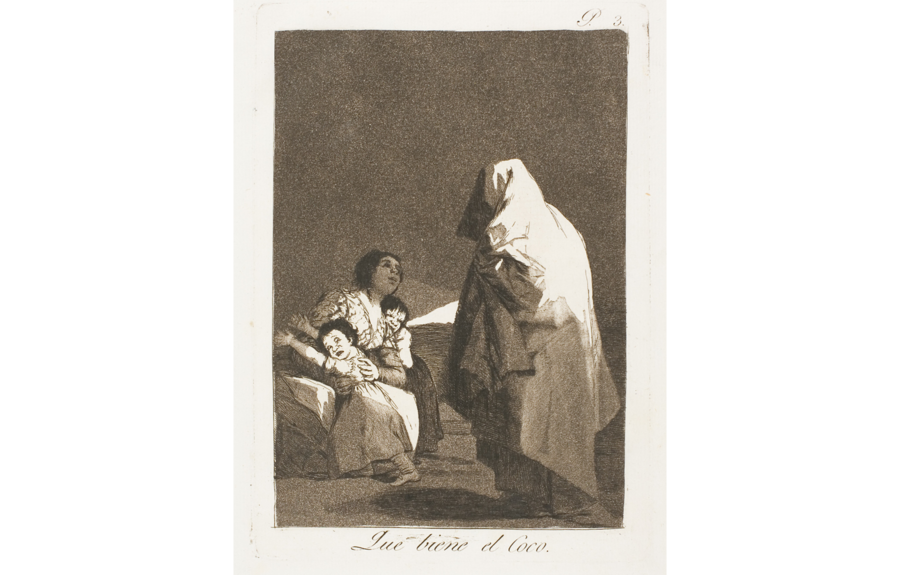
2. Francisco José de Goya and Lucientes, «Here Comes the Coco» (Que viene el Coco), 1797–1799 (The Art Institute of Chicago)
In the etching «Here Comes the Buck» from the series Caprices (Fig. 2), Francisco Goya depicted the familiar, everyday look of a nocturnal scarecrow. A tall figure in a hood, covered by a light sheet over a dark dress, with its face deeply shadowed, strides toward a seated mother and frightened children. By the end of the 18th century, white fabric had become associated with children’s boogeymen, but artists approached this motif through centuries of evolving concepts regarding post-mortem destiny and funerary rites.
The dead exist only inasmuch as the living imagine them [12]
Concept
In the iconography of the ghost, theological conceptions of the afterlife intertwine with actual burial practices; therefore, monuments from different eras reveal how the visible form of the spirit depended on religious doctrine and funerary custom. The chapters are arranged in chronological order of cultural models: first, the ancient sign of the shadow is examined, followed by the Old Testament narrative of invoking the dead in Aender, medieval miniatures with themes of Purgatory and shrouds, portrait ghosts in the illustrations of Shakespeare, and finally, a comparison between the European shroud and the Japanese burial kimono.
Written sources are divided into two groups. The first consists of literary and canonical monuments that describe concepts of the dead and spiritual phenomena: Homer’s epics [2; 3], Pliny the Younger’s letters [5], the biblical First Book of Kings [1], Plutarch’s biographies [6], and Shakespeare’s tragedies [7; 8]. For historical and art historical analysis, research by J. Le Goff on the origins of Purgatory [4], J.-K. Schmitt on medieval ghosts [12], J. O’Kelly on albino lechyes [11], S. Greenblatt on «Hamlet» [10], and Z. Davison on Japanese yūrei [9] was utilized.
Principle of Visual Material Selection
For this study, 35 works spanning from the 5th century BCE to the early 20th century have been selected, primarily from museum and library collections: Attic and Lucanian vase painting, illuminated manuscripts, easel painting, silk scrolls, relief engraving, etchings, lithography, and Ukiyo-e woodblock prints. Archetypal iconographic themes have been chosen for each period: lekythoi with winged eidolons, the appearance of Samuel in Aenador, scenes of purgatory and the savan, and illustrations from «Hamlet» and «Julius Caesar.» 19th-century Japanese prints and scrolls are included at the end as independent material for comparison with the European savan.
Introducing the Key Question and Hypothesis
How did artists from different eras make the intangible spirit visible by arranging only corporeal and material forms on a plane?
The working hypothesis is that the depiction of ghosts in art depends on societal perceptions of the afterlife and the role of funerary rites. If the afterlife is conceived as closed off from return, the soul is represented by a symbolic sign without traces of decay. However, when the appearance of the deceased is linked to the cleansing of sins or the violation of burial rituals, spirits are shown within funerary textiles, and in the Modern Era, they are endowed with individual facial features and contemporary clothing.
The Ancient Eidolon and Shadows in Hades
In Greek funerary vase painting from the 5th century BCE, the deceased was depicted as a tiny winged figure, devoid of portrait features or signs of physical decay.
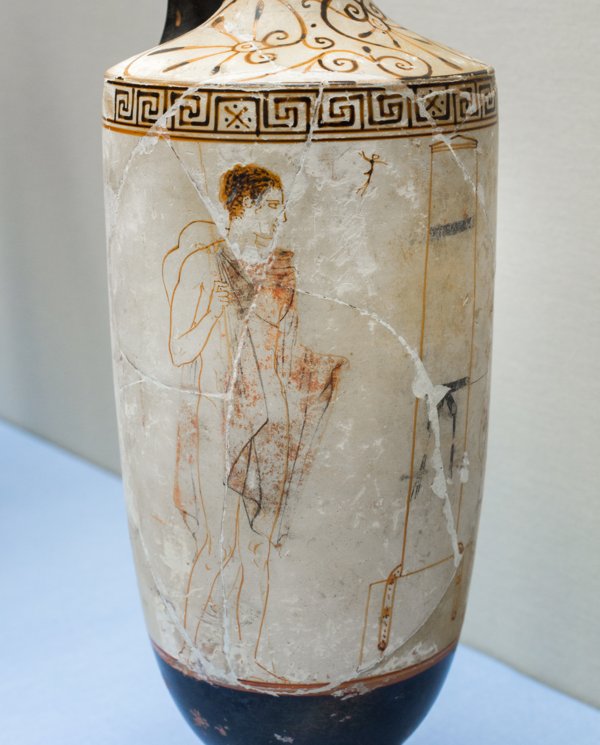
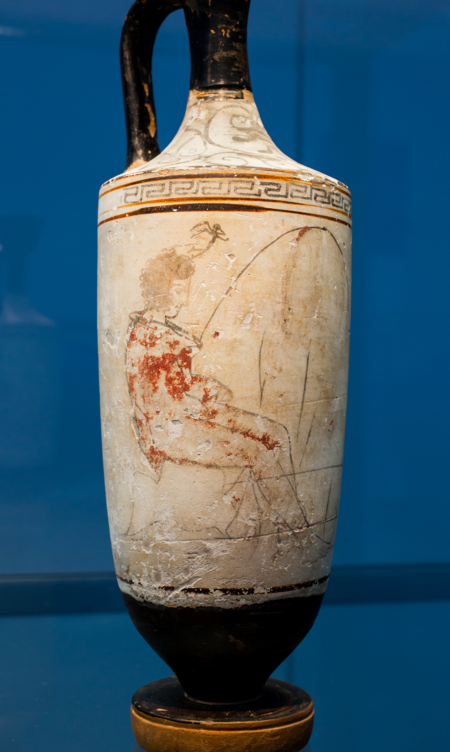
3. Achilles Painter «Attic White-Ground Lekythos: Two Youth by a Funerary Stele with a Hovering Eidolon, ” c. 440–435 BCE (British Museum) 4. Women Painter’s Circle „Attic White-Ground Lekythos: Youth by a Burial Mound with a Hovering Eidolon, ” c. 430–420 BCE (State Antiquities Collection, Munich)
Athenian white-ground lekythoi were brought to the tomb or placed in the burial alongside oil for libations [11]. In the Vase Painter Achilleus' vase (Fig. 3), a youth in a chlamys with a spear or staff stands to the left before a stepped stele tied with a dark ribbon, and a tiny dark silhouette of a winged eidolon floats high above the meander border. In a contemporary lekythos by the Vase Painter of Women (Fig. 4), a similar winged figure with outstretched arms hovers directly above the head of a youth in a red cloak seated by a white mound. In both scenes, the living do not show fear and do not even look up at the hovering spirit.
Sleep, Achilles! Have you truly abandoned me to oblivion?
You were not indifferent to the living; will you be to the dead?
Oh! bury me, and I shall enter the realm of Hades!
Souls, shades of the dead, are driven from his gates.
And to associate with the shades across the river, they do not allow me;
In vain do I wander before the broad-shouldered Hades. [2]
5. Vase painter Timotheus, «Attic white-ground lekythos: Charon in the boat receiving an eidolon, ” c. 460–450 BCE (Ashmolean Museum, Oxford) 6. Vase painter Saburov, „Attic white-ground lekythos: Charon, Hermes Psychopomp, and a floating eidolon, ” c. 450–440 BCE (Athens) 7. Vase painter Phiale, „Attic white-ground lekythos: Hermes Psychopomp on the rock, ” c. 450 BCE (State Antikensammlung, Munich)
In the Iliad, Patroclus’s shade requests burial to pass into the land of the dead [2], and in vase painting, the winged eidolon often appears precisely at the ferry crossing [11]. The vase painter Timbos (Fig. 5) depicted a bearded Charon in a pointed felt cap, pilos, holding a long staff at the bow of the boat: the ferryman extends his left hand directly beneath the eidolon fluttering toward him. In the vase painting of Saburov (Fig. 6), a miniature winged silhouette hovers between Charon’s boat and Hermes Psychopomp, who is stepping with a kerykeion. Meanwhile, on the fragment by the vase painter Phialos (Fig. 7), Hermes, seated on a rock and wearing a red pilos, extends his left hand forward, pointing the way to the crossing.
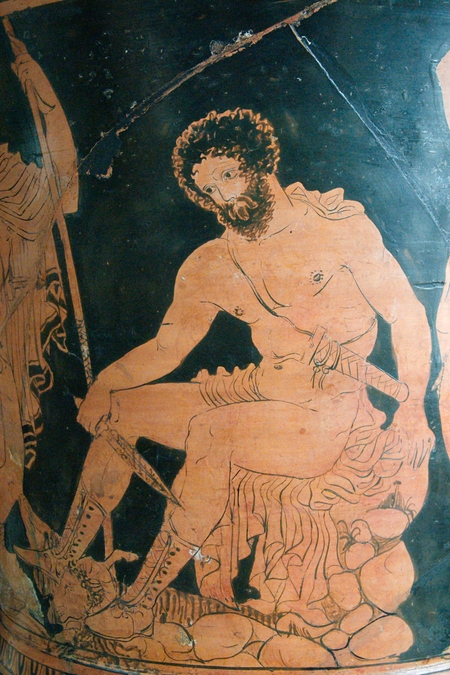
In the eleventh song of the Odyssey, the hero pours black sacrificial blood into a pit to summon the souls of the dead [3]. The vase painter Dolon (Fig. 8) avoided depicting the full figure and wings: Odysseus is seated on stones with a bare, short sword over the pit, from which rises only the bearded head of the prophet Tiresias, his eyes half-closed. The encounter remains free of fear for the living, and the edge of the earth denotes the boundary of the underworld, concealing the rest of the shadow’s body. 8. Dolon the vase painter «Lucanian Red-Figure Calyx-Krater: Odysseus and the Shadow of Tiresias, ” c. 390 BCE. (Cabinet of Medals, Bibliothèque Nationale de France)
In later classical literature, the figure of the ghost was frequently associated with frightening decay. For instance, Pliny the Younger, in one of his letters, recounted a story about a spirit appearing in an Athenian home: «In the nightly silence, the sound of iron was heard there, and if one listened more closely, the ringing of shackles could be heard first from a distance, and then very near; then the ghost appeared—an old man, thin, emaciated, with an unkempt beard and wild hair; he wore shackles on his feet and chains on his arms, which he shook» [5]. In contrast, artists on Greek vases of the Classical period refrained from depicting ghastly signs of decomposition, contenting themselves with the tranquil, winged symbol of the soul.
Samuil and the Andor Sorceress in Biblical Iconography
Addressing the only biblical narrative concerning the visitation of the dead, artists from the 16th to the 19th centuries approached how to render the prophet’s forbidden event with varying solutions.
The woman replied, «I see a rich man coming out of the earth. What does he look like?» Saul asked her. She said, «An old man comes out of the earth, dressed in long robes.» Then Saul realized it was Samuel, fell to the ground, and worshiped him. [1]
9. Jacob Cornelis van Oostsanen, «Saul of the Aenderse Sorceress, ” 1526 (Rijksmuseum, Amsterdam)
In the First Book of Kings, King Saul approaches a prophetess in Endor before his defeat [1]. Samuel’s appearance is described with only two features: old age and long robes. On the panoramic board (Fig. 9), Jacob Cornelis van Oostsanen depicts the prophet being ushered into the niche of a ruined arch, where a gray-bearded elder in long, dark garments emerges from a tomb labeled with a Latin plaque, «Sepulcrū Samuelis» («Tomb of Samuel»). In the foreground, the artist fills the scene with details of sorcery: inside a circle, a semi-nude prophetess sits with a staff; next to her, a satyr with an open book is visible, as well as women near a cauldron and fire, and figures flying in the night sky.
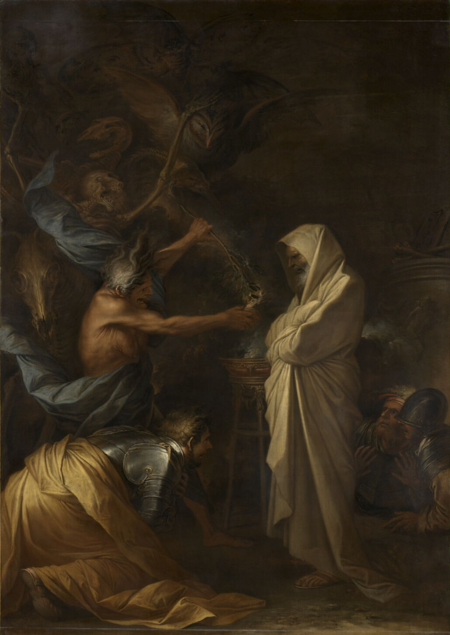
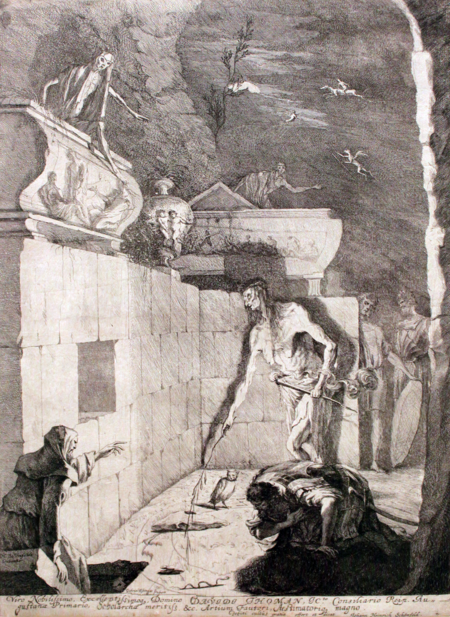
10. Salvador Rosa, «Samuel’s Shade, Who Is Saul Before the Aender Seeress, ” 1668 (Louvre, Paris) 11. Gabriel Eichinger after Johann Heinrich Schönfeld, „Saul Conversing with the Spirit of Samuel at the Aender Sorceress, ” 1675 (Städel Museum, Frankfurt am Main)