Rubricator:
Concept
The Image of the Dead Christ in Byzantine Art
The Spread and Reinterpretation of the Image in Western Europe
The Transformation of the Artistic Image
A Comparative Analysis of Works
Conclusion
The image of the deceased Christ holds a significant place in the history of Christian art. Since this narrative marks the culmination of Jesus Christ’s life, it enjoys immense cultural popularity. The shroud, in particular, has become one of the primary associations with this subject. This textile is used in religious services during Holy Week. It is compelling not only as a religious artifact but also as a work of art. At its core lie representations of death, burial, and suffering. It is perhaps the shroud that fueled the subject’s continued popularity. This research explores how the image of the dead Christ evolved and transformed within Byzantine and Western European art. I became fascinated by how the depiction of the same event could yield such diverse artistic solutions and semantic underpinnings. These changes even affected the very perception of Jesus Christ’s death—ranging from simply conveying a Gospel event to creating a distinct iconographic representation. I believe it is therefore crucial to examine not only the depiction of Christ but also the various meanings this image acquired within different cultural and historical contexts.
The work of German historian Hans Belting also becomes significant. He examined the relationship between the artistic image and liturgical practice. Belting paid attention to how liturgy influenced art [2]. This allows us to view images by considering their purpose and religious context. Depending on its function, the perception of a work could change.
In my work, I explore two artistic traditions—Byzantine and Western European. These traditions help track how the imagery was preserved, what was reinterpreted, and how the depiction of Christ’s body evolved. These artistic traditions are among the most popular and voluminous subjects. The artwork’s visual language will also be examined—the posture, gestures, facial expressions, composition, and degree of corporeal expressiveness. Although Christ was depicted as lifeless, the artists embedded much into his body language. Comparing Byzantine and Western European masterpieces is crucial for identifying the differences in how emotional and spiritual content was conveyed. Any possible borrowings or the influence of one tradition on another must be grounded in historical and art-historical research. This approach allows for a multifaceted study of this subject. The visual investigation aims to understand how its meaning has changed and how artistic means helped convey the complex interplay of human suffering, death, and the Christian concept of salvation.
The Depiction of the Dead Christ in Byzantine Art
In Byzantine art, the image of the deceased Christ took several forms. In some instances, he became part of the narrative of the final events of his earthly life. In others, he was depicted independently, outside of a specific Gospel scene. For example, Hans Belting, in his article «An Image and Its Function in the Liturgy: The Man of Sorrows in Byzantium, ” examines the connection between the image of the deceased Christ and liturgical practice, showing how important it is to consider the function of the image when analyzing its iconography [2].
The first group features scenes of Lamentation and Burial. In these, the body of Jesus Christ is depicted interacting with other characters. The main concept of the work is revealed through their gestures, the positioning of the figures, and the nature of their interaction with the deceased body. The other type is the independent depiction of Christ after death. Here, the artists focused more on the figure, the emotions, and the atmosphere surrounding him.
Unknown Byzantine master (St. Panteleimon Church in Nerezi) «Deposition from the Cross, ” 1164
The known works of The Burial are documented dating back to the 9th century. In Middle Byzantine painting, scenes of The Burial and The Lamentation often merged into a single narrative. It was only during the Palaeologan period, the 13th–15th centuries, that people began to separate them. The expansion of the number of participants in the episode influenced the changes in composition. The placement of the Theotokos, Joseph of Arimathea, John the Theologian, and other characters in the narrative could vary depending on the artistic program of the piece.
Mikhail Astrapa and Evtikhii (Church of St. George in Staro-Nagorichino) «Dormition (Burial) of Saint George, ” 1317–1318
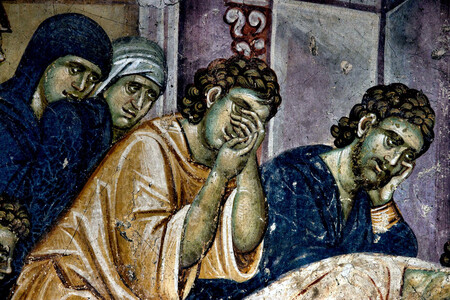
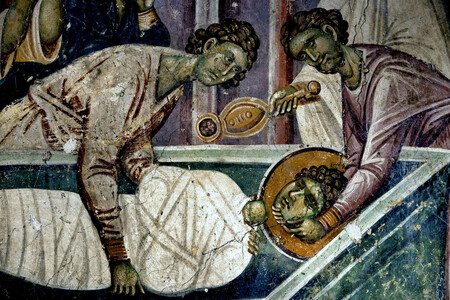
Fragments from the work «The Dormition (Burial) of Saint George,» 1317–1318
A clear example is the cycle of frescoes depicting the Passion of Christ in the St. George’s Church in Staro-Nagorichino. The Burial scene occupies a place within the overall sequence of events. The martyr is depicted wrapped in funeral shrouds: Joseph of Arimathea and John hold his body, preparing to place it in the sarcophagus. Nicodemus, the myrrh-bearers, the Theotokos, and Mary Magdalene are nearby. The scene unfolds through the reactions of those surrounding him. Their anguish and grief are conveyed through glances and gestures. The sorrow is particularly noticeable on the face of the young man in the ochre mantle. Many researchers believe this figure to be his servant and chronicler, Pasichrates.
Another important type is the self-portrait of the deceased Christ, known in the Byzantine tradition as the «Ultimate Humiliation.» Its formation dates back to the late 9th century. This tradition does not depict the staged death or burial of Christ. Instead, attention is focused on the martyr’s body.
An early, well-preserved example of the second type is the two-sided icon from Castoria. One side depicts the Theotokos Odigitria with the infant Christ, while the other features Christ in the guise of the «Extreme Humility.» It is important to note that they were conceived as a diptych. On the left side, the Mother of God’s facial expression differs from the usual serenity of the Odigitria; her brows are furrowed, and she is clearly sorrowful. This detail lends greater emotional tension to the image. The depiction of the Theotokos relates to the image of her deceased son on the reverse and is perceived as a premonition of his suffering and death.
Unknown Byzantine Master (Meteora, Transfiguration Monastery) «Two-Sided Diptych: The Theotokos Odigitria and Christ in the Tomb (Do Not Weep for Me, Mother)», late 14th century
The two-sided form of the icon carries significance for its very perception. These icons connect two of the most vital moments in the earthly life of Jesus Christ: his birth and his death. Their proximity allows the image to be read as a reminder of Christ’s sacrifice for the salvation of humanity.
The construction of the icon itself is also a significant detail. The indentations in the lower part of the frame suggest that it may have been used during church processions, as both sides would be revealed sequentially during the service.
«Extreme Humility» demonstrates how the depiction of the deceased Christ in Byzantine art gradually transcends the purely narrative scene of the Crucifixion. The creators build a composition where the focus shifts from the event of the burial itself to the state of the body. Yet, the image does not lose its connection to the liturgical tradition. Researchers link its formation to the hymns dedicated to the Virgin Mary’s grief.
Diffusion and Reinterpretation of Image in Western Europe
By the 13th century, the image of the deceased Christ, developed in Byzantine art, began to spread to Western Europe. Italy was one of the primary routes for this diffusion. Pilgrimages and the movement of religious artifacts and artworks played a significant role in this process. However, Western European masters did not merely copy Byzantine imagery; they augmented it according to local artistic and religious traditions [4; 5].
One of the popular works that advanced the popularity of the iconography of the dead Christ is the mosaic panel Imago Pietatis from the Roman church of Santa Croce in Gerusalemme. Despite disagreements regarding the work’s origin, the monument is significant as a testament to the synthesis of Byzantine and Western traditions. Christ is depicted from the waist up, with half-closed eyes and his head tilted onto his shoulder. He appears very emaciated and weary.
Unknown Byzantine master (Constantinople) «Micro-mosaic Icon: Christ, Man of Sorrows (King of Glory), ” circa 1300 (Santa Croce in Gerusalemme Basilica, Rome)
Another example of merging the Byzantine foundation with the Italian painting tradition is Roberto Oderizi’s «Man of Sorrows, ” dated to the 1350s. In this work, Christ retains the principal features of the Byzantine type: a bowed head, closed eyes, and crossed arms. However, the composition here is significantly more complex. Instruments of Christ’s Passion appear around the central figure. Additionally, the Virgin Mary and John the Theologian stand on the sides, mourning at the tomb. The instruments of the Passion here reveal the circumstances of Jesus Christ’s suffering, connecting the image to the sequence of the Passion cycle’s events. Thus, this version retains the Byzantine foundation while intensifying the work’s emotional content.
Roberto d’Oderizi, «Christ the Man of Sorrows with the Virgin, St. John the Theologian, and the Instruments of the Passion (Arma Christi),» c. 1354 (Harvard Art Museums / Fogg Museum)
Another example is a diptych from around 1255–1260. The left panel depicts the Mother of God with the Christ Child, while the right depicts the «Husband of Sorrows.» A similar subject appeared in a diptych, but the Italian piece shows its own distinct characteristics. Most notably, in my view, is the depiction of the hands bearing wounds; this emphasizes Christ’s sacrifice. However, the connection between the two images remains. Unlike a Byzantine icon, the image here becomes part of a personal prayer object due to the small scale of the work.
Crucifix Master from Borgo (Umbrian Master) «Diptych: The Mother of God with the Child and the Man of Sorrows, ” c. 1255–1260 (National Gallery, London)
In Central and Northern Europe, the depiction continues to evolve. One of the distinctions is the more «alive» portrayal of Jesus Christ. Now, instead of a gaunt figure in a closed posture—a tired and thin hero, but vibrant—the image appears. The only element that directly references this narrative is the marks from the nails, as seen in the Flemish miniature. Jesus Christ sits on a tomb; his head is no longer bowed, his eyes are open, and his right hand is raised in a gesture of blessing. He wears a crown of thorns, but the wounds and blood are not as pronounced as in the previous example. Thus, the image gains new meaning, presenting Christ as a Savior turned toward the supplicant, with the physical aspect taking a secondary role.
This miniature encompasses Christ’s entire cycle of suffering. It is found in a liturgical manuscript containing hymns, which demonstrates that the image of the «Man of Sorrows» was disseminated into illuminated manuscripts, where it was integrated into another visual and liturgical context [4].
Unknown Master (Flanders) «The Hours of De Greay (Christ the Man of Sorrows with the Instruments of the Passion), ” c. 1390
«The Man of Sorrows,» «Christ in the Tomb,» and «Behold the Man» are different subjects. In his study of the terminology, Christopher Horian explains that their connection lies in which moment of the Passion is depicted and in what state Christ is presented. For instance, «Behold the Man» refers to the episode of Christ’s presentation to the people following his scourging, whereas «The Man of Sorrows» shows him as a suffering or deceased Savior outside of a specific moment [3].
The Western European tradition retained the core characteristics of the Byzantine image, though it modified the composition and purpose slightly. In Italy, the prominence of the Passion narratives and secondary figures intensified. Meanwhile, in Northern Europe, depictions of Jesus Christ began to spread in a more «vibrant» interpretation. His image became integrated into other art forms: altarpiece painting, diptychs, and illuminated manuscripts. It is evident that Byzantine iconography was not merely transplanted to the West but was adapted to new forms of religious veneration and diverse artistic traditions.







