TABLE OF CONTENTS:
— Concept
— The Vatnik as Work and War Garment. 1930s–1950s
— The Vatnik as an Image of Soviet Everyday Life. 1960s–1980s
— Reinterpreting the Vatnik in Fashion. 1960s to the Present
— Conclusion
— Sources
Concept
The vatnik holds a unique place in the history of Russian costume. Its appearance is usually perceived as simple and nearly unchanging. The quilted surface and loose volume served a practical purpose, so the item rarely entered fashion history as an independent work of art. Visual sources compel us to question the notion of an object lacking its own aesthetic. The same basic form can look different depending on how it fits the human body. An item designed to protect against the cold gains a meaning that cannot be derived from its cut alone.
Under the name «vatnik, ” the work primarily refers to a quilted winter jacket (also known in Soviet vernacular as a telogreika). Individual variations differ in cut and how they are worn. The name does not automatically apply to any quilted garment. In the historical garment, the layer of cotton insulation was placed between the outer fabric and the lining. The quilting secured the padding and prevented its shifting. The vertical stitches simultaneously bound the layers of fabric and created the characteristic pattern. The ample ease across the chest provided mobility and allowed the jacket to be worn over other layers of clothing.
The subject of the research is not the entire history of cotton clothing production, but specifically the shift in the status of its visible image. The distinction between the authentic object and its representation is significant. Documentary photography captures the surface of the garment alongside the context of its wear. A fashion presentation, conversely, offers a more controlled form of existence for the clothing, as everyday imagery necessarily draws attention to the person wearing it. Comparing these approaches allows us to track when the stitching remains an inconspicuous structural detail and when it transforms into the primary motif of the image.
How does the vatnik alter its cultural status while retaining its recognizable constructive core (the central research question)? What is the difference between clothing chosen based on living conditions and the same item presented as an artistic motif?
The hypothesis posits that the cultural significance of the vatnik was neither sequentially nor definitively replaced. Different modes of perception coexisted, and the fashionable reinterpretation did not eradicate the original utilitarian nature. Later design interest was built upon the already established plastic expressiveness of the item.
The anticipated outcome of this research is linked to confirming the dependence of the costume’s image on the mode of its presentation. A visual comparison should reveal that historical memory is reinforced not solely through the recognition of the word «vatnik.»
The works were selected with the ability to verify the author and date, and to examine the garment in sufficient detail. Priority was given to authorial photographs available in museum collections. A consistent set of observations was used for comparison. The volume of the silhouette and the shoulder line, the density of the insulated padding, and the direction of the stitching are taken into account. Subsequently, the relationship between the costume and human movement and image construction is examined. The historical meaning is derived from observed features alongside the context of publication.
The first chapter examines the quilted coat in the context of work and military experience during the first half of the century. The comparison centers on the relationship between the standardized form and the individual figure. The second chapter addresses everyday situations of the late Soviet era. The third chapter is dedicated to moments when an object is consciously isolated for examination as a design subject. Historical attempts to alter the thermal jacket are compared with later methods of referencing its form.
The academic foundation is built upon the research of R. M. Kirsanova on Soviet costume from the Stalin period, E. S. Platonova on the debates surrounding clothing modernization in the late 1950s, and the monograph by Yu. Gronov with S. V. Zhuravlev on the post-war fashion system. For later design decisions, the archival sketch published by Vyacheslav Zaitsev is highly relevant.
The Vatnik as Garment of Labor and War
1930s–1950s
In this photograph of Max Alpert and Georgy Petrusov, a partisan unit advances into the depths of a snow-covered expanse. The figures are turned away from the viewer. Wide, insulated jackets blend into the overall silhouette of the armed group, and the stitching is only discernible where the light catches the fabric’s surface. The sleeves are voluminous compared to summer athletic wear because the clothing is designed for layering. The unified plasticity of the figures is more significant than the individual cut. The photograph does not present the costume as a standalone object but rather as part of a collective front body. The individual is recognized by their action and weapon, not by a trendy detail. The uniform weight of the clothing reinforces the impression of a harsh environment.
Max Alpert and Georgy Petrusov, «The partisan detachment under the command of Comrade R. is successfully operating behind enemy lines, ” 1942
Comparing this to a portrait of tractor drivers, such as Evgeny Rummer’s, changes the reading of the same form. For the partisans, the clothing almost erases the distinctions between figures, serving as spatial camouflage. For the tractor drivers, the winter coat helps to highlight the main character within the group. It turns out that the same object does not possess an intrinsic heroic meaning. Meaning is born from the compositional distribution of attention.
Sergey Vasin, «Schoolgirls Sew Winter Jackets for the Front, ” 1943
Sergey Vasin depicts the quilted coat before it meets the body. Detailed seams lie under the sewing machine’s needle, while the student’s hands hold a heavy, multi-layered package. The repetitive stitching lines reveal the item’s manufacturing logic. Frequent machine stitches are necessary to secure the insulation, as loose cotton would shift during wear. The front garment is depicted as the result of collective labor, not as a finished uniform on a hero. Visible cuts and open material edges offer more information about the construction than most posed portraits. The needle’s movement transforms the technological process into the main action of the frame.In Albert and Petrusov, the protective function has already dissolved into the movement of people. With Vasin, the jacket has not yet acquired an owner, and its character is defined by the stitching. The comparison shows that the significance of the greatcoat was also derived from its manufacturing history. Later fashion would turn specifically to the visible texture of the sewing work, which here was presented as evidence of the front’s supply chain.
Author unknown, «In the Trench. Two of Three Soviet Soldiers in Telogreika Coats, ” 1942
A photo from the «Military-Historical Journal» shows soldiers inside a dugout. Two fighters are wearing telogreika (thick quilted coats), and one is near the stove. In a front-line setting, a jacket is not required to look like formal military attire. The sleeve cuff rounds out under the weight of the batting. The collar line softly follows the posture of the neck, and the stitching on the sleeve emphasizes the construction from bonded fabric layers. A key distinction between a telogreika and a shinel (greatcoat) lies in the principle of form creation. The shinel builds a broad outer contour through the draping of dense broadcloth. The quilted jacket maintains volume within its multi-layered packet. According to the 1932 regulations, the outer layer was sewn from a protective-colored gymnast’s diagonal fabric, and the lining was made of dyed muslin. The distance between the stitched lines was about six centimeters. This construction schema is also evident inside the dugout.
A photograph of the female students shows the construction of a body warmer. Inside the dugout, the result of the sewing production on a moving body is visible. This comparison allows one to distinguish between the technological necessity of the quilting and its later decorative interpretation. In the frame, the similar clothing of partisans Albert and Petrusov makes the group part of the harsh landscape. In the confined interior, it serves as a home shelter and accompanies a brief pause between battles.
Evgeny Rummer, «Tractor Brigade Foreman from Mikhailovskaya MTS, Ivan Shatsky, ” 1940s
Evgeny Rummer places the foreman at the front of the tractor and the other workers. His jacket features a distinct, straight silhouette and vertical channeling, while the belt cinches the loose volume at the waist. The shoulder line remains soft because the dense insulation does not act as a rigid side panel. The belt creates a semblance of a uniform silhouette, even though the jacket itself has a utilitarian cut. The angle and gesture of his right hand position the figure as the nucleus of the professional team. The darker fabric emphasizes the slenderness of the vertical lines. The parka becomes part of the visual language of organized labor.
In the partisan shot, the figures move away from the viewer, but here the main character faces the viewer. The quilting simultaneously indicates belonging to a mass-produced clothing type and gives the costume rhythm. The direction of the photograph is more important than the date. For Rummer, the thermal top maintains the prestige of the profession, even though its construction hardly differs from the clothing of people in a harsher military context.
Valentin Khukhlaev, «New Models of Cotton Fabric Parkas for Rural Workers, ” 1953
In this photograph, Valentina Khukhlaeva’s telegreika is the primary focus among the selected examples. A man and a woman walk along an imagined runway in front of an seated audience. The vertical stitching on the front panels is clearly visible. The female model exhibits a more pronounced waistline fit, while the male garment retains a loose volume. Altering the length and placement of the fastener shapes a more structured silhouette. The upper section, made of woven cloth, is noted in the museum attribution. The act of demonstration itself transforms utilitarian clothing into a designed model, which is initially judged by sight. The 1953 date is particularly significant because it refutes the notion that interest in the telegreika's aesthetics emerged only after the collapse of the USSR.While Rummer uses a belt to adapt the garment to a specific figure, Khukhlaeva considers the proportions at the modeling stage. The similarity in the technological schema does not negate the difference in objectives. The subject shifts from labor to the space of aesthetic choice. Consequently, the transition toward a fashionable interpretation did not happen once or along a straight line—it began when the functional design became a subject of discussion among costume designers.
The intermediate comparison result shows that the absence of change in the basic structure does not imply the immutability of the cultural image. The material’s significance is revealed through the context of presentation and the degree of artistic emphasis on the surface.
The Vatnik as an Image of Soviet Everyday Life
1960s–1980s
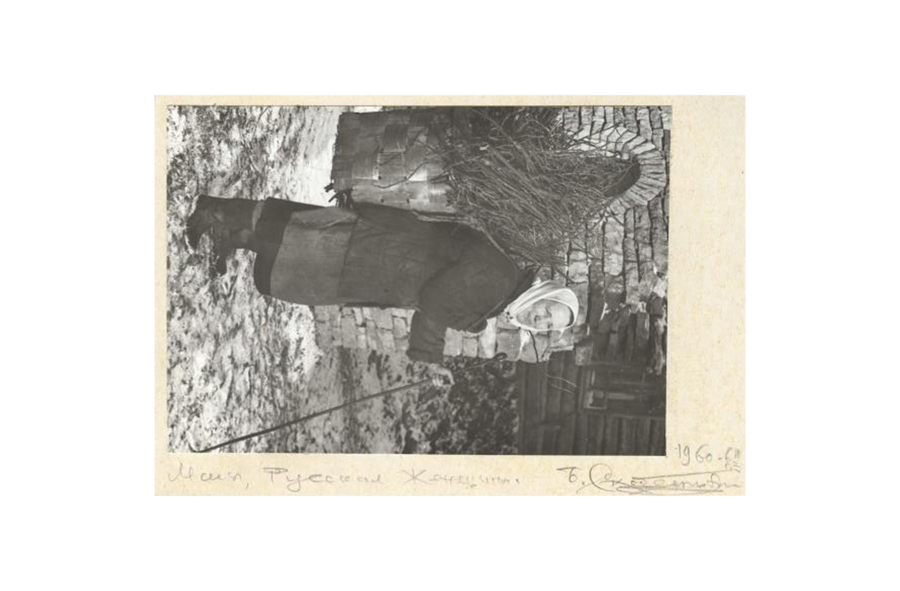
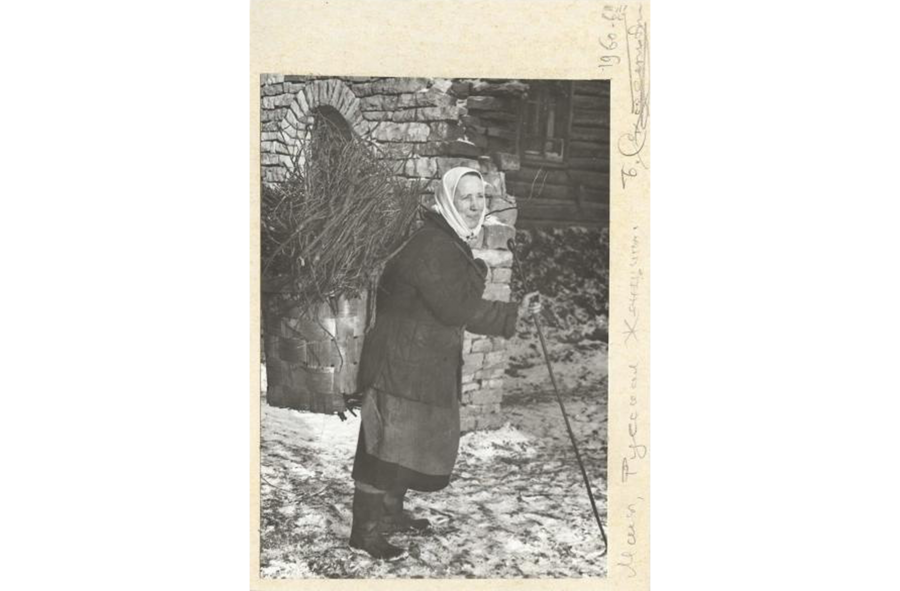
Boris Skobeltsyn, «The Russian Woman, ” 1960
Boris Skobeltsyn is photographing an elderly woman by a wooden house. Her figure, with a heavy knitted basket for kindling, appears small compared to the volume of her outerwear. The quilted coat does not create a defined waist and barely reveals the body’s contours. The fabric’s surface reads as soft due to the density of the insulated layer. The hemline overlaps the top of the skirt, causing the figure’s proportions to be structured not by the body’s lines, but by the boundary of the clothing worn. The scarf, along with the jacket, forms a cohesive winter ensemble. The title summarizes the depicted person, but the character of the movement and the gathered twigs retain private details of life.
In the portrait of foreman Rummer, the quilted jacket constructs a public, professional image. For Skobelitsyn, it barely participates in producing a heroic impression. The item wears out in daily use and becomes part of domestic plasticity. The difference is especially noticeable in the placement of the hands. In the foreman, the gesture is directed toward the frame’s space, whereas the woman’s hand is occupied with balancing the load.
All-Volod Tarasevich, «Boy with a Log,» 1960s
On a construction site in Moscow, a young worker, Vsevolod Tarasevich, walks across uneven ground carrying a long log. A slight turn of the torso and a tilt of the head are dictated by the weight of the load, causing the jacket to crease at the shoulder line. The stitching on the back runs in vertical lines, and the soft insulating material gathers in folds near the elbow. Unlike a staged display, the camera does not aim to reveal the entire construction. A low angle makes the person prominent against the backdrop of the buildings under construction. The plastic expressiveness of the fabric emerges from movement and labor. The quilted jacket here is not necessarily a marker of the past, as it serves the industrial environment of the time of filming.
Its similarity to the Rumer group lies in the connection between the heavy coat and mechanized labor. The difference lies in the mode of depiction. There, the posture fixes an achieved status; here, the movement remains incomplete. Compared to Skobeltsyin’s photograph, the frame shares the quality of not striving to emphasize the beauty of the garment itself. The quilted jacket functions as a part of daily corporeal practice.
Yuri Sadovnikov, «Beast Tamer Girls,» 1968
Yuri Sadovnikov brings two young women close to the viewer. Their faces dominate nearly the entire center of the frame, while their outerwear is visible only in fragments. The warm coats have significant volume, which is further emphasized by the fur collars. The texture of the insulated jacket is less discernible here than in Tarasevich’s photograph. The suit reflects the climate and the conditions of professional work, but the focus is primarily on the subjects' mood. The smile is not tied to an official demonstration of professional achievement. The clothing becomes the setting for a private portrait, so the professional affiliation does not overshadow the characters' individuality.