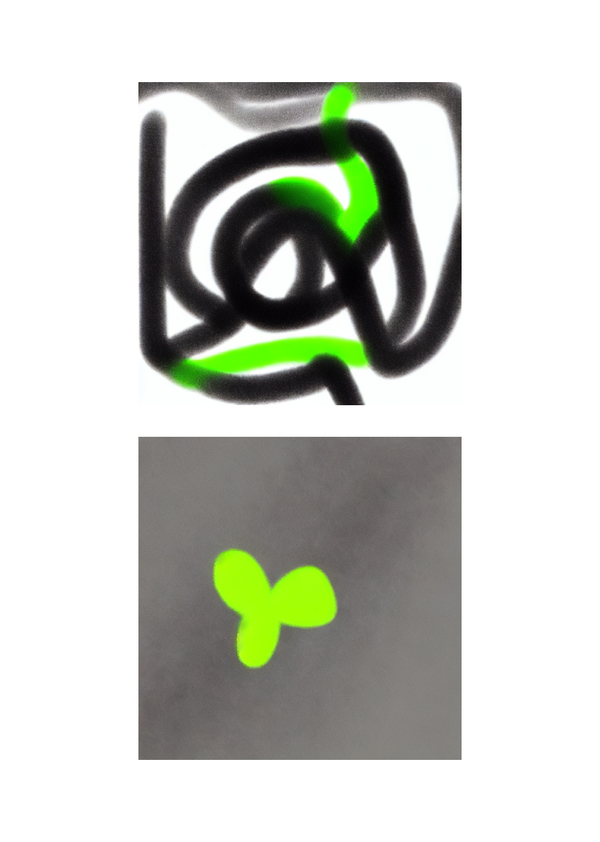
AIRGLYPH — Aerosolized Glyphs
Project Idea
I have always been fascinated by experimental typography—especially the moment when a letter ceases to be merely a symbol and transforms into an independent graphic object.AIRGLYPH is built upon a series of original images created using digital spray techniques. Soft, diffused edges, grainy texture, vivid colors, and fluid line work form a cohesive visual language where letters coexist with abstract symbols.
I became curious whether a generative neural network could learn to reproduce these characteristics and independently propose new forms.
The goal was not to create a complete typeface, but to develop a tool for visual searching—a glyph generator that could be used as standalone imagery or as starting points for further design work.
Original Dataset
For this project, I prepared a set of 20 original images. This collection includes letters, numbers, punctuation marks, and abstract shapes such as loops, spirals, a star, a heart, a flower, and other graphic elements. All images share several characteristics: a white background, a rich color palette, soft aerosol edges, and a simple construction.
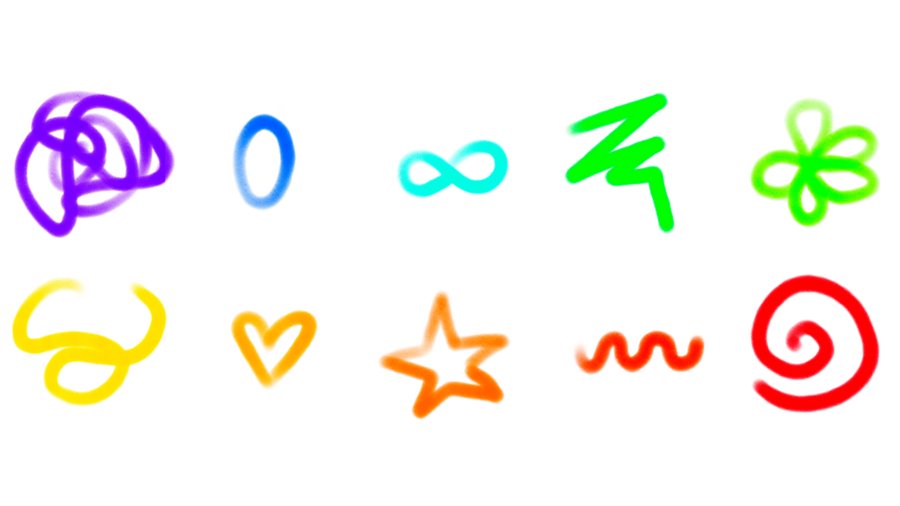
Each drawing is an individual composition in square format. For training, the images were scaled to a resolution of 512 × 512 pixels.I aimed to gather diverse shapes while maintaining the overall character of the line work, so that the model would learn visual patterns across the entire series, rather than a specific symbol.
Preparation and Learning Process
For this experiment, I utilized Stable Diffusion 1.5 along with the DreamBooth + LoRA fine-tuning method.
LoRA allows an existing generative model to be adapted to a specific visual style without the need to train the entire neural network from scratch.
The working environment was set up in Google Colab, utilizing an NVIDIA Tesla T4 GPU. The Hugging Face Diffusers library script was employed for training.
All images were given a unified text prompt incorporating the specific style identifier, airglyphstyle. This identifier links the aerosol texture and the characteristic graphic forms to the user’s prompt during subsequent generation.
Core Training Parameters:Base Model: Stable Diffusion 1.5Method: DreamBooth LoRADataset Size: 20 imagesResolution: 512 × 512Number of Steps: 600Learning rate: 0.0001LoRA rank: 8Batch size: 1Upon completion of training, the model weights were saved in .safetensors format.
First Generations
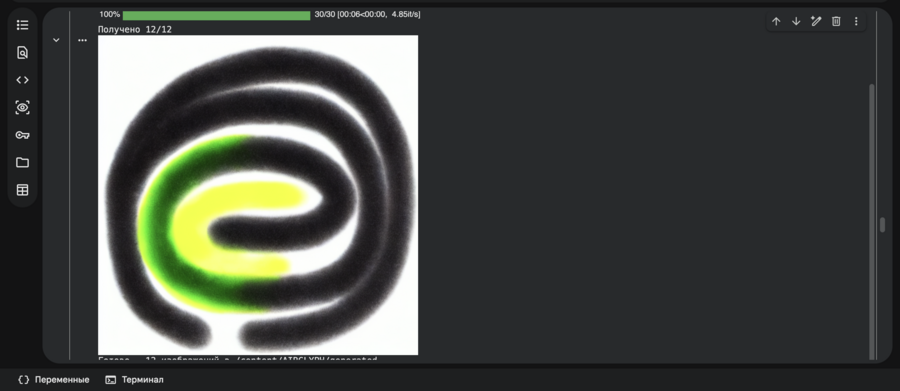
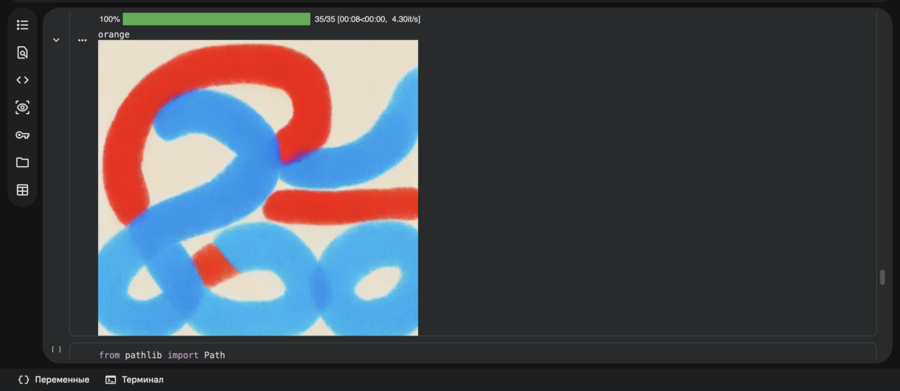
In the next stage, I asked the trained model to generate new graphic forms: spirals, loops, floral symbols, wavy lines, and abstract signs.The results showed that the neural network had partially absorbed the character of the original visual language. The images featured soft edges, thick rounded strokes, vibrant colors, and organic intertwining.However, the model did not always adhere to the constraints of the original dataset. Instead of a single-color sign on a white background, it sometimes created multi-layered compositions, used additional colors, or substituted the white background with gray or color.This became an important observation: the model was able to reproduce individual characteristics of aerosol graphics but did not fully internalize its underlying system.
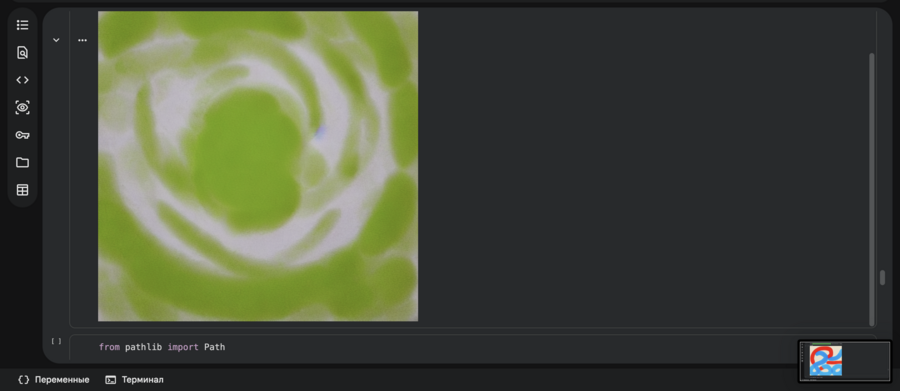
Prompt Experiments
After the first series of generations, I decided to test whether I could gain more precise control over the results using text prompts. To do this, I created new prompts with specific instructions regarding shape, color, the number of lines, and background texture. Additionally, I employed a negative prompt designed to exclude volumetric effects, dark contours, complex interweaving, and extraneous elements. However, the repeated generation did not yield the expected results. Despite the more detailed instructions, the model continued to create multi-layered compositions, blend colors, and alter the background. The experiment showed that in the current version of the trained LoRA, text prompts do not provide sufficient control over the visual characteristics of the images. The model partially reproduces the aerosol texture but inconsistently adheres to compositional constraints. This highlighted the need for further work on the training dataset and its textual descriptions.
Result
AIRGLYPH was an experiment at the intersection of авторская graphics, experimental typography, and generative design.The resulting images display new variations of loops, curves, and abstract symbols that were not directly copied from the original set.The model most convincingly captured the softness of the spray stroke, the blurred edges, and the free plasticity of the forms. The white background, the monochrome nature of the symbols, and the precision of the intended composition proved less stable.For me, the principle of interaction is what matters: the neural network does not replace the designer; rather, it proposes unexpected forms that can be selected, analyzed, and developed manually.In the future, I hope to expand the dataset and augment the images with individual text descriptions to more precisely control the shape, color, and composition of the generated graphemes.
Generative Model Application Description
The project utilized the base generative model Stable Diffusion 1.5, fine-tuned using the DreamBooth LoRA method on a proprietary dataset of 20 original images.Training and generation were performed in Google Colab using the Hugging Face Diffusers library.ChatGPT was also employed to assist with preparing the source code, debugging technical errors, developing prompts, and managing the project’s textual descriptions.Model: https://huggingface.co/stable-diffusion-v1-5/stable-diffusion-v1-5Training Tools: https://github.com/huggingface/diffusersProject Code: [https://colab.research.google.com/drive/1jElB82QRSRtrHqF6wUV9-qXxNbttEgGd?hl=ru#scrollTo=4e098367].