Navigation
- Introduction
- Where is the line between interest and obsession?
- Can one observe a person without violating their boundaries?
- Why does a person feel the need to collect and preserve everything?
- Why do we keep returning to the same image again and again?
- Can photography halt disappearance?
- What unites different photographic practices?
- Bibliography
Introduction
Obsession is a state in which a particular person, object, or idea occupies a disproportionately large place in a person’s mind.
Sophie Calle — Suite Vénitienne, Book (2002)
Attention becomes obsessive: a need arises to constantly return to the subject, to observe it, to gather related information, or to preserve its traces. However, this obsession does not always manifest overtly. It can be hidden behind actions that appear entirely ordinary on their own: photography, collecting, archival work, or repeatedly performing the same action.
In this study, I want to examine how obsession manifests in photography and how the photographic process can become its instrument.
The camera allows one to approach the object of attention, fix it, preserve the image, and return to it irrespective of time or circumstance. Photography can function not only as a means of documenting reality but also as a medium for observation, appropriation, accumulation, and control. I am interested in exploring the moment when the ordinary desire to capture something escalates into a systematic practice devoted to a single object or action.
Key research question
How does photography become a tool of obsession, and how does it manifest the human drive to observe, capture, and control the object of one’s attention?
Hypothesis
Photography allows a person to partially bridge the distance between themselves and an object of obsession. Through a camera, they can observe it, preserve its image, reproduce it repeatedly, or gather increasing evidence of its existence.
Thus, photographing ceases to be a singular act
and transforms into a recurring practice where the act of capturing acquires special significance.
The body of research will be divided into several conceptual sections. The first focuses on observation and surveillance: photographs in which the camera becomes a means of monitoring another person, documenting their actions, and penetrating the space of their private life. The second examines accumulation and cataloging: projects where photography is linked to collecting, organizing, and systematizing objects or information. The third addresses repetition and reproduction: serial practices, the multiple creation of similar images, and the return to the same motif. The final section is dedicated to photography as a method of preservation: an attempt to hold onto a person, a relationship, or a memory through an image.
Throughout the investigation, it is important not to equate all presented practices with psychological obsession. Rather, they will be examined as different forms of obsessive fixation, unified by the desire to constantly return to a specific object of attention. Comparing the photographic projects will reveal which visual techniques are used to convey this state and at what point photography transcends being merely a method of representation to become a part of the obsessive practice itself.
This research aims to study the relationship between obsession and photography—not only what subjects the creators photograph, but also how, why, and how systematically they do it.
Where is the line between interest and obsession?
Sophie Calle — Suite Vénitienne, Book (2002)
Sophie Calle — Suite Vénitienne (1980)
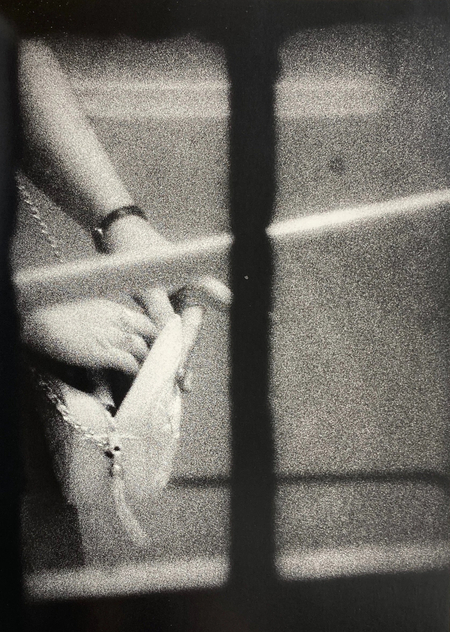
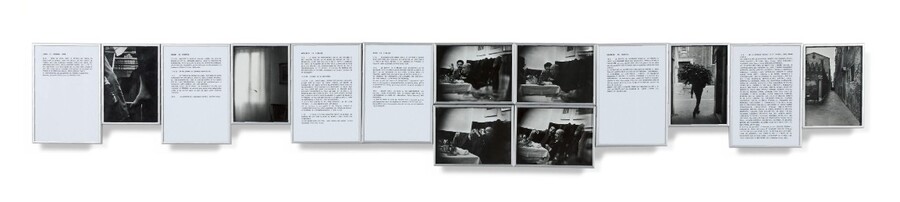
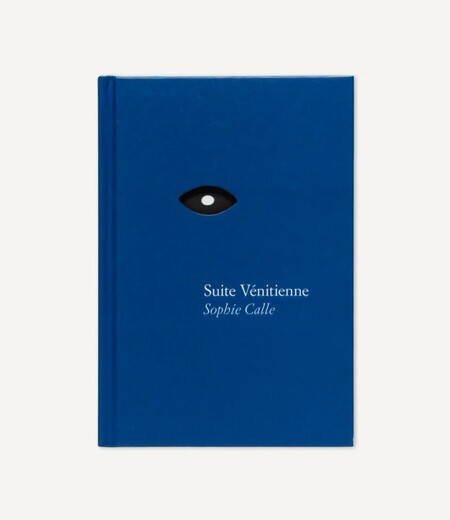
In her work Suite Vénitienne, Sophie Call documents her surveillance of an unfamiliar man, whom she names Henri B. She first noticed him on the streets of Paris and later met him by chance at an art event. Learning that the man was traveling to Venice, the artist decides to follow him.
Sophie Calle — Suite Vénitienne, Book (2002)
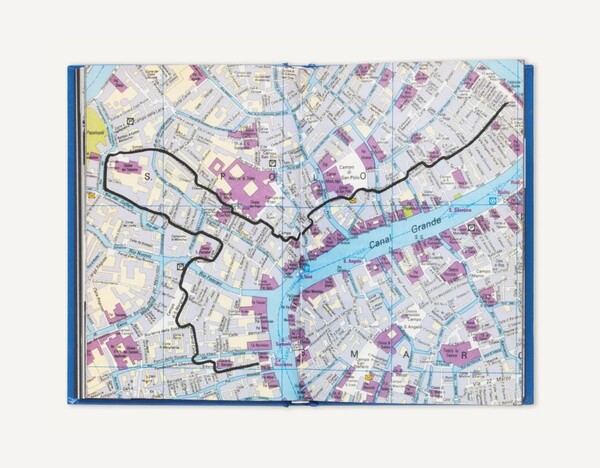
In Venice, Call spends several days trying to figure out where he is staying—calling hotels and searching the streets—before eventually beginning to secretly follow his movements. For about two weeks, she photographs the man, documents his routes and meetings, and records her own observations. To maintain a disguise, she uses wigs, hats, and other accessories. The resulting project combines black-and-white photographs, diary entries, and documentary materials.
Sophie Calle — Suite Vénitienne, Book (2002)
Sophie Calle — Suite Vénitienne, Book (2002)
In this work, the interest in a stranger gradually morphs into systematic surveillance. The project raises questions about the boundary between artistic inquiry, personal curiosity, and intrusion into another person’s private space.
Sophie Calle — Suite Vénitienne (1980)
Merry Alpern — Dirty Windows (1993–1994)
Merry Alpern — Dirty Windows, book (1995)
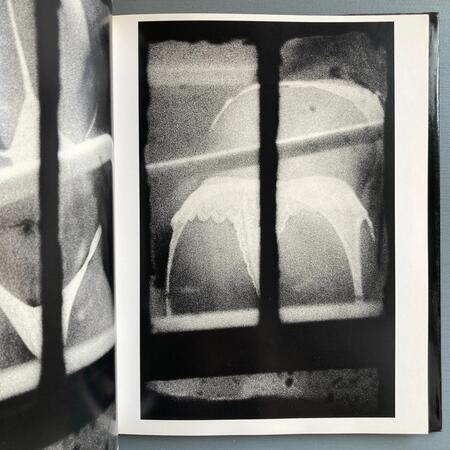
In the winter of 1993, Mary Alpern visited an acquaintance who lived in the Wall Street area of New York. From the window of his apartment, she noticed a small bathroom window in the adjacent building. Behind it was a private club where attendees met with dancers for discreet gatherings.
Alpern became so intrigued by what was happening that she began returning to the window regularly. For six months, she sat in a darkened room, using a tripod and a camera, observing the unfamiliar people.
Merry Alpern — Dirty Windows, Book (1995)
For several months, Mary has been returning to the same place, seeking to see and capture unfamiliar people once again. The project is interesting because it raises questions about a photographer’s right to turn someone else’s intimate life into an object of representation.
Merry Alpern — Dirty Windows, book (1995)
Why are some things impossible to throw away?