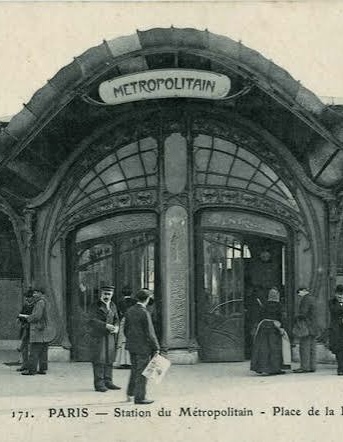
At the beginning of the 20th century, Paris was a time of monumental change. With the 1900 World’s Fair taking place, the city desperately needed a fundamentally new transportation system. People were not ready for the advent of the subway; it frightened them because the underground world seemed dangerous and utterly unknown. The Compagnie du Métropolitain understood that the subway entrances and exits needed to appear highly appealing and trustworthy to the residents. Therefore, a competition was announced in 1899. While no participant achieved a formal victory, the young architect Hector Guimard won the commission. He was entrusted with the artistic design. His solution was truly inventive—the pavilions and railings were shaped like plants seemingly sprouting from the Parisian sidewalks.
The topic is highly relevant because, in Ghiomar’s projects, ornament was no longer merely a flat decoration. Deliberate asymmetry, plants, and curved lines became a foundational structural element, uniting metal and glass. Cast iron details were also incorporated; the master was designing a modular system. The public perceived this as something living and highly organic. This work addresses the questions of how Deformism transformed into an object of urban life and infrastructure—a complete emblematic symbol of the era. The theme fits perfectly within the course «History and Theory of Styles and Ornament» as it effectively demonstrates the transition of ornament from a two-dimensional plane to a volumetric architectural form and reveals the mechanisms of natural motif stylization.
Key Question: How did the organic forms and biomorphic ornamentation in the design of Hector Guimard’s metro entrances influence the perception of urban space and become a manifesto for a new style?
Hypothesis: The biomorphism in the Guimard pavilions functions not merely as a decorative element, but as a visual technology that allowed for the softening of the industrial metropolis’s intrusion into the historical appearance of Paris, transforming a utilitarian entrance into a work of art. In this context, the ornament acts as a visual interface between the city and the underground space, with its effectiveness ensured by the precise stylization of vegetal prototypes and a deliberate color strategy.
Introduction: Material Selection Principle and Categorization
Material Selection Principle: For the visual study, I am using only dated objects from 1899–1913 (the period of active entry creation), as well as archival photographs and preparatory sketches from museum collections (MoMA, Musée d’Orsay, Smithsonian). I primarily select pieces where the ornamentation structure is clearly visible: cast-iron scrolls, vegetal prototypes, and color schemes.
Principle: The work is structured to move from the general context to the anatomy of the ornament, and finally to its semantic functions. It begins with the revolution of the «gemaar style» and the overall style, as well as the entrance facade. Subsequently, the Pattern itself is analyzed structurally—specifically its botanical prototypes, such as lily of the valley, thistle, and the «whip strike,» alongside its dynamic asymmetry. Only after this is the color and materials addressed, which are viewed as part of the biome or strategy. Finally, engineering and contemporary contexts, along with their legacies, are considered.
Hector Guimard. Entrance to the Paris Métro (Type A). c. 1900. Painted cast iron, glazed lava, glass. Museum of Modern Art (MoMA), New York.
If you look at the photo, this structure is not just an entrance to the subway or some kind of canopy; it is an entire system of complex engineering compromise. Cast iron was used to create such pavilions at the time—specially cast at specialized factories and then assembled on-site. The biomorphic elements serve not only an aesthetic role but also a practical one. Compared to the gray urban environment, the arch makes it more welcoming. If you look closely at the supports, you can see that they bear a real load while holding up the glass roof and simultaneously forming the image of a huge plant. The Museum of Modern Art (MoMA) describes these elements as «winding tropical flowers, ” and the canopies as „swollen buds, ” though they are actually made of amber.
Hector Guimard. Fragment of the «Métropolitain» sign. c. 1900. Enamelled lava, cast iron. Paris.
The selection of material takes center stage. The signs were made from a material known as glazed lava: clay was fired and coated with a vitreous enamel. This treatment allowed the color to remain rich, which is clearly visible in the photo. Furthermore, the surface was resistant to moisture and exhaust fumes. Typography also played a significant role: the typeface was designed by Himar himself for the needs of the subway system. From a design perspective, this is an interesting font; it was very distinctive. This suggests that it can be considered one of the early examples of corporate identity typography in design history—it was used on signs and transit tickets, ensuring a unified visual identity.

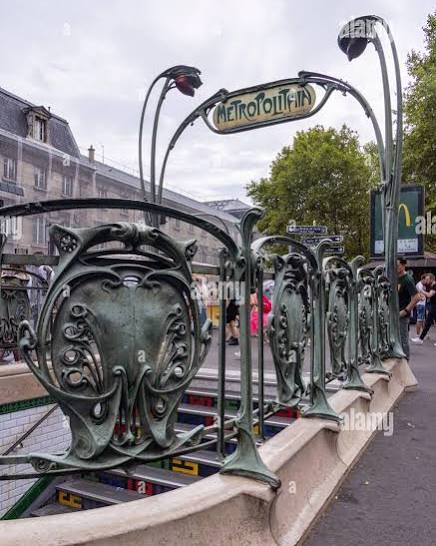
Left: Lily of the valley (photograph). Right: Hector Gimart. Detail of the cast iron stand. Circa 1900.
This screen helps you understand the biomorphic approach. Researchers and official resources (Sortir à Paris, Éduscol) agree that the vertical entryway posts are a stylized lily of the valley. Gimar did not literally copy the plant but rather subjected its form to geometric abstraction: the soft leaves were removed, leaving behind a rigid stem that became the load-bearing element. The lanterns at the top of the posts are interpreted as buds, and their glass sections function as diffusers. This confirms the main conclusion: biomorphism in architecture is not just decoration—it is the translation of organic structure into an engineered solution.
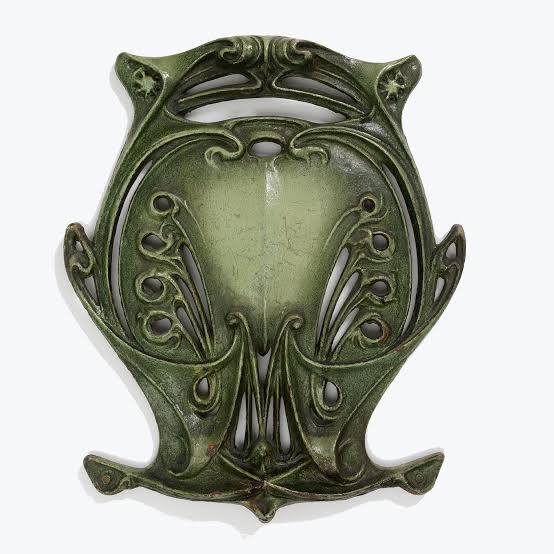
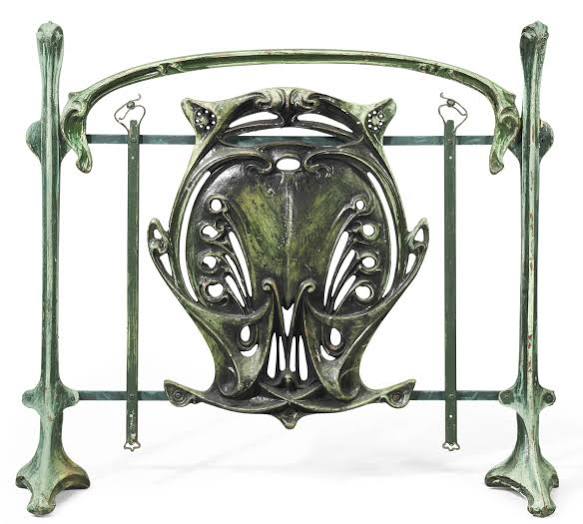
Ector Gimar. Cast iron medallion with a «whip strike» ornament. Circa 1900. Cast iron. Smithsonian Design Museum (Cooper Hewitt).