Concept
i. The Artwork Within the Event: Staging, Action, and Live Environment ii. The Artist as Persona: The Metamorphosis of Mamyshev-Monroe iii. Uniting the Heterogeneous: Space and Action in «Pop-Mechanics» iv. The Environment in Frame: «Pirate Television» v. The Party as an Artistic Situation
Conclusion Bibliography Image Sources
Concept
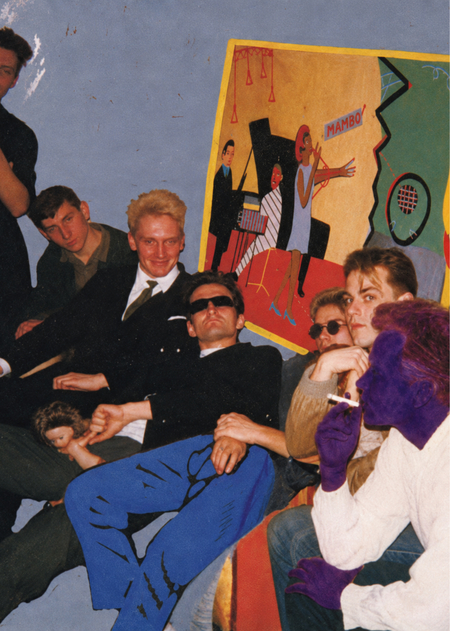
In the photos of the «New Artists» circle, it can sometimes be difficult to immediately grasp what is happening: a concert, a performance, a photoshoot, or a casual gathering. Musicians perform amidst paintings, artists take the stage themselves, changing outfits, painting, and photographing one another. To understand these events, it is not enough to examine only the artwork. One must see what was happening around the pieces and how the people who created them behaved.In an article about the group, written under the pseudonym Igor Potapov, Timur Novikov notes:
New theatrical productions—an extension of the perception of painting into space and time, complementing the language of painting with non-pictorial methods.
This thought provides the starting point for the research: painting continues in space, connecting with action. What linked the painting, the stage design, the costume, and the artist’s appearance before the camera? Can these connections help us understand how a circle of friends and collaborators created their own artistic environment?
The research focuses on the projects of the «New Artists» circle from the late 1980s to the early 1990s, with a reference to specific episodes from the middle of the decade. The main material includes the works and documentation of «Pop Mechanics,» Vladislav Mamyshev-Monro’s transformations, «Pirate Television,» and the «Gagarin Party.» Novikov participated in creating «Pirate Television» alongside Yuris Lesnik, Vladislav Mamyshev-Monro, and Georgy Guryanov, and in 1991, he exhibited his work at the «Gagarin Party."² One artist is involved in several narratives, and each requires a different approach to visual representation.
² Biography. 1989–1992 [Electronic Resource] // Timur Novikov’s Website. — URL: https://www.timurnovikov.ru/biography/1989-1992 (Accessed: 11/17/2026).
«New Artists»: O. Kotelnikov, I. Savchenkov, G. Guryanov, T. Novikov, Africa, I. Verichev. Photo (E-E) by Evgeny Kozlov, colored by G. Guryanov. 1985. G. Guryanov Archive
The central question of this research is how a work becomes part of an event, and what changes this entails for the artist and those around them. A painting on a concert stage is perceived alongside the music and the performers' movements. The mural created during a performance becomes an action unfolding before the public. Furthermore, the character an artist depicts in their works may acquire a face and a voice of their own. It is crucial to trace every such transition: precisely what happens to the image, and what new opportunities arise for its creator.
The hypothesis is that the artistic environment within this sphere is formed through the continuous integration of art into shared life. Works shape meetings and performances; artists embody conceived images; and events provide material for subsequent pieces. Painting, costume, music, and video mutually support one another. Therefore, any single work reveals only a segment of what is happening—its meaning can be augmented by where it is displayed, who is present, and what is taking place.
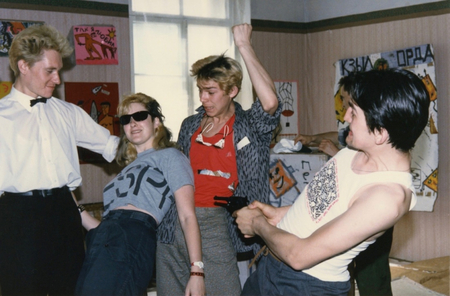
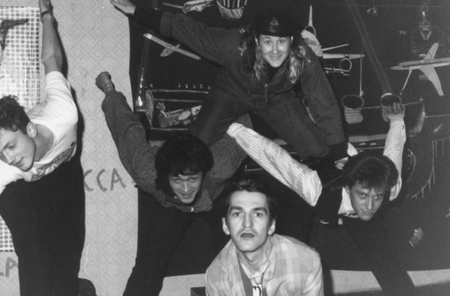
Georgy Guryanov, Joanna Stingrey, Sergey Bugayev, Timur Novikov / Viktor Tsoi, Joanna Stingrey, Georgy Guryanov, and Timur Novikov
This is especially clear in the practice of Mamyshev-Monroe: the artist depicts a character in their work and then appears in that character’s guise before the camera and the public. Makeup, clothing, facial expression, and gesture become tools of the artistic practice. By comparing the paintings, staged photographs, and documentation of the artist’s appearances, one can trace how a single image exists on canvas, in the frame, and among people.«Pirate Television» adds another dimension to this—the ability to create one’s own screen reality. The host, the guest, and the protagonist of the narrative become roles that can be adopted and replayed. Olesya Turkina, whose text is cited in the description of the MediaArtLab project, connects its structure to the imitation of television programming formats.³ For the research, it is important to consider how a familiar television format is populated by characters, humor, and the dynamics of a specific artistic circle. In this context, the camera actively participates in creating the event.³ Pirate TV (1989) [Electronic resource] // MediaArtLab. — URL: https://old.mediaartlab.ru/db/work.html?id=124 (Accessed: November 17, 2026).
Vladislav Mamyshev-Monroe, «The Lives of Remarkable Monroes.» 1996
PT Frame from the video «Eva and Adolph» / PT Frame from the video «Anti-TCP Committee Meeting» / Frame from the film «Another Two»
The goal of this study is to demonstrate how these working methodologies connect artworks with space and people. To achieve this, painting and textile works are juxtaposed with photographs of concerts, parties, and performances, as well as video recordings. The analysis is built upon specific details: where a canvas hangs, what is happening in front of it, who interacts with the material, and what characteristics of a character are echoed in the painting and the artist’s appearance. Photography allows for the contemplation of such coincidences, while video lets us observe how they shift in motion. Catalogs, artist statements, and memoirs clarify the context of events and allow us to distinguish between observation and assumption.The title, «From Painting to Party, ” maps a trajectory between the various situations in which art exists. It does not presuppose that artists initially created paintings and later abandoned them for events. The real interest lies in the coexistence of these practices—how a work could remain a standalone piece while simultaneously participating in a concert, how the artist could become a character in their own right, or how a gathering of friends could transform into artistic material. Through these episodes, the study examines the artistic milieu as something that participants created together—through their works, their appearance, and their actions.
Novikov T. New Artists [Electronic Resource] // Timur Novikov’s Website. Section «Articles by Timur Novikov, published under the pseudonym Igor Potapov.» — URL: https://timurnovikov.ru/library/stati-timura-novikova-izdannye-pod-psevdonimom-igo/novye-khudozhniki (Accessed: 11/05/2026).
Biography. 1989–1992 [Electronic Resource] // Timur Novikov’s Website. — URL: https://www.timurnovikov.ru/biography/1989-1992 (Accessed: 11/17/2026).
Pirate TV (1989) [Electronic Resource] // MediaArtLab. — URL: https://old.mediaartlab.ru/db/work.html?id=124 (Accessed: 11/17/2026).