Introduction
In 1995, Nike launched the «If You Let Me Play» advertising campaign, which championed girls' participation in sports. The focus was not on professional athletes or their achievements, but on everyday girls who shared why it was important for them to have the opportunity to be active. The advertisement primarily appealed to adults, showing how physical activity could influence a girl’s self-confidence, independence, and perception of her own capabilities.
Almost a quarter-century ago, in 2019, Nike launched the Dream Crazier campaign. Serena Williams used it to address the double standards faced by women in professional sports. The video blended athletes' performances, displays of intense emotion, and moments of overcoming societal constraints. Sporting achievement, in this context, became not just a personal triumph but a catalyst for conversations about gender stereotypes.
The goal of this research is to trace the evolution of female archetypes in Nike advertising from 1995 to 2019 and to determine how athletic imagery is beginning to be used to convey broader social meanings.
It is suggested that from 1995 to 2019, Nike gradually expanded its meaning by changing the visual representations of girls and women.
2. The Feminine Image in Nike’s Advertising Communications
At the core of Nike’s advertising communication is the concept of sport as a means to overcome limitations. Physical exertion, movement, and the drive for results become vital expressions of a person’s character. In this approach, athletic apparel and footwear are not the sole subjects of the advertising. The image of the person wearing them is equally significant.
This idea found additional development in Nike’s female advertising. Sport allowed the brand to address themes related to self-esteem, independence, and societal perceptions of femininity. Researchers Gene Grow and Joyce Walburg, who studied Nike’s advertising communication in the 1990s, identify three interrelated themes within it: women’s empowerment, affirming their right to participate in sports, and product promotion.
Characteristics of Imagery of Girls and Women
Nike’s campaigns often feature several types of female protagonists. Some advertising materials showcase professional athletes, whose achievements serve as proof of strength and mastery. Others feature everyday women for whom sports are simply part of daily life. A special place is given to young girls whose image represents the beginning of a sports journey and unfulfilled potential.
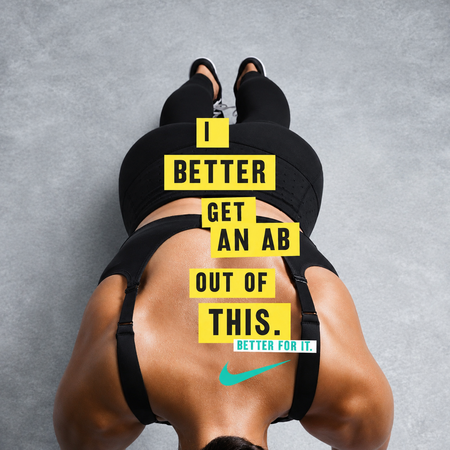
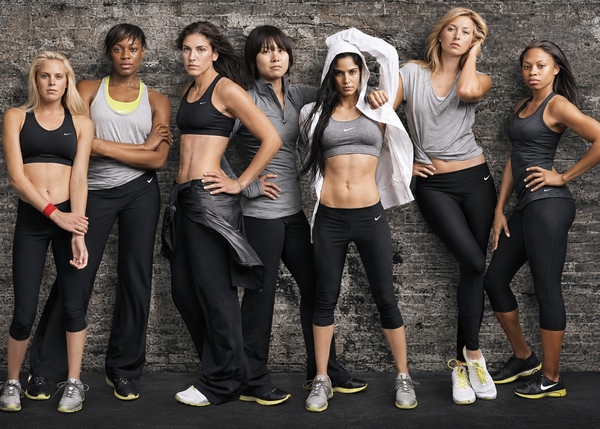
The differences between these images are evident not only in the choice of characters but also in the visual language. A professional athlete can be depicted during competition, where muscle tension, movement, and concentration are directly tied to the outcome. Everyday training allows for a less idealized portrayal of sport, one that includes fatigue, doubt, and gradual development.
The image of the girl carries its own semantic function. Unlike the adult athlete who has already achieved certain results, she can represent the very possibility of future success. Therefore, her presence is particularly significant in advertising focused on freedom of choice and overcoming gender limitations.
Prerequisites for Changes in Advertising Communication
Changes in Nike’s women’s advertising are linked both to the evolution of the brand’s visual language and to broader societal discussions about the role of women in sports. During the period under review, the advertisements addressed various issues: the accessibility of sports for girls, standards of feminine appearance, the insufficient representation of female athletes, and societal judgment toward women who deviated from conventional roles.
In 2001, Nike launched a campaign dedicated to women who balance athletics with daily life. Rather than showcasing solely outstanding athletic achievements, the brand depicted running, yoga, boxing, and other forms of physical activity as part of an ordinary woman’s life.
The topics, as well as the methods of engaging the audience, gradually expanded. Alongside printed announcements and television advertising, digital platforms were utilized, and the stories of individual female athletes were developed across multiple formats.
Against this backdrop, the female image became more multifaceted. The athlete could be not only an example of physical prowess but also a person with a personal history, doubts, and the right to diverge from social expectations.
3. The Evolution of the Female Image in Nike Advertising (1995–2019)
One of the most illustrative examples from the early period is the «If You Let Me Play» campaign from 1995.
In the television commercial, the girls address the viewer, explaining the opportunities that sports can open up for them. Their words are accompanied by close-ups of faces and everyday settings, without an emphasis on professional competitions or showcasing sports records. This approach differs from the traditional depiction of sporting victory. The protagonists are not trying to prove that they have already achieved outstanding results. Instead, they focus on the fact that, to develop these opportunities, one must first have the right to participate in sports.
A direct gaze into the camera plays a particularly important role. It creates a sense of personal conversation and allows the viewer to perceive the female subjects not as anonymous advertising figures, but as individuals with their own desires. The repeated address to adults reinforces the idea that the girls’ future achievements largely depend on the opportunities provided to them.
The athletic theme here is directly tied to societal attitudes toward girls. Consequently, Nike’s early advertising cannot be viewed solely as a demonstration of strength or physical results. By the mid-1990s, the brand was using female imagery to discuss social constraints.
2005–2014. Expanding the Image: Individuality, Confidence, and Diversity
In the mid-2000s, Nike’s women’s advertising began to more actively address themes of corporeality and individual perception of one’s own appearance. In 2005, the brand launched a series of print advertisements dedicated to different parts of the female body. Among these were visuals titled «My Butt Is Big» and «My Legs, ” where the female body was examined through the lens of physical capabilities rather than adherence to conventional beauty standards.
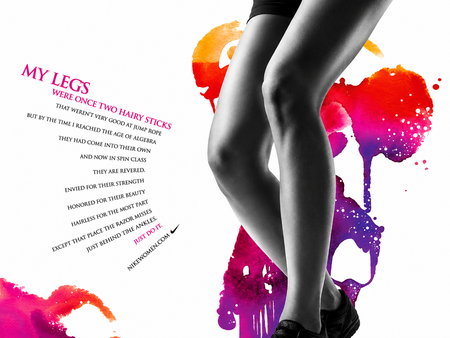
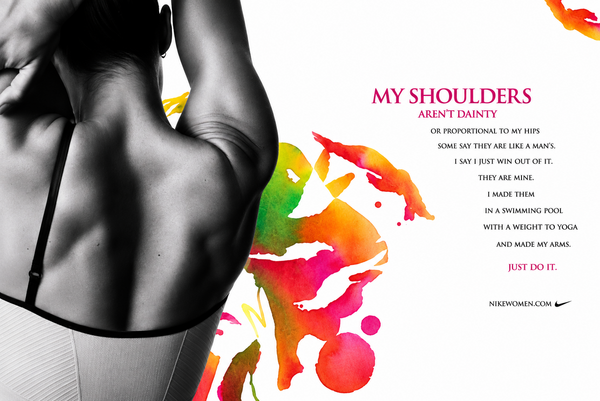
The composition of these ads is built around combining a close-up of the body with a textual message. Instead of a full portrait of the heroine, the viewer sees individual physical features that traditional beauty advertising might otherwise negatively frame.
Black-and-white photography makes the body’s form particularly striking, while bright color accents and unconventional typography add expressive quality to the image. The first-person text allows the image to be perceived not just as a demonstration of appearance, but as a statement from the woman herself.